Featured Sociology Courses: Spring 2026

Sociology of Mass Media
SYA 3930.001 ♦ Robert Caputi ♦ Boca Raton ♦ In-Person ♦ Tuesday & Thursday 5:00–6:20 PM
This course covers the sociological analysis of media and how media both influence, and are influenced by, the larger culture and society. Particular attention is paid to the meanings and social impact of movies, television programs, social media, music, advertising, and news.
By the end of the term, students will
be able to:
demonstrate improved media literacy skills,
understand the changing nature of media from analog to digital and the implications of this for individuals and society at large,
theorize the connections between media and other core institutions of society including government, education, family, religion, and economics,
articulate the relationships between the production, distribution, and consumption of media, and
identify inequalities involving access to, and representation in, various forms of media.
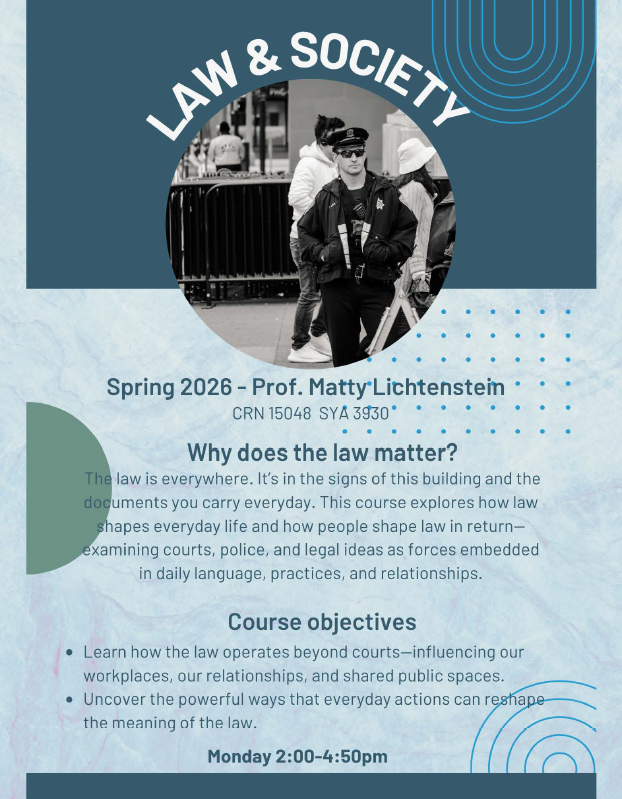 Law and Society
This course explores how law shapes everyday life and how people shape law in return-examining courts, police, and legal ideas as forces embedded in daily language, practices, and relationships. From this course you will learn how the law operates beyond courts-influencing our workplaces, our relationships, and shared public spaces. You will also uncover the powerful ways that everyday actions can reshape the meaning of the law.
***Click on image for PDF***
 Sociology of Consumption
SYA 3420 ♦ Robert Caputi ♦ Boca Raton ♦ In-Person ♦ Wednesday and Friday 12:30–1:50 PM
This course examines life in consumer society, also referred to by scholars as late capitalism, postmodern society or the society of the spectable. We will investigate both labor and leisure in the current U.S. and beyond through topics such as clothes, toys, food and dining, coffee (shops) and beer (gardens), music tourism, weddings, spectator sports, celebrities, and influencers, as well as other new and improved goods, services and experiences.
***Click on image for PDF***
 Sociological Analysis: Survey of Methods
SYA 3300.003 ♦ Robert Caputi ♦ Boca Raton ♦ In-Person ♦ Tuesday & Thursday 12:30–1:50 PM
This course introduces students to social science research methods used to study and understand human societies. Students learn the fundamentals of research design, measurement, sampling, data collection, data analysis and presentation using both quantitative and qualitative methods. Students in this course gain hands-on research experience by designing, executing and presenting a pilot research project based on human subjects.
***Prerequisite required: SYD 3792 or SYG 1000***
 Tourism & Society
SYA 3930.004 ♦ Patricia Widener ♦ Distance Learning ♦ Tuesday and Thursday 12:30–1:50 PM
This course examines the connections between the tourism industry, the traveler’s experiences, and
culture, society, and work. Tourism & Society adopts several sociological perspectives to better
understand the history, motivations, inequalities, typologies, adaptations, performances, impacts, and
dynamics of tourism, tourists, travelers, workers, and/or host communities, cultures, and societies.
 Career Paths in Sociology
SYG 3090.001 ♦ Maritza Flores ♦ Distance Learning
In this course, students are exposed to various marketable skills that will assist them in preparing for a career after graduation or for graduate school through “real-world” exposure using micro internships and supervised experience related to various career interests in Sociology. Like in any major, Sociology majors end up working in many different jobs. This course provides the most common career paths for Sociology majors. A portion of the course will be spent investigating what one can do with a Sociology degree. An introduction of possible levels of employment in the private or public sectors will be reviewed. Ultimately, this course begins to assist students in developing a plan for professional employment.
 Social Health, Medicine, and Illness
This course
introduces students to the sociological perspective on the social determinants of health and
illness. Students study how social factors like race, gender, and class shape individual health outcomes, and how patients and medical providers experience the healthcare system. This course examines the economic structures that distinguish American healthcare from other countries’ healthcare systems.
 Sociological Theory
This course provides an introduction and overview of some of the major theoretical traditions in sociology. Students learn about the development of sociology as a discipline, as well as how to use different sociological theories to make sense of social structures, social action and social change in the contemporary world.
 Sociology of Sport
This course is an introduction to the sociology of sports. It emphasizes the history and nature of sports, as well as the role that sports play in society, as well as interrelations between sports and other social institutions, including government, markets, the family, religion, education and the media.
 Race and Ethnic Relations
SYD 3700.002 ♦ Yangsook Kim ♦ Boca Raton ♦ In-Person ♦ Tuesday & Thursday 2:00–3:20 PM
This course surveys sociological perspectives of intergroup relations. It examines the evolution of race, the construction of racial and ethnic distinctions and the roles and experiences of racial and ethnic groups in the United States from a historical perspective.
Contemporary Social Problems
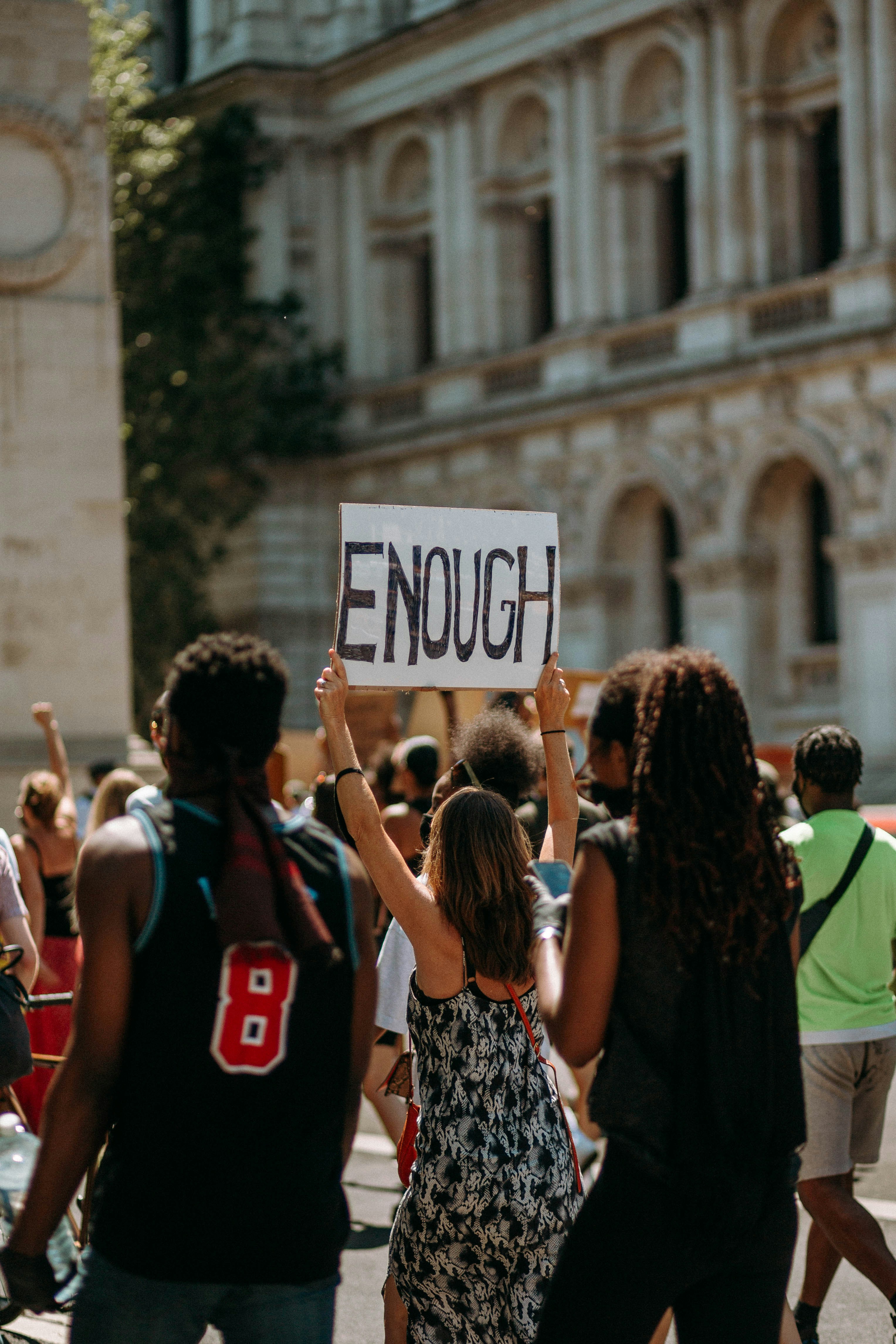
This course allows students to explore answers to interesting questions regarding social problems, including how social problems emerge, how sociologists study social problems, and how social problems are affected by publice opinion and government polices. Some specific areas covered in this course include economic inequality, social problems in urban areas, deviance and crime, as well as problems related to aging, race/ethnicity, and gender. While the focus of this course is on social problems in the U.S., selected issues will be discussed and analyzed from a broader, global, and comparative perspective.