Spatial Predictive Models for the Spread of COVID-19
Overview
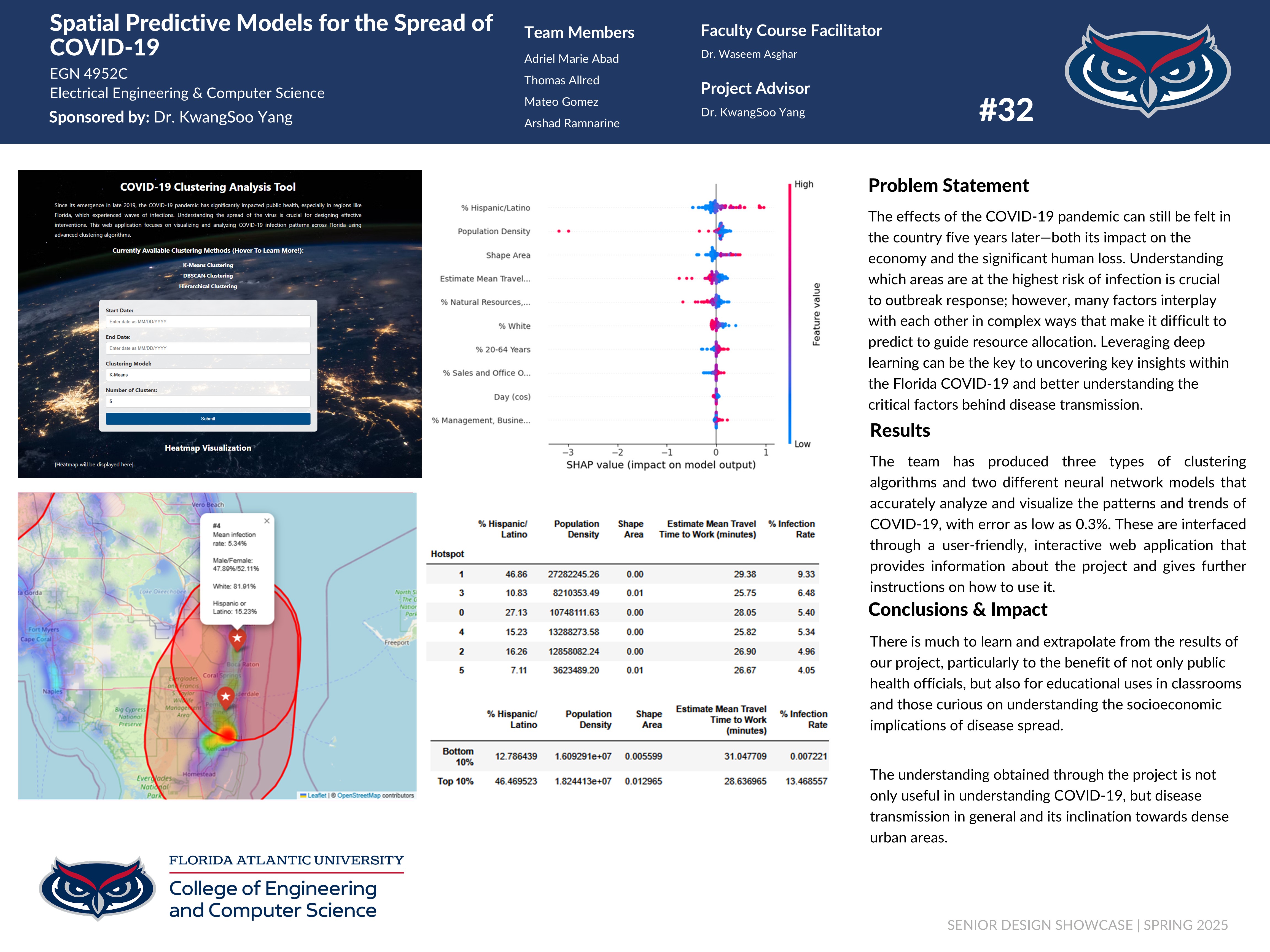
The COVID-19 pandemic stands to be one of the most notable events of the 21st century; its effects on the country can still be felt five years later. It has especially challenged the robustness of the nation's healthcare system and the effectiveness of its response to disease outbreaks. To guide future policies, however, it is important to retroactively analyze the spread of the disease, especially in its peak years from 2020 to 2021. Machine learning (ML), specifically deep learning, can uncover key hidden insights within the data that may have otherwise gone unnoticed. This project aims to provide a clear understanding of the patterns and trends behind COVID-19 using clustering and neural network models, which capture the complex relationships between demographic and spatiotemporal factors that influence infection rates. Users can interact with these models through a dynamic, web-based application that analyzes a specific time window and generates graphs that are interpretable for even non-technical users.
Community Benefit
It is crucial to improve the effectiveness of disease outbreak response to prevent significant disruption in the country's economy, as was seen for the COVID-19 pandemic. This project not only provides valuable insights for healthcare officials that will enhance decision-making and future policies but is also an educational tool for the public to understand critical socioeconomic factors behind disease spread.
Team Members
Sponsored By
Dr. KwangSoo Yang