Sample Collection for Diseased Floridian Hot Pepper Plants
Overview
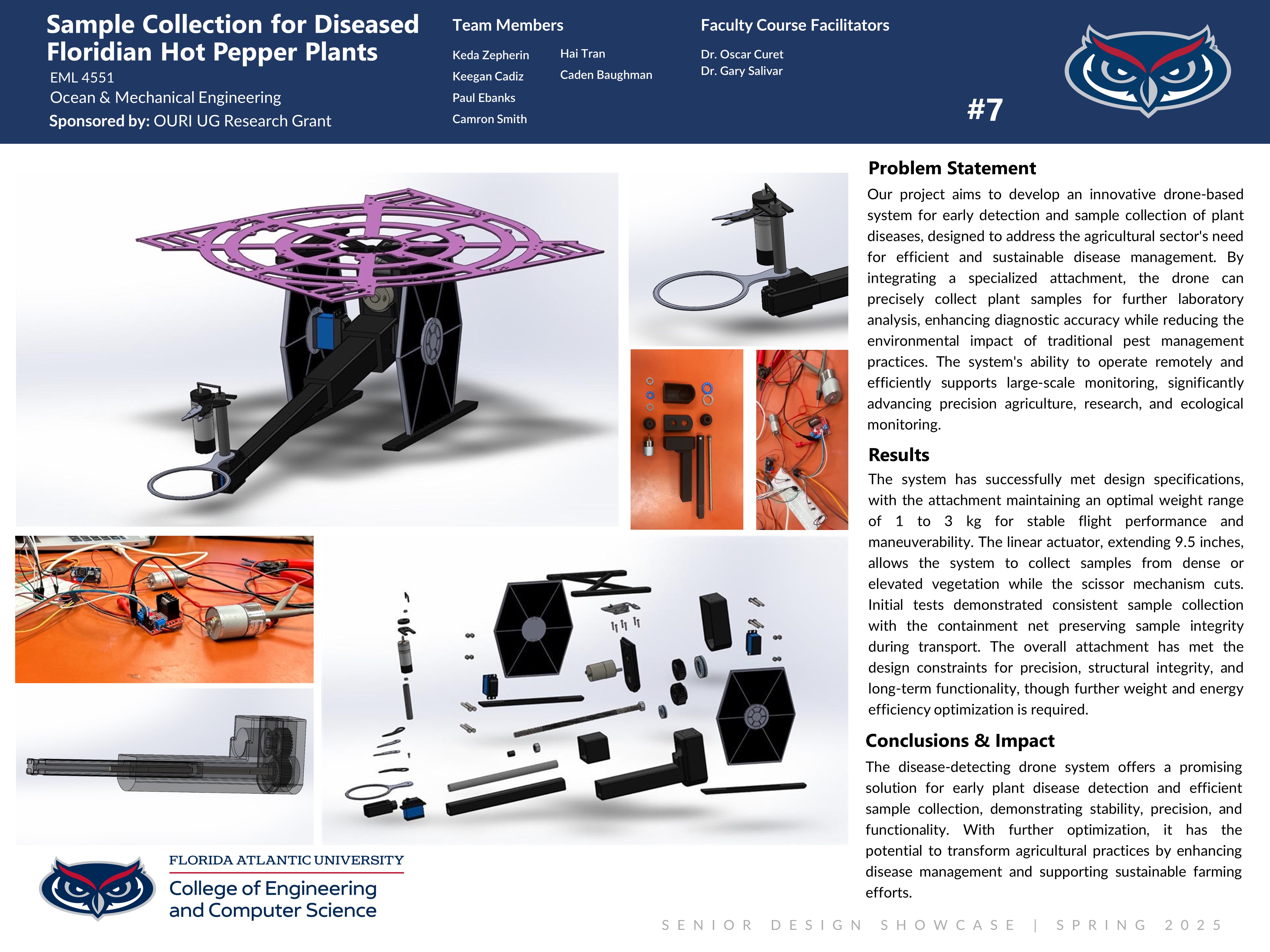
Our group aims to develop an innovative drone system that detects early signs of plant diseases and infestations while collecting physical plant samples for further analysis. The core technology includes a drone-mounted attachment featuring a linear actuator, a scissor-cutting mechanism, and a net for sample collection. The drone, equipped with advanced sensors, hovers over target plants and lands for stability. It also uses the actuator to position the scissor assembly for precise cutting. The collected plant samples are then stored in a net for transport and analysis. By providing a non-invasive, efficient, and accurate method of plant sample collection, this system reduces the need for manual labor, minimizes environmental impact, and holds potential for transforming agricultural practices, particularly in large-scale farming, research, and ecological monitoring.
Community Benefit
This project is designed to benefit the agricultural community by providing an innovative tool for early disease detection and more efficient crop monitoring. Farmers and agricultural businesses can quickly identify and address plant diseases using a drone system, ultimately reducing crop loss and improving overall yield quality. The system's non-invasive approach minimizes environmental disruption and reduces the reliance on pesticides, aligning with sustainable farming practices. Moreover, the project aims to make agricultural monitoring more accessible, reducing the time and labor typically involved in plant disease detection. As the system continues to evolve, it will have the potential to improve food security, reduce environmental impact, and enhance the livelihoods of farmers, particularly in regions like Florida, where hot pepper cultivation plays a significant role in the economy.
Team Members
Sponsored By
FAU Office of Undergraduate Research and Inquiry (OURI)