Remote Operated Vehicle for Excavation of Regolith (R.O.V.E.R.)
Overview
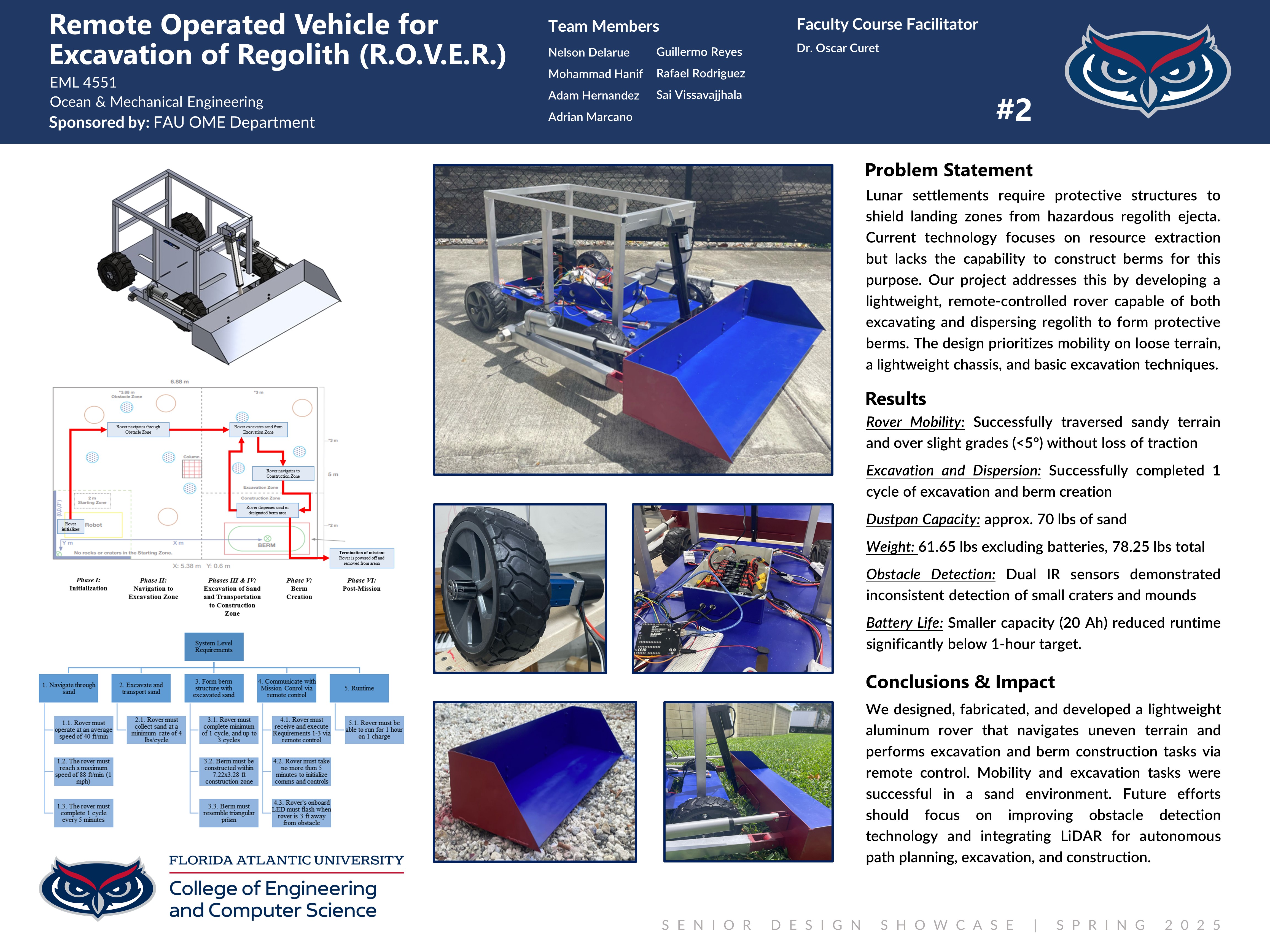
The Remote-Operated Lunar Excavator was designed to support NASA’s mission for a sustainable human presence on the Moon by constructing protective berms using lunar regolith. R.O.V.E.R. is remotely operated, allowing for direct human control in navigation, excavation, and construction tasks. The rover was engineered to function in a regolith environment and underwent testing in a terrestrial sand-based setup. It features a dustpan-style excavation system capable of lifting and transporting up to 4 pounds of material per cycle, followed by controlled material placement for construction purposes. The design incorporated a rectangular chassis with a support frame and airless plastic wheels that provided enhanced traction on loose surfaces. By integrating excavation and construction capabilities into a single device, this rover sets a foundation for reliable infrastructure development technology on the Moon, making long-term lunar missions – and eventually, human settlement – safer and more feasible.
Community Benefit
The development of R.O.V.E.R. has far-reaching implications on Earth and beyond. By constructing protective berms with material it already excavated, this project supports sustained lunar settlements by shielding landing zones from hazardous regolith ejecta, improving astronaut safety, and protecting critical infrastructure and equipment from blast damage. The excavation and mobility systems demonstrate practical applications in robotics, construction, and material handling, which could be adapted for use in hazardous environments on Earth, including disaster response and remote mining operations. This project also sets a foundation for future improvements: integrating automation for continuous operation, refining the excavation system for greater efficiency and quantity, and making the design more compact for better maneuverability, could all make further inroads into more advanced and reliable lunar construction methods.
Team Members
- Nelson Delarue
- Mohammad Hanif
- Adam Hernandez
- Adrian Marcano
- Guillermo Reyes
- Rafael Rodriguez
- Sai Shreshth Vissavajjhala
Sponsored By
FAU Department of Ocean & Mechanical Engineering