Concentrations
Students must earn a "C" or better in each course taken to fulfill a concentration requirement.

American Studies
The American Studies Concentration is designed to provide students with an interdisciplinary background in American society and culture. Areas of study may include: history, literature, politics, gender studies, women s studies, Latin-American studies, African-American studies, Native-American Studies, cultural studies, social sciences, environmental studies, rhetoric, film and media studies, art, and music. B.A. degree. Visit American Studies >>

Anthropology
The concentration in Anthropology provides students with a better understanding of the human condition. Anthropologists view humans holistically-biologically, socially, and culturally. The emphasis of this program is on cultural anthropology. B.A. degree. Visit Anthropology >>

Art (Transdisciplinary Visual Arts)
As our ways of interacting with the world change and expand, so must our ways of understanding and evaluating such interactions. The Wilkes Honors College (WHC) program in Transdisciplinary Visual Art encourages students to examine and develop multiple forms of analysis and critique from various academic disciplines which cross, interact and shape knowledge. B.A. degree. Visit Art (Transdisciplinary Visual Arts) >>

Biological Anthropology
Biological anthropology is the study of the physical aspects of humans, primates, and their ancestors. The field of biological anthropology encompasses several areas of study including primatology, paleoanthropology, human evolution and adaptation, genetic variation, forensic and medical anthropology. The Honors College concentration in biological anthropology is designed for students who are interested in pursuing a career in medicine or who want to combine their interests in biology and anthropology. B.A. or B.S. degree. Visit Biological Anthropology >>

Biological Chemistry
The biological chemistry concentration is designed for those students who wish to go on to graduate school, medical school, or who desire to work for biotech firms, government agencies or environmental organizations. It strongly emphasizes complementary coursework from both the biology and chemistry disciplines. To promote the interconnectedness of these disciplines, students choosing a research advisor in one discipline are strongly encouraged to have their second reader from the other discipline. B.A. or B.S. degree. Visit Biological Chemistry >>

Biology
The biology concentration is designed for those students who wish to go on to graduate school, medical school, or who desire to work for biotech firms, government agencies or environmental organizations. Our interdisciplinary curriculum will benefit students who choose to pursue graduate studies in biology, oceanography or environmental science. B.A. or B.S. degree. NOTE: Due to the significant overlap, students may not double concentrate in Biology and Biomedical Science.Visit Biology >>

Biomedical Science
The biomedical science concentration is designed for those students who wish to go on to graduate school, medical school, or who desire to work for biotech firms, government agencies, or other organizations in the biomedical field. NOTE: Due to the significant overlap, students may not double concentrate in Biology and Biomedical Science.Visit Biomedical Science >>

Business
The business concentration provides opportunities for students interested in a career in business to take business courses and interdisciplinary courses that provide perspectives and tools important for succeeding in a diverse, global environment. Students will benefit from receiving a broad liberal arts education that emphasizes writing and critical thinking skills, while getting the background in business that will prepare them for careers in business or for entering an MBA program. B.A. degree. Visit Business >>

Chemistry
The chemistry concentration is designed for those students who wish to go on to graduate school, medical school or who desire to work in industry. The interdisciplinary curriculum will benefit students who choose to pursue graduate studies in chemistry, oceanography, or environmental science. B.A. or B.S. degree. Visit Chemistry >>

Computer Science and Engineering Pathway
For students interested in pursuing Computer Science or Engineering, the Honors College has a pathway option. Honors College students can pursue a joint Bachelor of Arts or Sciences degree at the Honors College and a Masters of Science degree through the College of Engineering and Computer Science. These students typically concentrate in Interdisciplinary Math or Data Analytics at the Honors College. They also complete the prerequisite coursework for the Masters degree while at the Honors College in their first 4 years, and can complete the masters coursework in an additional year in this “4+1” program. Many of the prerequisite COECS courses are available online. Visit Computer Science and Engineering >>

Data Analytics
The Data Analytics concentration is designed to train students in the broad, interdisciplinary field of data science. Students will acquire proficiency in statistics and programming, and an understanding of problems and data structures in particular areas of study, through coursework taught by faculty at both the Honors College and the College of Engineering and Computer Science. Visit Data Analytics >>

Economics
Economics is the structured study of how people make decisions when faced with scarce resources. When aggregated, these individual decisions constitute markets—the key analytical construct in economics. B.A. degree. Visit Economics >>

English Literature
The English Concentration provides students with a background in literature in English, including an awareness of the historical/cultural origins of literary works and the relationship of literature in English to literature in other languages. Areas to consider are: literature's relationship to history, technology, religion, public institutions, notions of self and family; the development of literary history, including literary influences; stylistic and technical devices; generic distinctions; literary theory. B.A. degree. Visit English Literature >>

Environmental Studies/ Environmental Science
The Environmental Studies concentration is designed to provide an interdisciplinary education in environmental issues that draws from the natural sciences, social sciences and humanities. The required courses provide all environmental studies students the opportunity to ground themselves in relevant concepts and topics, as well as scientific methodologies and mapping skills that span the disciplines. B.A. degree. B.S. option for Environmental Science track. Visit Environmental Studies >>

Interdisciplinary Critical Theory
The concentration in Interdisciplinary Critical Theory (ICT) is designed to enhance the WHC s curriculum in the humanities and the sciences by creating strategic connections among different disciplines. Critical Theory includes perspectives in aesthetics, visual studies, media studies, cultural studies, studies in multicultural literatures, and studies in science, technology, medicine, and the humanities. B.A. degree.
Interdisciplinary History
History is a story about the human past. Through the study of history, we make other people's experiences our own. In this way we touch other times and places and add the knowledge and wisdom gained by others to our own personal experience. Studying history is not an exercise in memorization; it is, rather, a process of assembling information from the past and giving meaning to it. B.A. degree.
International Studies
International studies is an interdisciplinary concentration with a focus on issues that cross national boundaries. Courses that fulfill international studies requirements must have either substantive content that examines political, cultural, historical, economic and social issues in areas outside of the United States or a primary focus on transnational issues such as the global environment, international law, or international political and economic systems. B.A. degree. Visit International Studies >>

Latin American Studies
The concentration in Latin American Studies is designed to help students develop an interdisciplinary understanding of culture, history, politics and contemporary issues in Latin America and the Caribbean. The concentration is designed to present a broad regional approach to Latin America and to provide the student with a general knowledge and sympathetic understanding of the people and problems of this important area of the world. B.A. degree. Visit Latin American Studies >>

Law and Society
The concentration in law and society seeks to give students a deep understanding of the role law plays in resolving conflicts within and between societies and in realizing a just political order. The study of law and justice has a rich humanistic tradition and involves reflection on fundamental values from multiple perspectives. B.A. degree. Visit Law and Society >>

Marine Biology
The Marine Biology Concentration allows students interested in marine biology to study through a joint program with FAU's Harbor Branch Oceanographic Institution (HBOI). Several of the classes are taught at the HBOI campus in Ft. Pierce, FL. B.A. or B.S. degree. Visit Marine Biology >>

Mathematics
Legend has it that across the arched entrance to the Academy founded by Plato in 357 B.C. were the words "Let no man ignorant of geometry enter here." Whether or not the legend is true, there is no question of the importance of mathematics at this early institution of higher education. B.A. degree. Visit Mathematics >>

Mathematical Sciences (Interdisciplinary)
The Interdisciplinary Concentration in the Mathematical Sciences offers a great deal of breadth and flexibility for the design of quantitatively-based programs. Students choose an area of emphasis in Applied Mathematics, Computer Science, Biology, Physics, Chemistry, Economics, Psychology, or another area negotiated with the advisor. B.A. degree. Visit Mathematical Sciences (Interdisciplinary) >>
Medical Humanities
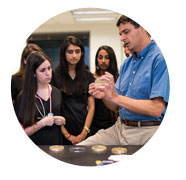
Healthcare professionals (physicians, nurses, psychotherapists, etc.) must be able to relate to patients on a human level - morally, by being sympathetic or empathetic; interpersonally, by being able to elicit appropriate responses and communicate effectively and creatively, in their ability to analyze patients' symptoms and conditions to effectively diagnose and recommend treatment. B.A. degree. Visit Medical Humanities >>

Neuroscience
Neuroscience students study the molecular, cellular, structural, and functional aspects of the nervous system. Neuroscience is an interdisciplinary field of study that combines biology, psychology, chemistry, and other fields in an attempt to understand how the nervous system works. B.A. or B.S. degree. Visit Neuroscience >>

Philosophy
Philosophy, quite generally, is critical thinking. It requires deep consideration, reflection and evaluation, be it of ideas, principles, approaches, or even of the very tools or processes of understanding, reflection and evaluation. The essence of philosophy is formulating and asking questions. How one asks a question can determine the likelihood of success in finding an appropriate answer. B.A. degree. Visit Philosophy >>

Physics
The Honors College curriculum in Physics offers students a number of options for study, depending on their interests. The core requirements for the concentration are kept low enough to encourage interdisciplinary study. B.A. or B.S. degree. Visit Physics >>

Political Science
Political science is a broad discipline concerned with how people with different interests and values reach collective decisions and form binding policies in order to maintain a stable and flourishing society. It studies the role of law and government and non-governmental institutions in distributing scarce resources. B.A. degree. Visit Political Science >>

Psychology
The Psychology concentration provides students with a background in the science of mind and behavior, and an understanding of how empirical methods are used to study human cognitive, motivational, social, and emotional processes. Requirements for the concentration include introductory and survey courses, specialized seminars, laboratories, and a research thesis. B.A. or B.S. degree. Visit Psychology >>

Spanish
We wish our students to have a broad understanding of the Old World / New World dynamics marking Hispanic literatures and cultures. Students concentrating in Spanish will be required to take courses in both the Peninsular and Latin American areas that deal with literatures and cultures prior to the 1700s. B.A. degree. Visit Spanish >>

Women's Studies
Women's Studies is an interdisciplinary field designed to provide an understanding of the complex ways in which gender and sexuality are defined in relation to society, culture, science, and technology. Its critical perspectives are both analytical (synchronic) and historical (diachronic). B.A. degree. Visit Women's Studies >>

Writing
The Writing Concentration provides students with practice in the craft of writing, a background in literature in English, and experience in critical and creative reasoning. Areas of emphasis include but are not limited to: fiction, poetry, creative nonfiction, and professional writing. The degree prepares students for careers in business, education, journalism, editing, and government, as well as for graduate and professional schools such as writing, education, medicine, and law. B.A. degree. Visit Writing >>
Declare a Concentration, Individual Concentration or Minor | List of Minor Concentrations