
Hazing Education and Prevention
Florida Atlantic University encourages a living and learning environment that promotes the health and safety of all members of the University community. Hazing behaviors can cause serious physical and neurological harm and can be life-threatening. Hazing is strictly prohibited, and the university maintains a zero-tolerance approach to hazing in any form or circumstance.
University Regulation 4.007(5) Student Code of Conduct prohibits:
(l) Hazing - Any action or situation, which occurs on or off university property, that recklessly or intentionally endangers the mental or physical health or safety of a student for purposes including, but not limited to, initiation or admission into, affiliation with, or the perpetuation or furtherance of a tradition or ritual of any University student organization or group whether or not officially recognized by the university. Hazing does not include customary athletic events or other similar contests or competitions or any activity or conduct that furthers a legal and legitimate objective. Hazing includes, but is not limited to:
- Pressuring or coercing a student into violating state or federal law;
- Any brutality of a physical nature, such as whipping, beating, branding, exposure to the elements, forced consumption of any food, liquor, drug, or other substance; or other forced physical activity that could adversely affect the physical health or safety of the student; or
- Any activity that would subject the student to extreme mental stress, such as sleep deprivation, forced exclusion from social contact, forced conduct that could result in extreme embarrassment, or other forced activity that could adversely affect the mental health or dignity of the student
Hazing is also illegal and can lead to serious criminal charges. In the state of Florida, Statue 1006.63 Hazing Prohibited states:
- Felony Hazing (Third Degree): committed when someone plans, encourages, or participates in hazing that causes serious injury, permanent harm, or death.
- Misdemeanor Hazing (First Degree): committed when someone plans, encourages, or participates in hazing that puts someone at serious risk of injury or death.
Florida laws apply to anyone involved in a student organization, including current, former, or potential members. Hazing is taken seriously and can result in jail time and fines.
Note that the following circumstances are not a defense to allegations of hazing:
- The conduct or activity that resulted in the death or injury of a person was not part of any official organizational event or otherwise sanctioned or approved by the student organization or group; or
- The conduct or activity that resulted in the death or injury of a person was not done as a condition of membership into a student organization.
IS THIS HAZING?
Some students may not realize that what they’re experiencing or hearing about is hazing or may be unsure about what to do if it happens. The resources below are here to support the university community in recognizing hazing, understanding the experiences, and exploring options for reporting or seeking help.
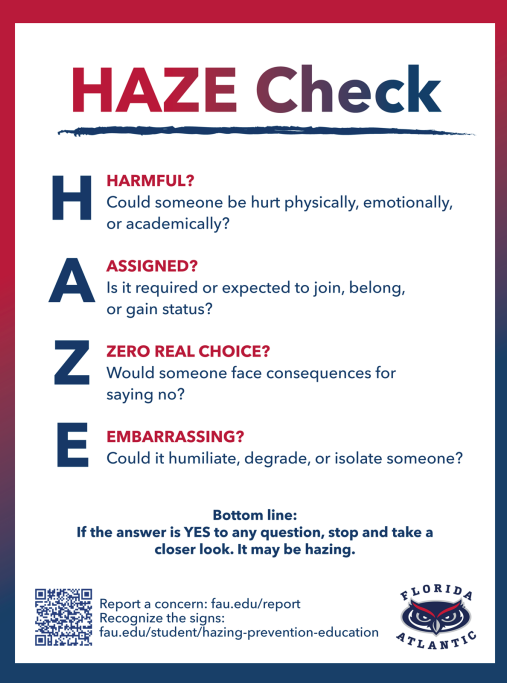
AM I BEING HAZED?
Is my friend being Hazed?
What can Parents/Families do to help?
Amnesty
At Florida Atlantic University, student safety is a top priority. If you or someone else is in a serious or life-threatening situation related to hazing activities, you are strongly encouraged to seek immediate medical attention. To reduce fear of disciplinary action, the University may not pursue conduct charges if individuals or organizations follow certain steps outlined in Florida’s Andrew’s Law (F.S. 1006.63). This includes staying with the person in need, calling for help, and fully cooperating with emergency responders. Taking responsible action to help someone in distress can be a mitigating factor in any student conduct process.
Please note: This protocol applies only to university policies and procedures. Law enforcement agencies, including the Florida Atlantic Police Department, may still take action under state or federal law. For more details, please review the full Hazing Amnesty Protocol in University Policy 6.5(C). If the situation involved substance use, the FAU Medical Amnesty Policy may also apply when emergency assistance was sought.
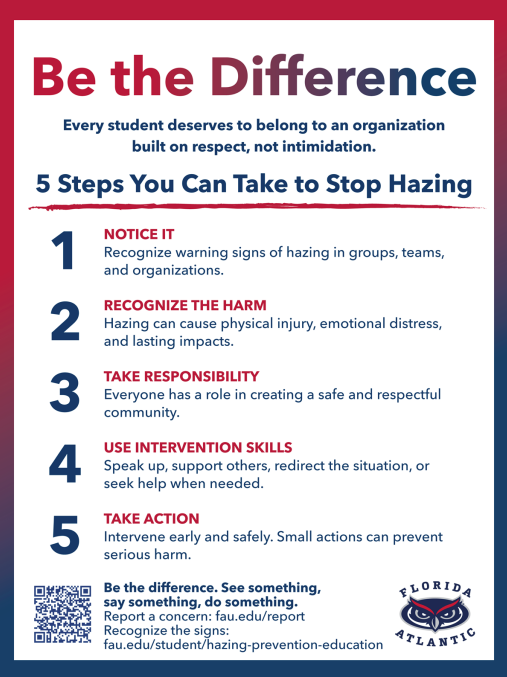
Incident Reporting
How to Report Hazing
If you or someone you know finds themselves in an emergency situation, please dial 911 or contact the Florida Atlantic Police Department at (561) 297-3500. Reporting an incident or occurrence of hazing can be submitted by anyone with knowledge or information pertaining to an actual or potential event of hazing in numerous ways.
To Report Online
To Report In-Person
Prevention and Educational Efforts
Fit First Year Hazing Prevention 101—College Edition
National Hazing Prevention Week at Florida Atlantic
Greek University
iLead
Additional Information
The links below offer important information about reported hazing at Florida Atlantic University, along with helpful resources available on campus and national organizations.
Crime and Violation Statistics
The websites below provide data on hazing-related incidents, including crime statistics and organizations found responsible for hazing violations.
Jeanne Clery Campus Safety Act
Campus Hazing Transparency Report
Florida Atlantic Resources
The links below connect you to campus offices at Florida Atlantic University that offer support, services, and resources to assist and empower our student body.
Counseling and Psychological Services (CAPS)
Victim Services
Owls Care Health Promotion
External Resources
The external links below connect you to resources from non-university agencies and organizations dedicated to hazing prevention, awareness, and education. These materials support the university community in promoting safety, belonging, and accountability.
Hazing Prevention Network
- Hazing Prevention Network is a nonprofit dedicated to empowering people to prevent hazing. Their goal is to educate people about the dangers of hazing, advocate for change, and engage the community in strategies to prevent hazing.
- https://hazingpreventionnetwork.org/
StopHazing.org
- StopHazing’s mission is to promote safe and inclusive school, campus, and organizational environments through research, resource sharing, and the development of data-driven strategies for hazing prevention and the promotion of positive and inclusive group climates.
- https://stophazing.org/
Gordie Center
- The mission of the Gordie Center is to end hazing and substance misuse among college and high school students nationwide. They are dedicated to sharing Gordie Bailey's story to prevent future hazing-related alcohol overdose deaths. The Gordie Center empowers students to transform their campus and community cultures through peer education and bystander intervention using our evidence-informed, student-tested resources. Our APPLE Training Institutes are the leading national substance misuse prevention and health promotion conferences for NCAA student-athletes.
- https://gordie.studenthealth.virginia.edu/
Inside Hazing: Understanding Hazardous Hazing
- Their mission is to provide methods of prevention and intervention in hazing; to explain the psychology of hazing in high school, college, the military, and the workplace. It also presents the theoretical perspective of Susan Lipkins, PhD, author of "Preventing Hazing: How Parents, Teachers, and Coaches Can Stop Violence, Harassment, and Humiliation."
- https://www.insidehazing.com/