



Malcolm McFarland

photo of Malcolm McFarland
Preserving Diversity in Oceanlife

By Lynn Laurenti

Toxic algal blooms in South Florida’s coastal and inland waters pose a serious threat to marine and plant life as well as the regional economy. One of the researchers on the forefront of the ongoing effort to detect new blooms and develop ways of combating them is Malcom McFarland, Ph.D., a research associate and lab manager at FAU’s Harbor Branch Oceanographic Institute (HBOI).

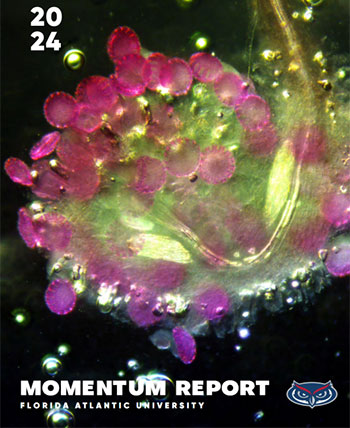
McFarland, who holds a doctorate in biological oceanography from the University of Rhode Island’s Graduate School of Oceanography, specializes in the study of marine phytoplankton populations in both salt water and freshwater environments. He is part of the HBOI team that is developing a revolutionary new underwater holographic microscope under a major multi-year grant from the National Science Foundation. The team, led by HBOI Director Jim Sullivan, Ph.D., has been awarded nearly $900,000 to perfect the invention, which allows scientists to get real-time, three-dimensional views of the millions of microscopic organisms and particles that populate bodies of water. In addition to providing views not accessible to the naked eye, the microscope reveals flow-field dynamics and permits non-intrusive observation of fish, shellfish and corals, including the ways in which they interact. This breakthrough technology is of special importance to research on algal blooms in the Indian River Lagoon, in which McFarland is taking part.

The microscope, which operates autonomously from a moored underwater position, continuously records images of the water column, which can then be analyzed for content.

McFarland has co-authored 15 journal articles and conference papers on algal blooms and related subjects.

Here is more information about him, in his own words: