Dr. Luke Rosedahl Receives New Grant to Advance Brain-Inspired Visual Learning
by Behnaz Ghoraani | Tuesday, Jan 27, 2026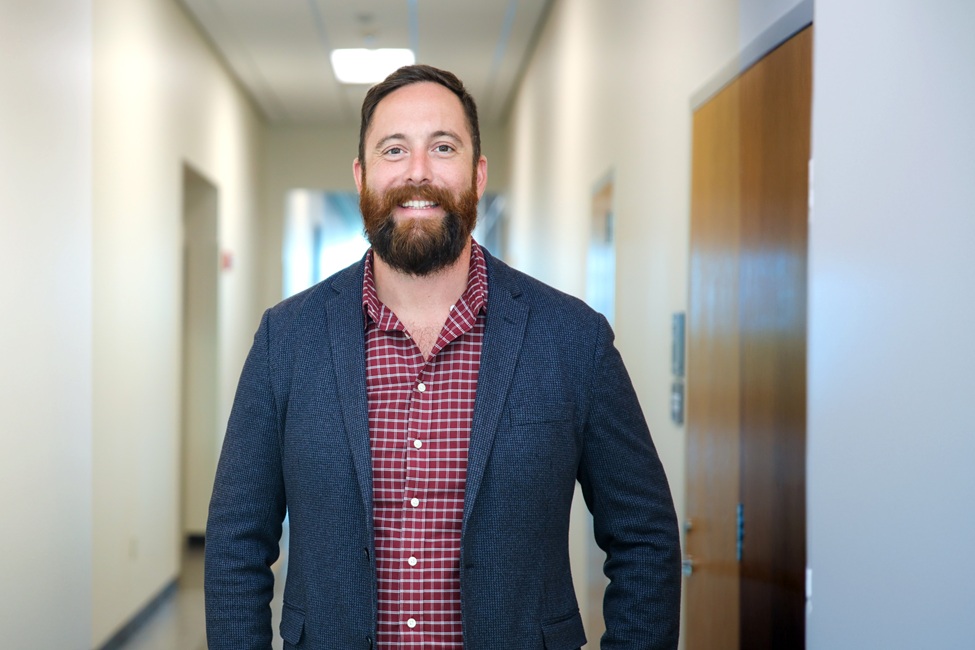
Dr. Luke Rosedahl, an affiliated faculty member of the Center for SMART Health at Florida Atlantic University, brings a fresh perspective to the university as he begins his faculty career in the Department of Biomedical Engineering and serves as a Faculty Fellow with I-SENSE. With a background grounded in biomedical engineering and computational neuroscience, his research bridges fundamental insights into brain function with the practical advancement of visual health technologies. He earned his undergraduate degree in biomedical engineering with a concentration in neural engineering from the University of Minnesota, followed by a PhD in dynamical neuroscience at UC Santa Barbara, and completed his postdoctoral training at Brown University, where he specialized in neuroimaging and AI-based modeling of brain function. Now at FAU, he leads a research program focused on uncovering the neural mechanisms that underlie how we see.
Dr. Rosedahl’s fascination with vision stems from a deep curiosity about how the brain deciphers high-bandwidth sensory input. Vision is not only essential to interacting with the world around us but is also implicated in a wide range of cognitive and perceptual disorders. His research explores how the brain processes visual information using computational models—aiming to design interventions and technologies that support individuals living with visual impairments.
That mission has received a significant boost with a new three-year, $746,998 grant from the National Eye Institute of the National Institutes of Health (NIH). The project investigates why improvements in difficult visual tasks tend to remain highly specific, limited to the particular objects or regions of the visual field encountered during training. The research aims to uncover the neural mechanisms behind this specificity and explore how different forms of attention interact to facilitate generalization. By doing so, it could pave the way for more effective and adaptable training paradigms for individuals undergoing visual rehabilitation, while also informing the design of assistive technologies and AI systems that better emulate the brain’s adaptive visual learning.
The project combines computational modeling, functional brain imaging (fMRI), and magnetic resonance spectroscopy to develop a unified model of how attention and perceptual learning interact in the visual system. These tools will allow Dr. Rosedahl’s team to probe both the behavior and biology of visual learning with precision, building a foundation for future translational work.
The grant also creates valuable opportunities for student engagement. Several PhD students will be supported through the project, and both undergraduate and master’s students will have the chance to participate. These students will gain hands-on experience in computational modeling, experimental design, and non-invasive imaging of brain activity and neurotransmitter dynamics, contributing to a uniquely interdisciplinary training environment.
Reflecting on the grant writing process, Dr. Rosedahl notes that one of the main challenges was translating the complexity of his theoretical neural circuit models for a broader scientific audience. He credits peer feedback as essential, recommending that researchers share early drafts with colleagues, even those in adjacent fields, to clarify ideas and strengthen the narrative.
Dr. Rosedahl emphasizes that future translational efforts will depend on strong collaborative partnerships, especially within the Center for SMART Health. His research integrates computational neuroscience, human experimentation, and neuroimaging to study visual learning at both behavioral and neural levels.
As his lab takes shape, Dr. Rosedahl is poised to contribute meaningfully to neuroscience, engineering, and digital health. His work captures the essence of the SMART Health mission, pushing forward brain-inspired, personalized approaches to real-world health challenges through rigorous science and thoughtful innovation.