Quantum Computing Projects
Design and Analysis of Quantum Machine Learning Models and Circuits
PI: Dr. Arslan Munir
This project advances the frontier of quantum-enhanced machine learning (QML) by designing, analyzing, and benchmarking novel algorithms and circuit architectures for high-impactapplications in healthcare and other data-intensive domains. Our research investigates different QML models that exploit quantum feature maps, variational circuits, and quantum optimization strategies to capture nonlinear patterns and correlations beyond the reach of classical approaches.
In a recent study, we demonstrated the potential of quantum support vector machines (QSVMs)for the early detection of chronic kidney disease, highlighting how quantum methods can achieve competitive predictive accuracy while offering pathways to improved scalability and reduced computational overhead. By systematically evaluating the trade-offs between classical baselines and quantum-enhanced models, our work provides fundamental insights into the expressiveness, robustness, and resource efficiency of QML techniques on today’s noisy intermediate-scale quantum (NISQ) hardware.
Looking forward, this project lays the foundation for scalable, domain-specific quantum learning pipelines capable of transforming real-world applications in medicine, finance, and cybersecurity, while simultaneously addressing the theoretical and engineering challenges of integrating QML into next-generation hybrid computing ecosystems.
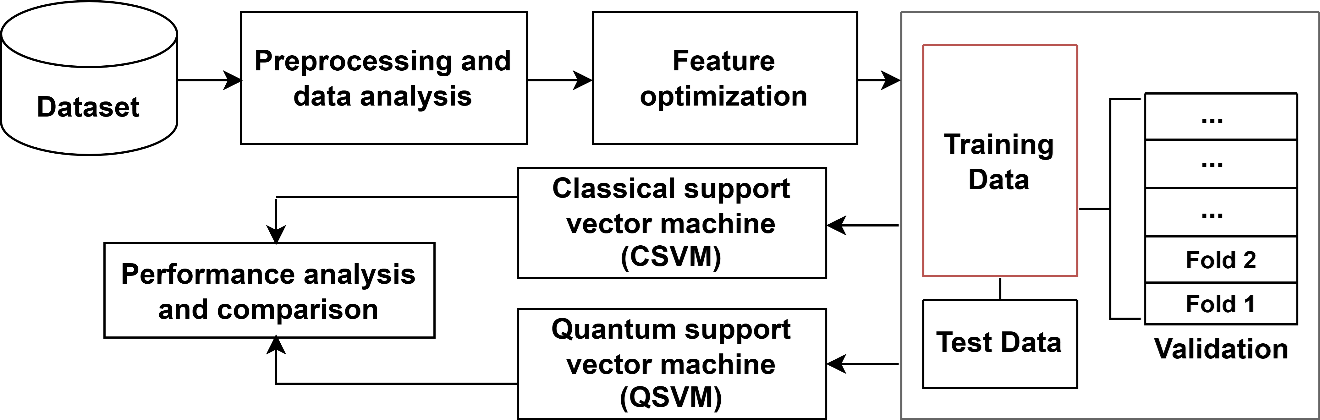
Figure: Workflow of QSVM research.
Design and Analysis of Hybrid Quantum-Classical Machine Learning Models and Circuits
PI: Dr. Arslan Munir
This project pioneers the development of hybrid quantum-classical machine learning models that integrate the representational power of parameterized quantum circuits with the scalability and maturity of classical deep learning. Our research investigates fundamental questions at the intersection of quantum information theory and machine learning, including the expressive capacity of quantum layers, their ability to enhance feature spaces via entanglement and superposition, and their robustness under noisy intermediate-scale quantum (NISQ) constraints.This research project also investigates the potential of hybrid quantum-classical computing for fundamental computer vision tasks of image classification, object detection, and activity recognition. The project aims to design, develop, and evaluate novel hybrid model architectures that integrate variational quantum circuits with classical deep learning components.
We have designed compact two-qubit variational circuits embedded within convolutional architectures, enabling practical deployment on current hardware while achieving statistically significant improvements in classification accuracy and generalization compared to purely classical baselines. For example, our H-QNN models consistently outperform traditional CNNs in binary image classification, demonstrating resilience against overfitting even in data-limited regimes. Beyond classification, we have extended these architectures to image retrieval tasks, illustrating their adaptability to downstream applications and their potential relevance to medical imaging, artificial intelligence security, and high-dimensional data analytics.
By rigorously benchmarking against classical networks and systematically analyzing quantum-classical resource trade-offs, this work provides critical insights into the design principles of hybrid learning pipelines. Ultimately, our H-QNN research establishes a foundation for scalable, domain-specific quantum machine learning frameworks that can leverage the evolving capabilities of future fault-tolerant quantum systems, bridging the gap between today’s NISQ-era experimentation and tomorrow’s practical, quantum-enabled AI applications.
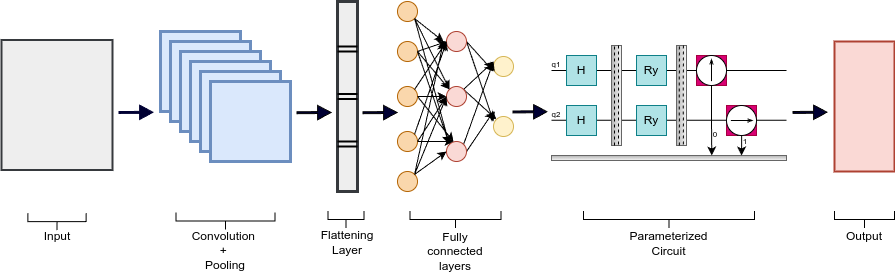
Figure: Proposed H-QNN network consists of six convolutional layers, three fully connected layers, and a two-qubit parameterized quantum circuit.
Post-Quantum Cryptography Based Authentication and Secret Key Establishment in Smart Grid
PI: Dr. Arslan Munir
Partial Funding Support: $3.9M from the U.S. Department of Energy (DOE), Office of Cybersecurity, Energy Security, and Emergency Response (CESER)
Reliable and secure operation of smart grid depends on authentication and secure communication between nodes at all hierarchical levels of smart grid, that is, between central control station (SCADA) and substations, between distributed energy resources (DERs) controller and SCADA, between phasor measurement units (PMUs) and phasor data concentrators (PDCs), between DERs and the substation, and between smart meters and the utility provider. The existing standards for data communication between nodes in smart grid, such as IEEE C37.118.2 and IEC 61850-90-5, either do not specify cybersecurity specifications for communication between nodes or there are security vulnerabilities. This project proposes post-quantum cryptography (PQC)-based protocols for authentication and secret key establishment in smart grid. This project also aims at addressing the security vulnerabilities of the existing standards by integrating the proposed authentication, secret key establishment, and encryption-based secure communication mechanisms with existing standards for reliable authentication and communication between nodes in smart gird. This project plans to integrate proposed authentication, key establishment, and encryption mechanisms with inverters’ gateway and other grid-edge devices and address real-time requirements. The developed technologies will be validated and demonstrated using testbed platforms available at team institutions’ laboratories, in a small-scale network of inverters, and large-scale utility-owned facilities. This project is highly relevant to advance cybersecurity technologies specifically designed to reduce cyber risks to energy delivery infrastructure. The project will ensure compliance of developed security technologies with recent post-quantum security standards by NIST and communication standards by IEEE and IEC. It is anticipated that this effort will have a tremendous impact in supporting and ensuring a more secure, resilient, and reliable energy delivery system by developing post-quantum authentication and encryption mechanisms to mitigate a cyber incident disruption to energy delivery.

Figure: Overview of smart grid’s secure communication between nodes.
Scaling Quantum Systems via Distributed Quantum Computing and Networking
PI: Dr. Zebo Yang
Scaling a single quantum processor monolithically is extremely challenging due to fabrication limits, error rates, and coherence constraints. We address this scalability challenge by interconnecting multiple quantum processing units (QPUs) through distributed quantum computing (DQC) and quantum networking. We develop well-performing entanglement routing protocols, remote gate scheduling approaches, and noise-aware circuit compilation and partitioning strategies to execute large-scale quantum circuits across distributed systems. Our research provides benchmarks, protocols, and algorithms that enable scalable, reliable, and efficient quantum computation beyond the limits of single-chip architectures.
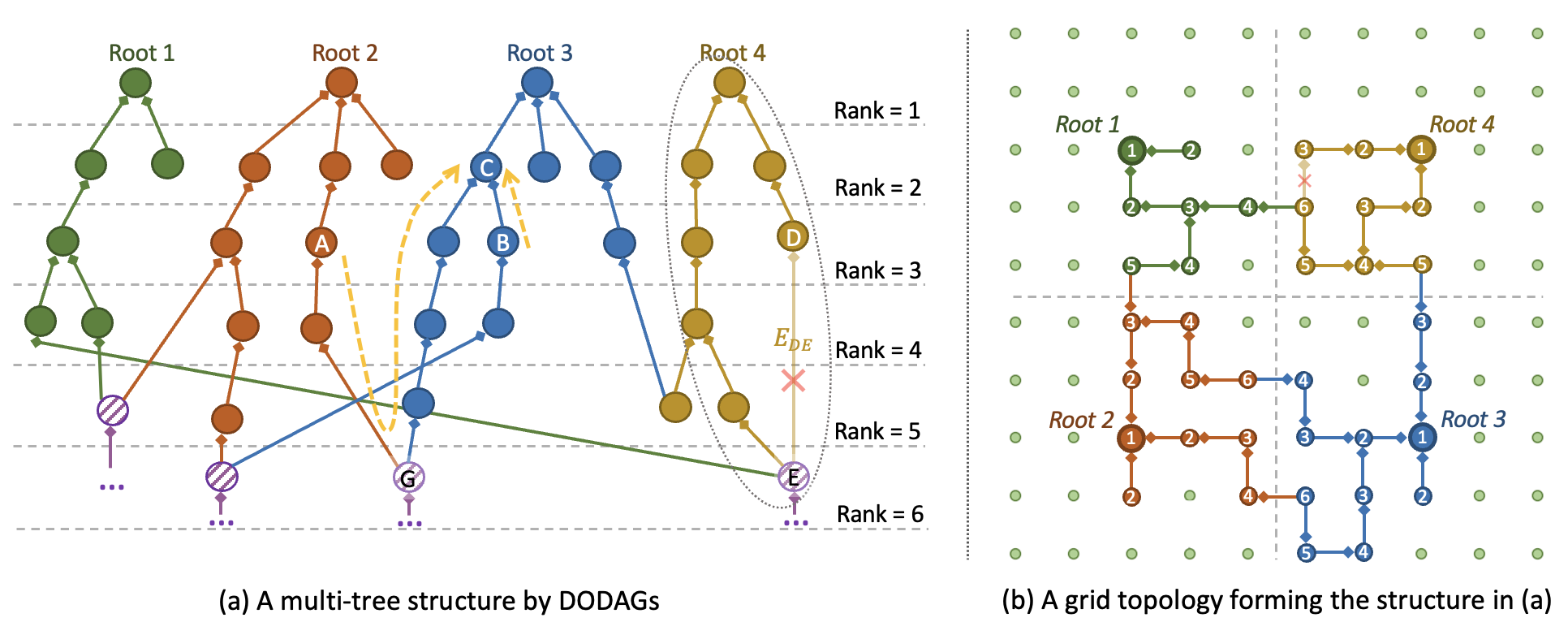
Figure: Multi-tree quantum networking.
Cross-Domain Quantum Optimization
PI: Dr. Zebo Yang
Many problems across science and engineering, including genomics, chemistry, logistics, and neuroscience, are inherently combinatorial and difficult to solve optimally using classical methods. We investigate how quantum optimization techniques, such as the Quantum Approximate Optimization Algorithm (QAOA) and quantum annealing, can unlock new solution spaces and offer potential performance advantages. Our work produces generalizable frameworks and reproducible benchmarks that clarify when quantum optimization provides an advantage and how it can be effectively integrated into practical workflows.
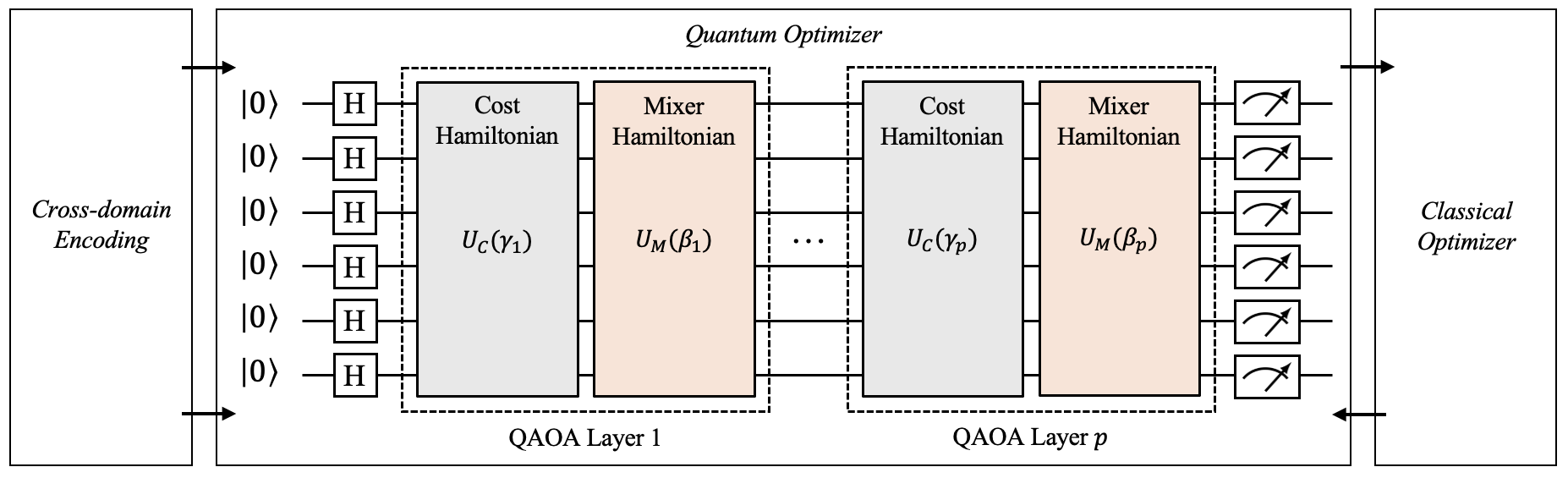
Figure: Cross-Domain quantum optimization.
Quantum Security for a Trustworthy Quantum Ecosystem
PI: Dr. Zebo Yang
As quantum technologies mature, they create both new opportunities and new security vulnerabilities that must be addressed to build a trustworthy quantum ecosystem. We study the security of quantum communication and computation systems, design robust quantum-safe protocols, and analyze potential threats and attack models. Our work provides tools, frameworks, and guidelines to ensure secure entanglement distribution, state transfer, and computation in future quantum systems and networks.
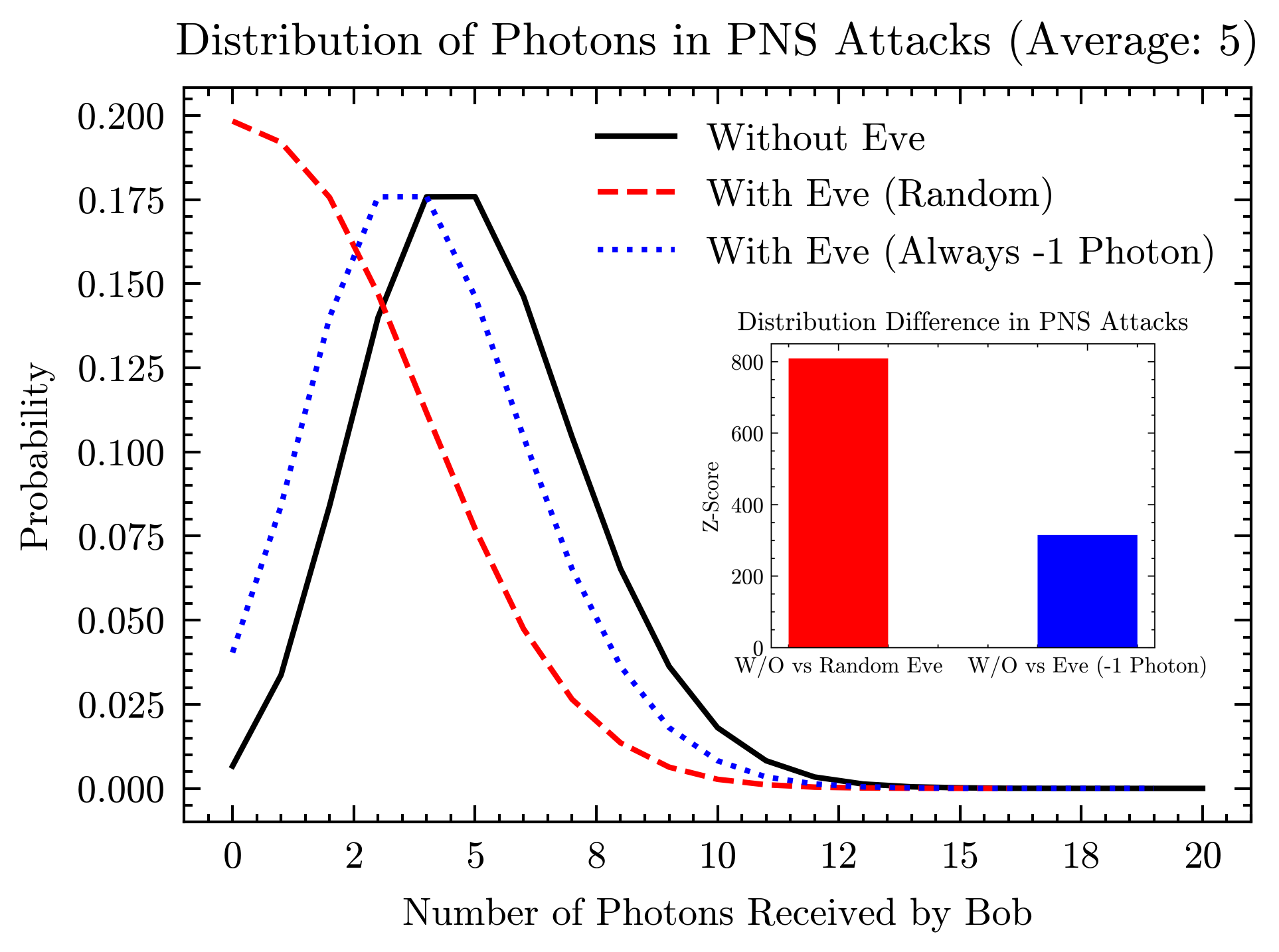
Figure: Photon distribution in the simulation of PNS attacks.