CA-AI Student Spotlight: Jacob Kahn
by Nicole G Nussbaum | Monday, Mar 09, 2026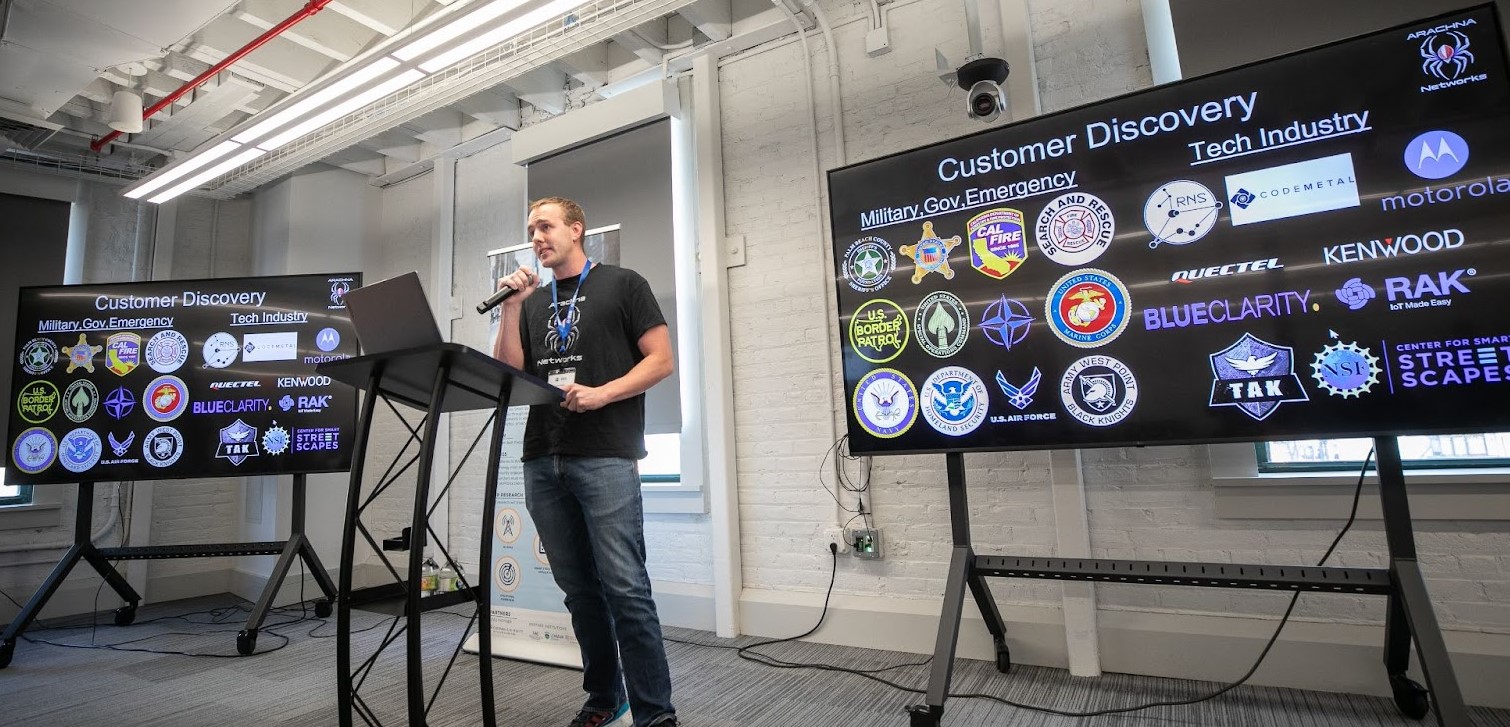
A computer engineering student who began his academic journey at Florida Atlantic University in 2022 and is now pursuing his master’s degree, Jacob Kahn has quickly become a key contributor to the Center for Connected Autonomy and Artificial Intelligence (CA-AI). His work spans autonomous drone systems, smart agriculture, public safety technology and entrepreneurship, often operating at the intersection of all four.
Jacob’s involvement with CA-AI began through research on smart farming initiatives with the Navajo Nation, where he worked on applying AI and mesh networking technologies to support sustainable agriculture. That experience became a springboard into more advanced research, including U.S. Department of Defense–supported projects and the development of FAU’s growing autonomous drone program.
Today, Jacob is helping build FAU’s autonomous drone fleet, including a diverse collection of GPS-less drones, vertical takeoff and landing (VTOL) systems, interceptor drones and airborne sea-drones designed to operate in challenging, real-world environments.
“We’re building drones that can work where traditional systems fail,” Jacob said. “These platforms are meant to be easily accessible and support public safety, defense, and environmental applications.”
The core of Jacob’s research aims to improve the operation of teams of autonomous systems in harsh or high-risk environments, enhancing the effectiveness of military and law enforcement technologies. The same core research also supports sustainability through AI-driven precision agriculture.
Alongside his academic research, Jacob is a co-founder of Arachna Networks, a startup developing universal mesh networking solutions for tactical situational awareness platforms such as ATAK (Android Team Awareness Kit). The company has received recognition from the National Science Foundation and has contributed to the deployment of smart city technology in West Palm Beach.
He has also competed in drone racing and design challenges against U.S. military and allied forces across the country — experiences he credits with sharpening both his technical skills and confidence as an engineer.
“Competing in hackathons against teams from MIT, West Point, and Harvard showed me that where you come from doesn’t define how far you can go,” he said. “CA-AI gave me the opportunity to step into those arenas, represent FAU and demonstrate that passion and persistence can rival any pedigree.”
Jacob says CA-AI’s interdisciplinary, hands-on approach has played a major role in shaping his academic and career goals.
“CA-AI reflects where engineering is moving today,” he said. “The work is highly interdisciplinary and immersive, exposing students to real-world challenges that don’t fit neatly into one department. It can be stressful, but knowing the mission has real societal relevance makes the experience meaningful.”
That mission-driven mindset has helped define Jacob’s path forward. He aims to develop next-generation drone applications that make advanced technology accessible to public safety professionals and “everyday heroes.”
Looking ahead, Jacob plans to expand his work internationally, implementing AI-powered mesh networking solutions for agricultural applications from South Florida to Brazil. He is also collaborating with international partners interested in deploying drone-based security systems, including initiatives to support police forces in the Caribbean against narco-terrorist forces.
At FAU, Jacob and the CA-AI drone team are preparing to compete in upcoming design competitions and pursue government Small Business Innovation Research (SBIR) opportunities to further advance their autonomous systems.
Outside the lab, Jacob is a featured musician, writing and producing ska-punk music through FAU’s Commercial Music program with albums available on Spotify, including Apocalypse King .
It’s a fitting reminder that CA-AI students aren’t just engineers — they’re innovators, creators and problem-solvers shaping the future from every angle.