FAU CA-AI Hovering Owls Among Two University Teams to Top 2:1 Payload-to-Weight Ratio at DARPA Lift Challenge
Wednesday, Sep 02, 2026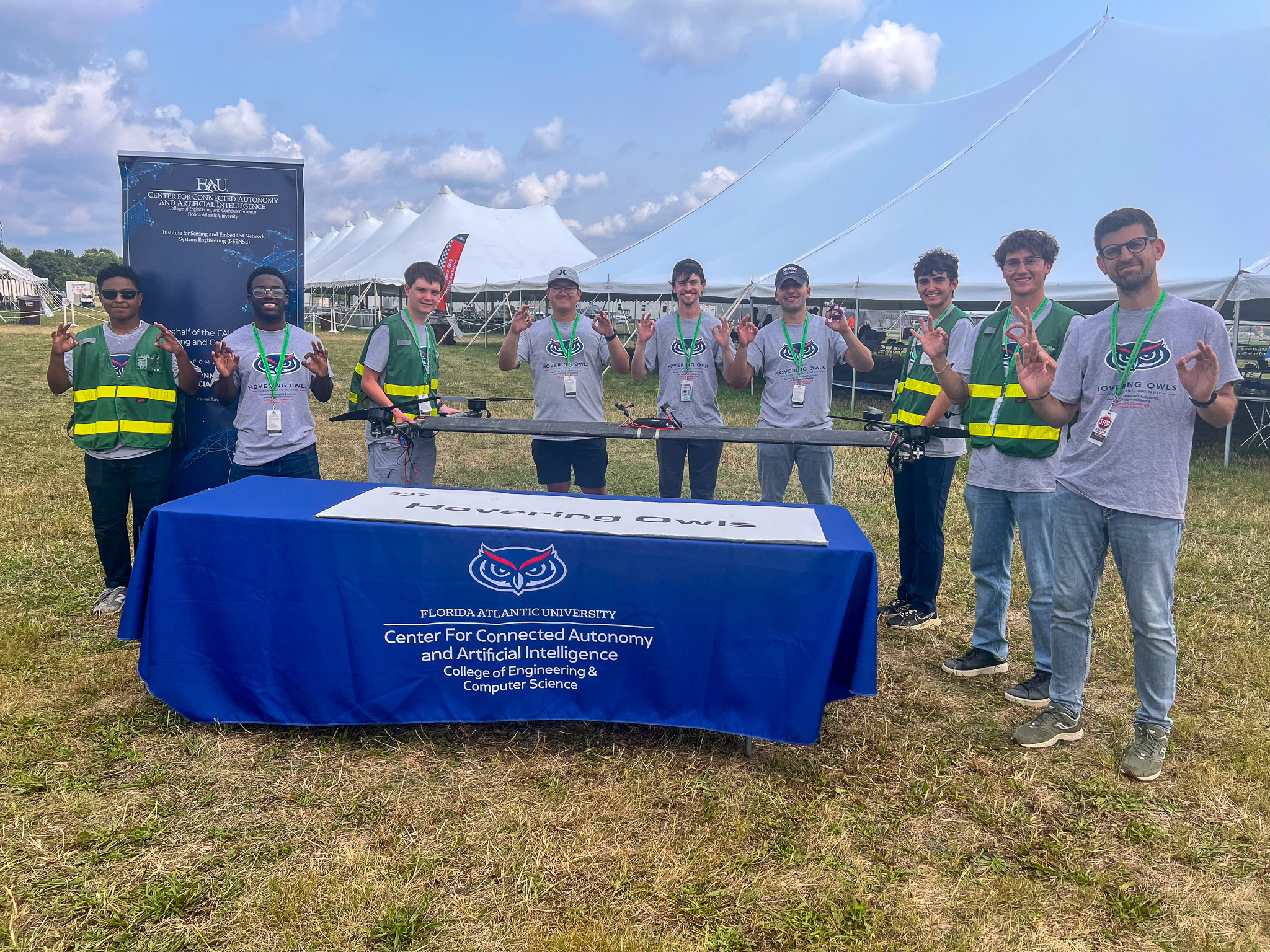
Florida Atlantic University’s Center for Connected Autonomy and Artificial Intelligence (CA-AI), within the College of Engineering and Computer Science, achieved a 2.16:1 payload-to-weight ratio at the Defense Advanced Research Projects Agency (DARPA) Lift Challenge, making the FAU CA-AI Hovering Owls one of only two university teams to demonstrate a ratio above 2:1 by the end of the competition.
Held at the National Museum of the U.S. Air Force in Dayton, Ohio, the DARPA Lift Challenge is part of a long tradition of DARPA-led technology competitions designed to accelerate breakthroughs in emerging technologies. Previous DARPA Grand Challenge and Urban Challenge competitions helped advance autonomous vehicle technologies years before self-driving systems became commercially viable. The Lift Challenge extends that challenge-based approach to autonomous aviation and next-generation aerial logistics.
The competition challenged teams to significantly increase the amount of payload a vertical-lift aircraft can carry relative to its own weight. Teams were required to meet rigorous technical and safety requirements as they progressed through the competition.
Out of 489 total applications, 132 teams were invited to compete, and 76 advanced to the on-site check-in, weigh-in and aircraft inspection process. To proceed to flight qualification, teams were required to demonstrate compliance with DARPA and Federal Aviation Administration requirements, including aircraft weight, vertical takeoff and landing capability, remote identification, pilot certification, emergency procedures and an operational kill switch. The FAU CA-AI Hovering Owls were among 62 teams to clear all required safety checks and complete a qualifying run. Their 52-pound autonomous aircraft successfully lifted 112 pounds, demonstrating a 2.16:1 payload-to-weight ratio.
By the end of the competition, the Hovering Owls were one of only two university teams to demonstrate a payload-to-weight ratio above 2:1. Only five teams, all from industry, went on to complete a scored run, underscoring the technical difficulty of the challenge and the significance of FAU CA-AI’s performance.
“FAU CA-AI’s performance at the DARPA Lift Challenge speaks to the caliber of our students, faculty and research in autonomous systems,” said Stella Batalama, Ph.D., dean of the College of Engineering and Computer Science. “Our Hovering Owls were one of only two university teams to demonstrate a payload-to-weight ratio above 2:1 in a highly competitive field, while the five teams that ultimately completed scored runs were all industry teams. This achievement demonstrates the advanced engineering capabilities our students are developing through CA-AI and the level at which they can contribute to technologies with direct relevance to autonomous aviation and national defense.”
The Hovering Owls were led by CA-AI faculty mentors George Sklivanitis, Ph.D., associate director of CA-AI and Schmidt Research Associate Professor in the Department of Electrical Engineering and Computer Science, Oscar Curet, Ph.D., CA-AI senior member and Professor in the Department of Ocean and Mechanical Engineering, and Dimitris Pados, Ph.D., director of CA-AI and Charles E. Schmidt Eminent Scholar Professor in the Department of Electrical Engineering and Computer Science. They guided and supported a team of eight undergraduate engineering student researchers through the development and testing of a heavy-lift autonomous tiltrotor designed for next-generation aerial logistics.
The team worked across the full aircraft development process, including computer-aided design, structural and aerodynamic simulation, fabrication, propulsion, autonomous controls, system integration and flight testing. The platform they developed integrated flight-control hardware, propulsion systems and a composite airframe into an operational autonomous aircraft capable of meeting the competition’s demanding lift requirements.
“DARPA competitions have a long history of accelerating technologies that ultimately reshape entire industries, particularly in autonomous systems,” said Pados. “For the FAU CA-AI Hovering Owls to demonstrate a 2.16:1 payload-to-weight ratio in this environment is a significant technical accomplishment. Our students, all undergraduate, worked alongside CA-AI faculty through every stage of development, from design and simulation to fabrication, integration and flight testing, and demonstrated what a university research team can achieve when challenged against demanding performance and safety requirements.”
“Participating in the DARPA Lift Challenge gave our students a rare opportunity to work in the same environment as experienced industry teams and evaluate their engineering against technologies developed by professional competitors,” said Sklivanitis. “Under a demanding development timeline, they had to make critical design decisions, solve integration challenges and adapt to strict weight, safety and performance constraints. That experience strengthened not only their technical capabilities, but also their ability to collaborate, respond under pressure and carry an ambitious autonomous system from concept through flight testing.”
Fully funded, organized and supported by CA-AI, which was established through a gift from the Schmidt Family Foundation, the project presented FAU engineering students with direct responsibility for developing an autonomous aircraft under the technical constraints of a national DARPA competition. The team extends its gratitude to Dick Schmidt and the Schmidt Family Foundation for their continued support of CA-AI and its students. Their work brought together aircraft design, artificial intelligence, autonomy, controls, communications and advanced manufacturing while contributing to CA-AI’s broader research in networked AI, connected robotics and autonomous systems.
The Hovering Owls’ performance at the DARPA Lift Challenge reflects CA-AI’s focus on advancing autonomous systems through research, technology development and project-based engineering education. Within the College of Engineering and Computer Science, CA-AI provides students with opportunities to work alongside faculty on nationally significant engineering challenges while developing the technical expertise needed for emerging applications in autonomous systems and national defense.