2/12/2026
Art of Science: ‘Survival’ Earns Honor
Researcher’s Experiment is Award-winning Art
When Dr. Hussam Alshareef, a postdoctoral fellow at the FAU Stiles-Nicholson Brain Institute, noticed a maze of looping lines being carved across a small petri dish, he said he did not initially see art. He saw stress.
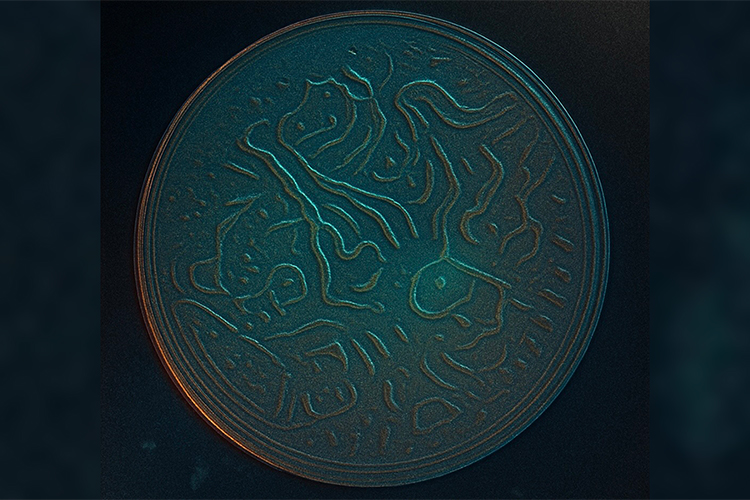
But, that unexpected pattern, which Alshareef titled Survival, earned recognition in the Art of Science. It’s also a perfect example, he said, of how a routine research observation can translate into a striking visual image.
This image shows the movement of microscopic worms as they respond to simulated starvation. Barely visible to the naked eye, these transparent worms are widely used in biological research because they share many genetic pathways with humans and allow scientists to closely observe behavior and biological change in real time. Hussam uses them to study addiction, specifically the effects of amphetamines on health and behavior.
In Survival, the worms crawl across and burrow through a jellylike substance made from seaweed that serves as both a growth surface and food source in laboratory experiments. As nutrients become scarce, the worms trace winding paths through the gel, clustering and scattering as they search for sustenance. The result is a dense network of etched lines that resembles an abstract drawing.
While Survival was not created with art in mind, Alshareef said he recognized something striking in his observation. The patterns felt expressive, almost communicative, revealing how organisms respond when resources disappear, he said. Some viewers may see a maze, others a body, an animal, or a symbol entirely their own. That ambiguity is intentional, he said.
For Alshareef, the piece also underscores an important philosophy he carries into his work: Discovery often happens when researchers allow themselves to notice what they weren’t looking for. The patterns that became Survival emerged not just from a planned experiment, but from paying attention.
Art of Science
Join us in celebrating this year's winners of the 7th annual Art of Science contest during the opening ceremonies of the nearly monthlong exhibition. Free food, wine and giveaways.
4 to 6 p.m., March 31
Exhibition runs through
April 19
Register Now for the 7th Annual Art of Science Gallery opening ceremonies
View all Art of Science winners here.
Get your copy of the commemorative Art of Science coffee-table book ...
All of the research
All of the pictures
All of the stories
All yours.