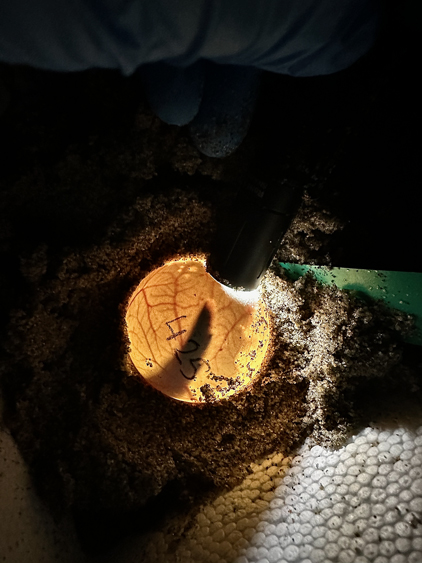
Second Place: Sea Turtle Beginning
Charles E. Schmidt College of Science
Mentor: Jeanette Wyneken, Ph.D.
Through a method called candling, a flashlight is held up against an egg in the dark to visualize embryonic development. The flipper outline of a developing loggerhead sea turtle (Caretta caretta) embryo is visible within its egg, along with the intricate network of extraembryonic blood vessels that sustain growth. These vessels facilitate gas exchange and nutrient transport, serving as visible markers of embryonic development. The egg shown here was incubated at controlled temperatures as part of an experiment investigating temperature-dependent sex determination (TSD). In sea turtles, incubation temperature, rather than genetics, determines whether embryos develop as male or female: cooler temperatures produce males, while warmer temperatures produce females. Once hatched, the turtles were raised at the FAU Marine Laboratory, where their sex was identified to advance understanding of the molecular mechanisms underlying TSD and to assess how climate change may alter future sex ratios.