Dr. Du Develops New Technology for Rapid Cell-Based Diagnostics
by Behnaz Ghoraani | Tuesday, Jan 27, 2026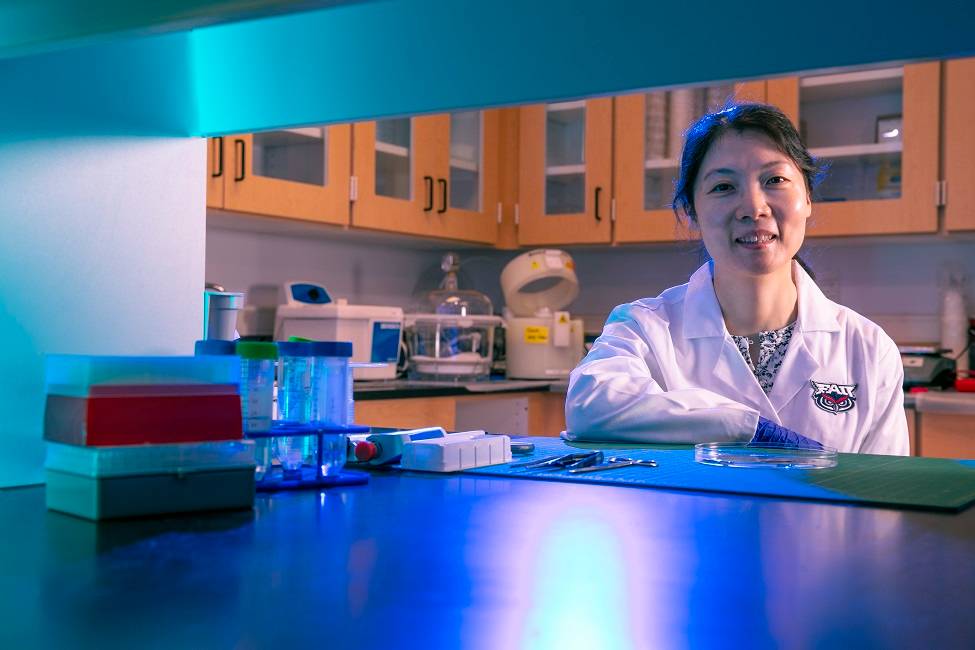
Dr. E (Sarah) Du, Professor in the Departments of Ocean and Mechanical Engineering and Biomedical Engineering and Co-Director of the Center for SMART Health at Florida Atlantic University, continues to push the boundaries of biomedical innovation at the intersection of engineering and healthcare. With a background in mechanical engineering and postdoctoral training in cell biomechanics at MIT, Dr. Du has built a research career that combines fundamental studies in cell biophysics with translational goals. Her work centers on developing biosensing platforms and microfluidic tools to detect cellular and molecular abnormalities associated with hematologic, infectious, inflammatory, and neurodegenerative diseases.
Her latest innovation, recently granted a patent (PCT/US2025/018142), introduces a new technique called Electro-Deformation Spectroscopy (EDS). This system enables the simultaneous measurement of both mechanical and electrical properties of single cells. By capturing frequency-dependent biophysical behaviors, EDS can detect subtle heterogeneity in individual red and white blood cells under various physiological conditions. Its unique dual-marker approach, which captures signals from both the cell membrane and the cytoplasm, offers new opportunities for single-cell disease detection.
What sets EDS apart from existing methods is its accessibility and versatility. Unlike traditional tools like optical tweezers, ektacytometry, or impedance spectroscopy, which often require complex preparation or costly instrumentation, EDS is low-cost, high-throughput, and minimally invasive. These characteristics make it especially suited for rapid diagnostic applications in point-of-care settings.
Currently in the pilot testing phase, Dr. Du and her team are working with clinical and industry partners to validate the system’s utility in real-world healthcare environments. In collaboration with Nami Diagnostics and Dr. Mario Rueda of St. Mary’s Medical Center, EDS is being assessed as a potential tool for sepsis detection, a critical condition that requires swift and accurate diagnosis. This translation from lab innovation to clinical pilot reflects a growing ecosystem at FAU focused on accelerating biomedical technologies toward market readiness.
Supporting this translational effort, Dr. Du also secured an Innovation Pilot Award to facilitate technology transfer and foster partnerships between academia and industry. The funding helps advance the EDS platform by validating its performance and laying the groundwork for commercialization.
True to the Center for SMART Health's mission, Dr. Du’s work exemplifies how interdisciplinary research can be channeled into innovations that transform healthcare delivery. The invention itself was born from collaboration, merging Dr. Du’s bioengineering expertise with the biomedical insights of Dr. Jianning Wei from FAU Medicine. Moving forward, clinicians and entrepreneurs will play an equally critical role in scaling the technology for broader impact.
Student researchers are also central to the project’s success. From running experiments to analyzing data, undergraduate and graduate students contribute directly to the development and testing of the EDS platform, gaining hands-on experience in translational science. Their participation reinforces the lab’s dual commitment to high-impact research and experiential education.
As Dr. Du continues to evolve the EDS system and other biosensing technologies, her work underscores SMART Health's core values: advancing patient-centered innovation, building robust interdisciplinary teams, and creating tools that are both scientifically rigorous and clinically actionable.