3/21/2026
Plastic chemicals alter octopus hunting patterns
Research shows chemicals like oleamide change how South Florida octopuses hunt and interact.
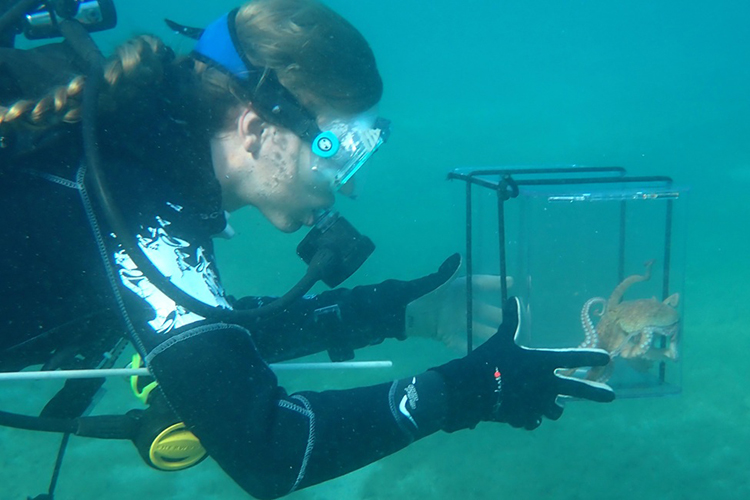
Plastics release thousands of chemicals into the ocean – including oleamide, an industrial lubricant, which is also naturally produced by many organisms. By mimicking natural signals, plastic-derived oleamide may quietly alter how marine life senses food and interacts with one another. FAU researchers studied these effects on a common South Florida octopus (Octopus vulgaris) and four widespread prey: hermit crabs, free-living crabs, snails and clams. In laboratory aquariums, they tracked more than 31,500 individual observations of octopus hunting, recording successful predation, failed attempts and brief grasps, to measure how oleamide influenced prey choice, predator behavior and predator-prey encounters.
The study, published in the Journal of Experimental Marine Biology and Ecology, found that oleamide quickly altered both predator and prey behavior. Octopus shifted preference from hermit crabs to free-living crabs, while crustacean prey reduced predator-avoidance behaviors, continuing to forage even near the predator. Interactions increased, but successful predation did not; most contacts were non-consumptive. These effects persisted for at least three days, suggesting that plastic-derived chemicals can subtly disrupt chemical communication, leaving prey less cautious, altering predator-prey dynamics, and potentially reshaping coastal marine ecosystems by changing feeding behavior, species interactions and resource distribution.
“Many species rely on chemical information to detect food, assess predation risk, and balance the tradeoffs between foraging and staying safe,” said Michael W. McCoy, Ph.D., senior author, associate director, FAU School of Environmental, Coastal, and Ocean Sustainability, and professor of quantitative ecology, Department of Biological Sciences, FAU Charles E. Schmidt College of Science and FAU Harbor Branch Oceanographic Institute. “What’s striking about this study is that when oleamide entered the system, that chemical communication appeared to break down. Crustacean prey reduced their predator-avoidance behaviors, even as the octopus became more exploratory and increased their interactions – especially grasps. Normally, more predator contact would heighten prey defenses. But in the presence of oleamide, that expected response simply didn’t happen.”