3/25/2026
2026 Indian River Lagoon Symposium
Annual Event Featured Innovation and Collaboration to Advance Solutions for a Clean and Healthy Lagoon
In February, more than 1,000 scientists, students, environmental managers and interested members of the public converged in-person and virtually at Florida Atlantic University’s Harbor Branch Oceanographic Institute for the 15th annual Indian River Lagoon (IRL) Symposium.
This collaborative, one-day gathering is dedicated to advancing the science, dialogue and stewardship for one of Florida’s most important ecosystems. The theme for 2026 was “Emerging Technology and Novel Methods." Presentations highlighted applications of artificial intelligence, machine learning and molecular techniques, as well as advances in sensor systems, remote sensing and autonomous platforms.
The day opened with a keynote address from Christine Angelini, Ph.D., vice president, advisory services, AECOM, a sustainable infrastructure consulting firm. During her talk, Angelini emphasized the importance of including policymakers in research studies. There are many challenges to translating published research into meaningful policy change, she said, but by actively engaging and communicating with officials in language that is digestible and actionable, important discoveries have better potential to lead to real-world solutions.
“Scientific research is in an era of rapid change and innovation, thanks to the emergence of technologies like automation and machine learning," said Rachel Brewton, Ph.D., assistant research professor at FAU Harbor Branch and a member of the event’s steering committee. “The IRL Symposium is an ideal platform for sharing novel methods and tools, because we can foster collaboration and potentially accelerate new strategies for restoring and protecting the lagoon."
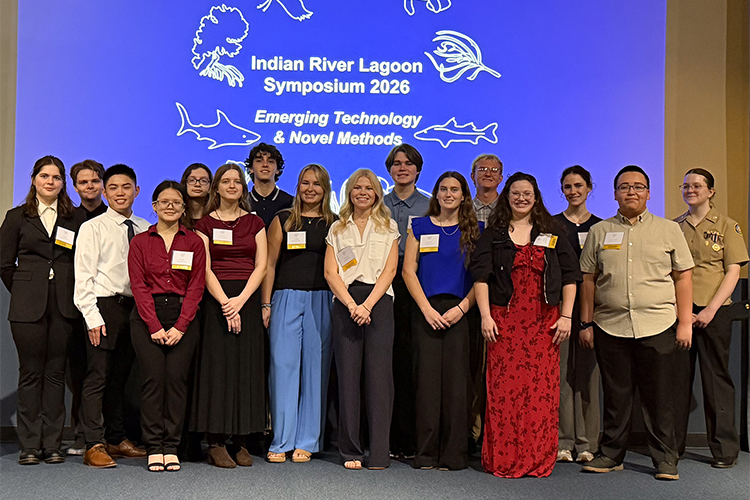
The one-day symposium featured 103 oral and poster presentations, including 57 made by students from universities across the United States. Oral presentations were categorized into four sections: novel applications, sensors and remote technology, molecular innovation, and living resources. Presentations were 10 minutes or, for those up to the challenge, three minutes.
For instance, Megan Conkling, Ph.D., research scientist at FAU Harbor Branch, presented a 10-minute talk on a recent study that revealed how freshwater runoff and nutrient pollution appear to be lowering aragonite saturation (a key indicator of coastal acidification), which could be causing smaller, less resilient shellfish in the IRL. These findings have major implications for shellfish restoration efforts in the lagoon and nearshore reefs.
Richard Acs, a computer science Ph.D. student at FAU, took the three-minute talk challenge and succinctly presented a novel machine-learning approach that can automatically organize hours of underwater acoustic recordings from the IRL into data clusters that map biological and human-made sounds. This approach exponentially accelerates analysis time to more efficiently support long-term IRL biodiversity assessment and management.
The evening reception included a poster session where attendees could speak directly to the researchers about their work and findings. New this year were two digital poster sessions where researchers presented in 10-minute time slots.
Among the traditional poster presentations were studies conducted by Junior Scientist Fellows, a joint program between FAU Harbor Branch and the Indian River Land Trust. Under the guidance of institute scientists and Land Trust managers, these Indian River County high school students worked in groups to conduct field research in and around the IRL at the Land Trust’s Coastal Oaks Preserve, followed by analysis in labs at Harbor Branch. Their projects investigated native vegetation regrowth following Brazilian pepper removal; diversity and abundance of seagrass in the central IRL, and compared larval barnacle abundance and recruitment in two lagoon locations.
The IRL Symposium is also a competition for the student presenters. Six categories were judged by a panel of volunteers, and four categories were “people’s choice" with votes cast by attendees. Each award included a $200 prize.
Outstanding student presentations were awarded to:
- Jonathan Terzado, Outstanding 10-Minute Oral Presentation (Judges’ Choice), Florida Atlantic University, “High-Resolution Electrochemical Profiling Reveals Disparate Levels of Sediment Sulfate Reduction Between the North and South Forks of the St. Lucie Estuary"
- Katherine Harris, Outstanding Three-Minute Oral Presentation (Judges’ and People’s Choice), University of Central Florida, “High-Resolution Electrochemical Profiling Reveals Disparate Levels of Sediment Sulfate Reduction Between the North and South Forks of the St. Lucie Estuary"
- Jordyn Delikat, Leroy Crosswell Best Student Poster Award (Judges’ and People’s Choice), University of Central Florida, “Unintended Consequences of Restoration on the Eastern Oyster Crassostrea virginica"
- Giuliana Vomero Fernandez, Best Student Digital Poster Award, Florida Atlantic University, “The Discovery Floating Classroom: Educating Future Scientists and Environmental Leaders"
- Tara Blanchard, Best Student 10-minute Oral Presentation (People’s Choice), University of Central Florida, “Don’t Go Breaking Apart: How Habitat Fragmentation Affects Oyster Reef Biodiversity"
- Janie Reavis, Best Student Digital Poster (People’s Choice), Arizona State University, “From Turtle Trials to Marine Applications: A Controlled Facility for Testing Wildlife Behavior"
- Sharanya S. Natarajan, Indian River Lagoon National Estuary Program Promising Scientist Award, Edgewood Jr./Sr. High School, “An Integrated Detection and Delivery System to Abate Contaminants in Water Bodies"
- Cecilia Hampton, Dennis Hanisak Storyteller Award, Florida Atlantic University, “Habitat Use During Foraging and Other Behaviors by Whitespotted Eagle Rays (Aetobatus narinari) in the Indian River Lagoon, Revealed by Novel Biologging Technologies"
“Student research is a key component of the IRL Symposium," said Kristen Davis, manager of FAU Harbor Branch’s Indian River Lagoon Observatory Network of Environmental Sensors, and event steering committee member. “They are the next generation of experts, stewards and changemakers who will continue the vital work underway to restore a healthy lagoon."
The Indian River Lagoon Symposium is organized by a volunteer steering committee with representatives from academic, governmental and nonprofit organizations. This year’s co-chairs were Brewton, Davis and Matt Ajemian, Ph.D., associate research professor at FAU Harbor Branch. A recording of all oral presentations can be viewed online, along with the event program and abstracts of all presentations at www.fau.edu/hboi/events/irl-symposium.