Spring 2025
Florida Atlantic: To Infinity and Beyond
Alumna Helps NASA Send Astronauts to the Moon
The path to engineering for Nicole Cummings ’03 began modestly.
As a student at Wellington High School, Cummings said she had not considered engineering until she was encouraged by one of her teachers to join an after-school program. The initial meetings provided a fun atmosphere where students would play music and build small-scale items like mouse traps and miniature bridges.
What began as a hobby soon turned into an engineering scholarship at Florida Atlantic University’s College of Engineering and Computer Science.
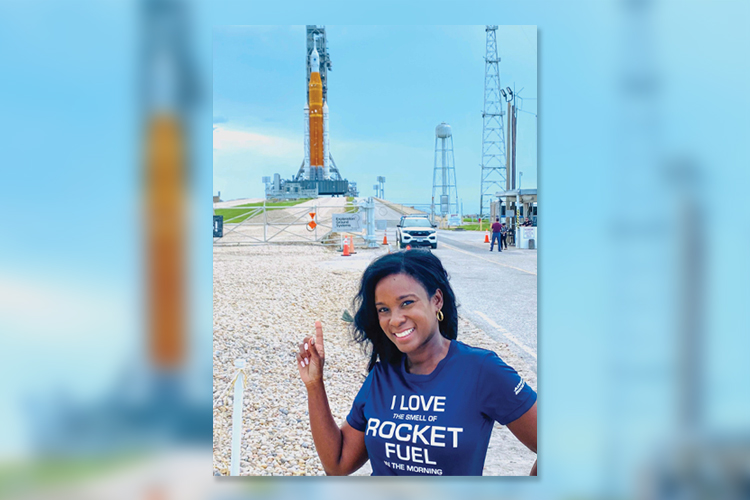
Today, Cummings is part of the team that is building an engine to power NASA’s Artemis II rocket, which will soon carry astronauts to the moon for the first time in more than 50 years. The Artemis program is slated to take the first woman and first person of color to the moon.
“The industry right now has so much excitement,” Cummings said. “Standing in my shoes, you realize that you’re actually at a part of history where you’re going to have footprints and fingerprints on this mission. It really is very exciting for me.”
Cummings serves as program manager at Jupiter’s Aerojet Rocketdyne, running the RL10 engine program. The RL10 rocket engine is a critical component to propelling the Orion spacecraft to the moon as part of the Artemis II mission. A 10-foot long, 508-pound engine, the RL10 will provide more than 24,000 pounds of thrust, helping push the spacecraft into lunar orbit.
The RL10 is expected to play an even larger role in Artemis IV, which will utilize four engines and carry the largest payload in history, allowing NASA to build the first lunar space station.
Florida Atlantic played a key part in Cummings’ journey, she said, setting the stage for her flourishing career. Cummings had a natural instinct for engineering when she arrived on campus, but admitted the coursework could be challenging, and at times, she questioned whether she wanted to stay in the field. Any time she had doubts, she said the professors were always helpful and encouraging.
“It was their support that got me through,” Cummings said. “There were many times that I didn’t want to do it. I didn’t want to continue. I felt like giving up, but it was support from others that always helped me.
It was a needed nudge when you just were getting tired.”
Cummings powered through and is now an expert in the industry. Among her many achievements include being inducted into the Florida Atlantic Alumni Association Hall of Fame in 2023 and receiving the Women’s Chamber of Palm Beach County’s Giraffe Award, which recognizes women who have “stuck their neck out” for other women in the community.
Additionally, Cummings serves on the advisory board for Florida Atlantic’s College of Engineering and Computer Science, paying it forward to students who are pursuing a similar path in engineering.
“If it wasn’t for the support I received from Florida Atlantic, I wouldn’t have [made it to where I am today],” Cummings said. “I realize how important it is to give that support back, and that’s why I am on the board.”
Stella Batalama, Ph.D., dean of Florida Atlantic’s College of Engineering and Computer Science, said the college’s faculty, staff and students are proud of Cummings, noting the pivotal role she’s playing in shaping the future of space exploration.
“Nicole’s leadership in building the RL10 rocket engine, a key component of NASA’s Artemis II mission, is helping to pave the way for groundbreaking achievements,” Batalama said. “Her contributions to this historic mission underscore her profound impact on advancing engineering innovation and expanding humanity’s reach into space.”
The Artemis II mission is slated to launch from Cape Canaveral in April 2026, according to NASA. Cummings said she wouldn’t miss it for the world.
“I plan to be front and center, and see it take off,” Cummings said. “We’ve been working hard on this, and our prize moment is getting to see Artemis II launch. We are excited, and the whole team plans to see it all the way through to the launch.”
For more information, email dorcommunications@fau.edu to connect with the Research Communication team.