9/1/2025
Studying Mangroves
FAU Harbor Branch Partnership Fuses Mangrove Research and Education for Exhibit at St. Lucie Aquarium
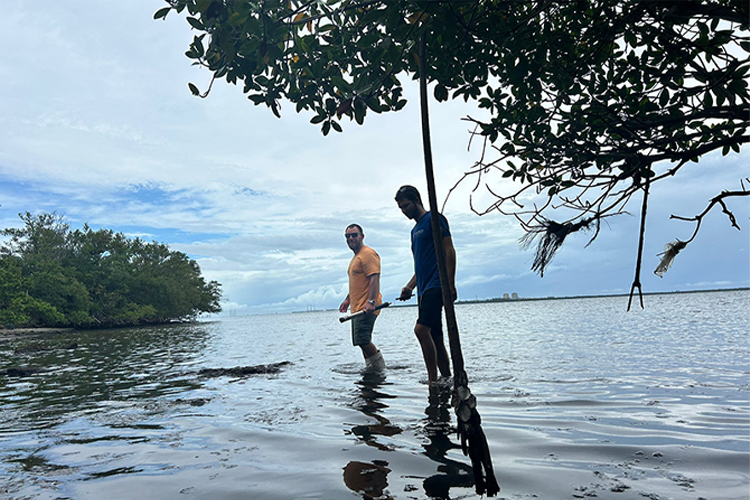
Mangrove trees are one of the most productive ecosystems in the ocean and an important part of the Indian River Lagoon ecosystem. Mangroves are responsible for moving large amounts of carbon dioxide, organic matter and nutrients through the water, sand, and mud, and play an important role in how energy and chemicals move between coastlines and ocean. Researchers at FAU Harbor Branch's Geochemistry and Geochemical Sensing Lab and Indian River State College, in partnership with the Smithsonian's Marine Ecosystems Exhibit at the St. Lucie County Aquarium (SMEE), are studying how elements like sulfur and iron move through the sand and mud in these mangrove environments.
Iron is an important ingredient for aquatic life and is basically what makes mud brown, while sulfur, known for its rotten egg smell, is important to the decay and recycling of organic matter. Interactions between these two elements regulate whether hydrogen sulfide, which can be toxic in high concentrations, is released to the lagoon or sequestered in sediments as safer forms. By using special electrodes to detect subtle differences in chemistry, these tiny sensors allow a controlled and detailed look at what's happening beneath the surface without disturbing the sediments. By comparing the extent that the aquarium exhibit mimics natural mangrove environments, this work can enable SMEE to make necessary adjustments to ensure a thriving artificial ecosystem.