Fall 2025
Florida Atlantic: Stronger by Nature
Engineers Reinforce Wood with Eco-friendly Nano-iron
Wood is one of the world's most abundant and renewable resources, with more than 181 billion tons produced annually. But could it also be the material of the future?
Researchers from Florida Atlantic University and collaborators said they believe the answer is yes — especially when wood is combined with a little high-tech chemistry.
A study, published in ACS Applied Materials and Interfaces, reveals how a simple, cost-effective treatment using a naturally occurring mineral can strengthen the microscopic structure of wood without adding much weight or environmental burden. The research could lead to a new generation of bio-based materials strong enough to replace steel and concrete in everything from skyscrapers to furniture.
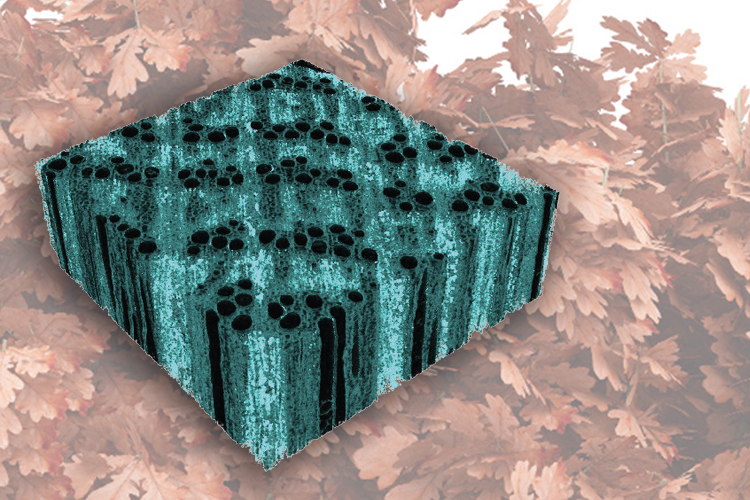
The team focused on red oak, a common North American hardwood from the ring-porous wood family — trees like oak, maple and cherry, known for their large, ring-shaped vessels that transport water. The researchers infused the wood with ferrihydrite, an iron oxide mineral created by mixing ferric nitrate with potassium hydroxide — a safe, simple chemical reaction.
"Wood, like many natural materials, has a complex structure with different layers and features at varying scales. To truly understand how wood bears loads and eventually fails, it's essential to examine it across these different levels," said Vivian Merk, Ph.D., senior author and assistant professor in Florida Atlantic's departments of ocean and mechanical engineering, biomedical engineering, and chemistry and biochemistry. "To test our hypothesis — that adding tiny mineral crystals to the cell walls would strengthen them — we employed several types of mechanical testing at both the nanoscale and the macroscopic scale."
To analyze the effects, the team used atomic force microscopy and a technique called AM-FM, which combines two frequencies to create both topographical images and measurements of elasticity and stickiness. This allowed them to see how the nano-iron crystals reinforced the individual cell walls.
They also conducted nanoindentation tests inside a scanning electron microscope, pressing microscopic probes into the wood to measure its stiffness, and followed up with traditional bending tests on both treated and untreated samples.
The results? The nano-iron significantly boosted the stiffness of the wood's cell walls. And while the overall behavior of the treated wood — how it bends and breaks — stayed relatively consistent, the internal structure became much tougher. The researchers noted that while some bonding between cells weakened slightly, the gains in microscopic strength could lead to major performance improvements when fine-tuned for future applications.
"By looking at wood at different levels — from the microscopic structures inside the cell walls all the way up to the full piece of wood — we were able to learn more about how to chemically improve natural materials for real-world use," Merk said.
With sustainability driving the search for greener building materials, this study brings us a step closer to building stronger — and smarter — with wood.