3/14/2025
Protecting and Restoring the Indian River Lagoon
Annual Symposium Showcases Research and Community Engagement
Nearly 800 scientists, students, environmental managers and interested members of the public recently converged in-person and virtually at Florida Atlantic University’s Harbor Branch Oceanographic Institute for the annual Indian River Lagoon (IRL) Symposium.
For decades, the IRL has faced challenges that threaten the delicate balance of its ecosystem, which impacts local wildlife, water quality and ultimately the quality of life and economy of communities situated along its 144-mile shoreline. The IRL Symposium is a unique forum organized by multiple educational, nonprofit and government organizations to disseminate current knowledge about the lagoon and its management and foster collaborations among key stakeholders.
"The Indian River Lagoon Symposium has become an integral connection point for researchers, policymakers and concerned citizens who care about the health of the lagoon and its surrounding communities," said Rachel Brewton, Ph.D., assistant research professor at FAU Harbor Branch and a member of the event’s steering committee. "We share ideas, new discoveries, success stories and challenges, all with the common purpose of protecting and restoring this irreplaceable natural resource."
The two-day symposium featured 117 oral and poster presentations, including 52 made by students from universities across Florida. Technical sessions were broken into four sections: climate, marine botany, marine fauna, and harmful algal blooms and IRL restoration. Speakers provided updates and insights on such topics as seagrass restoration research, sea-level rise and shoreline resiliency, water quality trends, native fish species and marine mammals.
The evening reception included a poster session where attendees could speak directly to the researchers about their work and findings. Among the presentations were the studies conducted by the Junior Scientist Fellows, a joint program between FAU Harbor Branch and the Indian River Land Trust. Under the guidance of institute scientists and Land Trust managers, these Indian River County high school students worked in groups to conduct field research in and around the IRL at the Land Trust’s Coastal Oaks Preserve, followed by in-depth analysis in labs at Harbor Branch. Their projects investigated marine invertebrates, sediments and salt marsh vegetation.
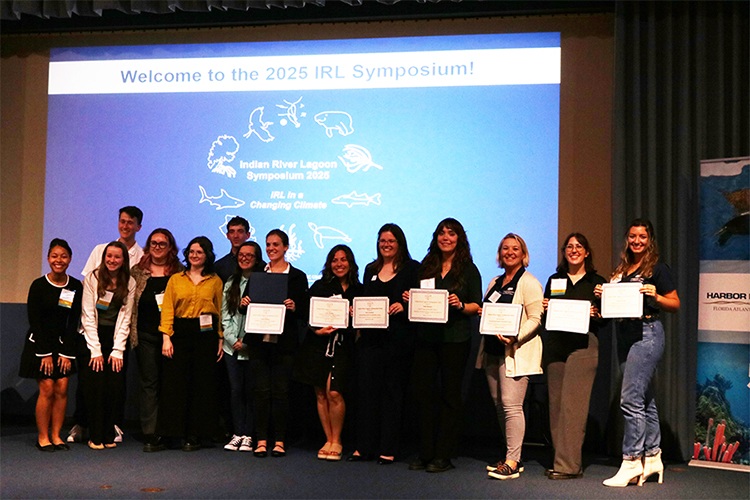
Day one was also a competition for the student presenters. Five categories were judged by a panel of volunteers and three categories were "people’s choice" with votes cast by attendees. Each award included a $200 prize.
Two FAU Harbor Branch graduate students received accolades:
- Sarah Webb, Outstanding 10-Minute Oral Presentation, Re-emergence of the Endangered Smalltooth Sawfish (Pristis pectinata) in a Historic Nursery"
- Sarah Newton, IRLNEP Promising Scientist Award, "Examining Relationships Between Sediment Nutrients and Halodule wrightii in the Southern Indian River Lagoon"
A new award was introduced this year called the Dennis Hanisak Storyteller award to honor the late M. Dennis Hanisak, Ph.D., a renowned Harbor Branch research professor who founded the IRL Symposium in 2012. The inaugural winner was Isabel Bennett from the Florida Institute of Technology for her presentation "Mapping the Distribution of Seagrass Seeds in the Indian River Lagoon."
"The Dennis Hanisak Storyteller Award pays tribute to the importance Dr. Hanisak placed on both good science and communicating science in ways that are meaningful and accessible to everyone," said Kristen Davis, manager of FAU Harbor Branch’s Indian River Lagoon Observatory Network of Environmental Sensors, and another steering committee member. "This was our first symposium since his passing. Though we all felt the weight of his absence, the incredible turnout and enthusiastic participation from across the state is a testament to his enduring legacy and indelible impact on advocacy for the IRL."
Day two of the symposium, the IRLS Forum, focused on community collaboration and communication. The morning was divided into three subject-area sessions: environmental monitoring and citizen science; coalitions and counties; and living shorelines and youth-focused environmental groups. Presenters represented governing bodies, such as the Florida Fish and Wildlife Commission; nonprofits, such as Marine Resources Council and the River Kids; and research institutions, including FAU Harbor Branch and Hubbs-SeaWorld Research Institute.
For more information, email dorcommunications@fau.edu to connect with the Research Communication team.