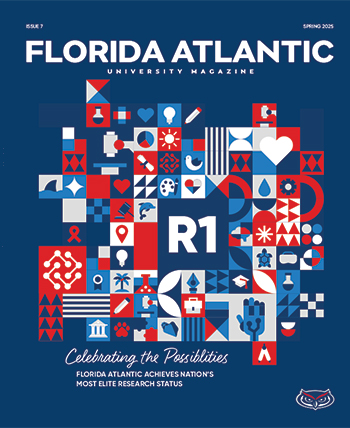
Spring 2025
Florida Atlantic: Pinnacle of Research Excellence
Florida Atlantic Achieves Elite Status as an R1: Very High Research Spending and Doctorate Production University
Florida Atlantic University has officially established itself among the most prestigious colleges and universities in the United States for its notable accomplishments in research. Alongside Harvard University, Stanford University, the University of California, Berkeley and MIT, Florida Atlantic now holds the esteemed designation as an R1: Very High Research Spending and Doctorate Production University in the Carnegie Classification of Institutions of Higher Education.
Sixty years is considered young in the world of academic institutions, but Florida Atlantic has defied the limitations of that label. Now, soaring in its stature nationally and internationally, the University is ranked No. 103 among U.S. News & World Report's Top Public Schools. It also is ranked No. 32 in the nation in the "Social Mobility" category, due to its innovative programs and services that support low-income students.
Florida Atlantic's Division I athletics program also continues to attract top student-athletes and national attention. With premier academic and athletic offerings firmly in place, exemplary research that merits R1 status is now the third sturdy leg supporting Florida Atlantic's burgeoning reputation.
"The R1 designation is a highly coveted achievement in the collegiate world, symbolizing the pinnacle of research excellence," said then- Interim FAU President Stacy Volnick. "This designation is more than just a title; it serves as a powerful catalyst for transformation, opening doors to major donors and research grants that will elevate our institution's capabilities and reach."
In the competitive landscape of higher education, the Carnegie Classification of Institutions of Higher Education plays a pivotal role in determining a university's standing. To qualify for the highly desired R1 status, institutions must spend at least $50 million on research and development and produce at least 70 research doctorates annually.
Amidst a sea of nearly 4,000 higher education institutions, Florida Atlantic is one of only 187 R1 universities. Remarkably, Florida Atlantic also is one of only 30 R1 universities nationwide recognized as a Hispanic Serving Institution by the U.S. Department of Education, emphasizing its dedication to ensuring students from all backgrounds succeed.
"Florida Atlantic is now the sixth institution in the Florida State University System to hold R1 status," said Piero Bussani, chair of Florida Atlantic's Board of Trustees. "Since its inception, the University's efforts have been propelled by the state's steadfast commitment to advancing academic research, which is crucial to the United States' global competitiveness."
SIGNIFICANT IMPACT
The prestige associated with R1 status acts like a magnet, drawing in world-class faculty and top-tier students eager to be part of an elite academic community. This influx of talent enhances the university's academic landscape and boosts its national prestige.
Florida Atlantic faculty members drive the University's rapidly expanding external funding portfolio through their scholarly work, including externally funded research projects, peer reviewed publications, and initiatives in indexing and polling.
This effort also results in news stories in media outlets worldwide and translates into millions of dollars in advertising value equivalency (AVE). For the 2022-23 fiscal year, Florida Atlantic's research-related news garnered more than 31,000 mentions in national and international media, resulting in an impressive AVE of $371 million. The key takeaway? Florida Atlantic's expertise is making a global impact by educating and informing the public worldwide.
With the R1 recognition comes a wealth of new opportunities for collaboration, allowing faculty members and researchers to engage with their peers across the nation and beyond. Moreover, the R1 designation fosters increased engagement with industry and community partners, bridging the gap between academia and real-world applications. This accelerates innovation, entrepreneurship and knowledge creation, positioning Florida Atlantic as a hub of groundbreaking research and development.
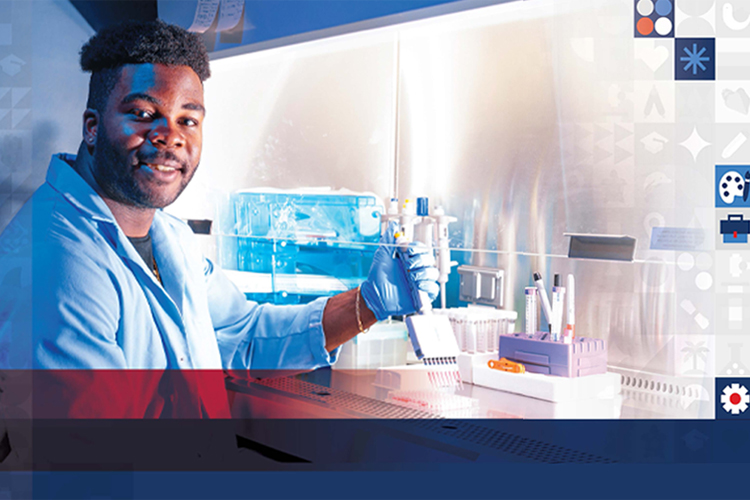
Florida Atlantic's robust graduate programs also play a crucial role in supporting the research enterprise, cultivating a skilled workforce and nurturing the next generation of researchers. Students benefit immensely from unique research opportunities and internships, immersing themselves in a rich academic environment that encourages exploration and discovery. Research laboratories benefit from talented graduate student assistance in the discovery process.
"Ultimately, the R1 designation empowers Florida Atlantic to address pressing societal issues head-on, contributing to advances in health, technology and policy," said Gregg Fields, Ph.D., vice president for research at Florida Atlantic. "This alignment with societal needs enhances the University's mission and reinforces its commitment to making a meaningful impact on the world. In this way, the R1 status is beyond an accolade; it's a vital tool for driving progress."
RESEARCH PIONEERS
Florida Atlantic's ascent to the R1 designation reflects the vision and groundbreaking achievements of its pioneering researchers across diverse disciplines. Among the most notable is the late William "Bill" Glenn, Ph.D., whose revolutionary advancements in high-resolution imaging earned him 137 U.S. patents and an Emmy for the invention of the digital noise reducer.
The late Edwin Link, Ph.D., founder of Harbor Branch Oceanographic Institute, transformed ocean exploration with cutting-edge underwater technologies like submersibles and remotely operated vehicles, setting new standards in marine science. Shirley Pomponi, Ph.D., also played a pivotal role in advancing marine science and ocean exploration, serving on national advisory panels that influenced congressional funding for critical research.
Other Florida Atlantic Harbor Branch researchers, such as Brian Lapointe, Ph.D., and John Reed, Ph.D., have made significant contributions to marine science, from addressing nutrient pollution's effects on coral reefs to spearheading coral restoration efforts.
In health care, Charles H. Hennekens, M.D., made monumental contributions to cardiovascular research, demonstrating the life-saving potential of aspirin in preventing heart attacks and strokes, a discovery credited with saving more than 1 million lives worldwide.
Anne Boykin, Ph.D., the inaugural dean of Florida Atlantic's Christine E. Lynn College of Nursing, revolutionized nursing education through her holistic approach, emphasizing caring as a central tenet of the nursing profession.
In neuroscience, Randy Blakely, Ph.D., has been a leader in understanding brain function and earning recognition as a global neuroscience educator; and J. A. Scott Kelso, Ph.D., has made groundbreaking contributions on coordination dynamics that significantly advanced our understanding of complex systems.
Trailblazers such as Taghi Khoshgoftaar, Ph.D., director of Florida Atlantic's Data Mining and Machine Learning Lab, have cemented the University's reputation in artificial intelligence (AI), becoming one of the nation's most highly cited researchers in computer science. Leonard Berry, Ph.D., was instrumental in climate change advocacy, providing critical testimony on sea-level rise before the U.S. Senate.
Additional luminaries include Isaac Elishakoff, Ph.D., an international authority in structural mechanics and composite materials, and Richard Shusterman, Ph.D., founder of the field of somaesthetics.
Through the extraordinary efforts of these visionaries and many others, Florida Atlantic has laid a strong foundation for excellence, propelling its rise to R1 status. Their collective impact continues to position it as a leader in research, innovation and interdisciplinary collaboration, addressing some of the world's most pressing challenges across science, health, technology and the humanities.
HALL OF INNOVATION
Florida Atlantic has cultivated a legacy of distinguished alumni who have made remarkable contributions across a wide range of industries, shaping the future of science, technology, space exploration, health and beyond. Among these trailblazers is Steve Swanson, Ph.D., a NASA astronaut who flew on the Space Shuttle Atlantis in 2007 and Discovery in 2009, as well as the Russian Soyuz TMA-12M in 2014, representing the University's commitment to advancing space exploration and innovation.
Nicole Cummings exemplifies the University's influence in aerospace engineering, overseeing NASA's Artemis program, which aims to land the first woman and first person of color on the moon. Morgan Cable, Ph.D., a research scientist at NASA's Jet Propulsion Laboratory, has played key roles in iconic missions like Cassini, Europa Clipper and Mars Perseverance. And Christopher McKay, Ph.D., a planetary scientist at NASA's Ames Research Center, has led pioneering studies on astrobiology and the potential for life on Mars - further cementing Florida Atlantic's impact on space exploration.
In the technology sector, Florida Atlantic alumni have driven innovation that shapes modern life. Jimmy Clidaras, founder of Google's Data Center R&D teams, has revolutionized cloud computing infrastructure; while Mark Dean, Ph.D., an inventor of the IBM PC and holder of multiple revolutionary patents, transformed consumer computing forever.
In the realm of cybersecurity and digital communication, Phil Zimmermann, a Florida Atlantic computer science graduate, changed the way the world protects its data by creating Pretty Good Privacy, the most widely used email encryption software globally. His work laid the foundation for secure digital communication in an increasingly connected world.
In health and wellness, Florida Atlantic alumni have left an indelible mark. Richard DiMarchi, Ph.D., was honored with the American Association for the Advancement of Science's prestigious 2023 Mani L. Bhaumik Breakthrough of the Year Award for his transformative work in obesity treatment. Hannah Herbst, a Forbes 30 Under 30 honoree and America's Top Young Scientist, created an innovative automated tourniquet device to save lives during trauma emergencies, embodying the University's spirit of problem solving and compassion. Maria Jasin, Ph.D., a renowned cancer researcher at Memorial Sloan Kettering and recipient of the Shaw Prize in Life Science and Medicine, has made groundbreaking contributions to the field of genetics and tumor suppressor genes.
Florida Atlantic alumni also have made strides in renewable energy and sustainability. Sue Skemp, a mechanical engineering leader, returned to her alma mater to develop ocean energy technologies, advancing the field of renewable, clean energy solutions. From space exploration and advanced technology to lifesaving medical innovation and environmental sustainability researchers and entrepreneurs who drive meaningful change. Through their profound contributions, Florida Atlantic alumni continue to elevate the University's global reputation as a hub of excellence, innovation and societal impact.
EYE ON THE FUTURE
Looking toward the future, Florida Atlantic is focused on expanding its graduate programs in key areas such as biotechnology, AI, cybersecurity and marine sciences. The University is committed to fostering interdisciplinary collaboration, ensuring that students and faculty members work across departments to drive innovation. To support this growth, Florida Atlantic plans to enhance its research infrastructure, investing in state-of-the-art laboratories, specialized centers and advanced technology to facilitate cutting-edge research in various fields such as life sciences, engineering and smart health. Collaboration will remain a cornerstone of Florida Atlantic's development, with established partnerships like those with the Max Planck Florida Institute for Neuroscience, Memorial Healthcare, Florida Power & Light and many others - and is expected to grow even stronger. The University also is committed to expanding its global reach, building international research partnerships and providing students with opportunities for global engagement.
As it continues its growth, Florida Atlantic is positioned to become a key player in addressing critical challenges, such as climate change, health care and technological innovation, further solidifying its status as a leader in higher education and research.
"At Florida Atlantic, we are not just building a university - we are shaping a future where discovery knows no boundaries, collaboration drives innovation, and education transforms lives," Fields said. "The challenges we face today demand bold solutions, and Florida Atlantic is prepared to lead the way."
For more information, email dorcommunications@fau.edu to connect with the Research Communication team.