Fall 2025
Florida Atlantic: Once Bitten
Florida Atlantic Researchers Advance Shark Discoveries
In the crystal-clear waters off South Florida and the mysterious depths of the open ocean, scientists at Florida Atlantic University are taking a bite out of groundbreaking discoveries with one of nature's most fascinating creatures: the shark.
These researchers are unraveling the secrets of these apex predators — from their migration patterns and deep-sea behavior to their surprising engineering brilliance. Armed with cutting-edge tools like aerial drones, shark-mounted sensors, genetic analysis and powerful synchrotron X-ray nanotomography, their expertise and relentless curiosity are reshaping how we understand, protect and coexist with these critically important animals.
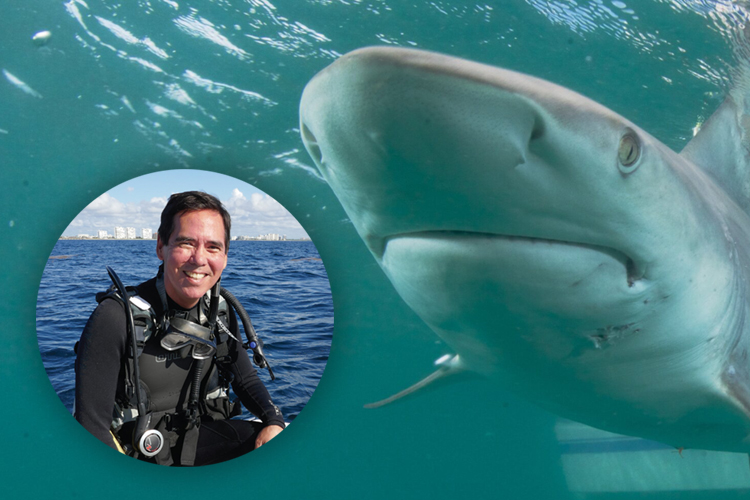
In a quiet, landlocked town of just 4,000 residents in Ontario, Canada, Stephen Kajiura, Ph.D., didn't have the ocean outside his window when he was a child — but he had it in his imagination. Long before he ever set foot in the ocean, he was already mentally diving into the depths, obsessed with marine life — and sharks in particular.
He spent hours at the local library poring over every book on marine life that he could find, mesmerized by the "alien" world that existed far beyond his snowy hometown. Sunday afternoons were reserved for Jacques Cousteau documentaries, which deepened his captivation with the ocean.
That childhood curiosity became a lifelong pursuit. Today, Kajiura is not only one of the world's foremost shark experts but also the director of the Florida Atlantic's Elasmobranch Research Laboratory. The lab focuses on how sensory systems, behavior and body structure are connected, using behavioral tests, fieldwork and anatomy comparisons to explore how these traits evolve in sharks and rays.
"I remember being fascinated by the 'shovelhead' shark, which I later learned was a bonnethead shark — the smallest member of the hammerhead family," said Kajiura, who is also a professor of biological sciences in the Charles E. Schmidt College of Science. "Even as a kid, I was drawn to their uniqueness — the odd shape of their heads. I just couldn't believe such a strange shark existed."
Kajiura's research also includes studying local shark and ray populations using aerial surveys, telemetry, drones and underwater video. His decades of work have left a lasting impact on marine biology — and reached audiences around the world.
From Quarry Dives to Coral Reefs
Kajiura's academic journey began at the University of Guelph in Ontario, where he earned a degree in marine biology — a somewhat unconventional choice for someone who had yet to see the ocean.
"My parents were supportive of my decision to study marine biology but understandably skeptical," Kajiura said. "They asked, 'What kind of job can you get with that degree?' But I knew it was what I wanted to do. I didn't have a plan B."
After earning his bachelor's degree in marine biology, he took a detour through the Florida Keys, working at a wholesale tropical fish supplier while gaining hands-on experience in animal husbandry. He also enjoyed scuba diving in warm, tropical waters; a far cry from his first dive certification training in an icy, abandoned quarry back in Ontario.
"I suddenly found myself diving in an underwater tropical paradise every weekend," he said. "It was a completely different world from where I first learned to dive — where it was rare to even see a fish in the cold, murky water. Diving on the coral reefs and seeing living examples of the different marine species that I had learned about really cemented the theoretical knowledge I had gained as an undergraduate."
Kajiura went on to earn his master's degree from Florida Institute of Technology and fulfilled a lifelong dream by completing his doctorate at the University of Hawaii, where he focused his research on hammerhead sharks. He then conducted his postdoctoral research at the University of California – Irvine before coming to Florida Atlantic.
"Living and studying in Hawaii was an unforgettable experience," Kajiura said. "I made it a point to take one day off each week to hike, dive and simply enjoy life. It's a practice I still recommend to my students today: maintaining balance is essential."
Unexpected Discovery in the Deep
It was during those graduate years that Kajiura began work on a project that would take nearly two decades to fully come to light: the unexpected discovery of a new species of deep-sea lanternshark, now officially named Etmopterus lailae.
"There are only about 500 known species of sharks worldwide, so discovering a new one is very exciting," Kajiura said. "What made it even more exciting was that we didn't initially realize we had found something new. It was only when we submitted our manuscript to a journal that a reviewer pointed out that some of the anatomical differences we noted warranted a closer look at some of the specimens."
Discovered 1,000 feet below the surface off the Northwestern Hawaiian Islands, Etmopterus lailae is a miniature marvel. This bioluminescent shark glows in the dark and is barely a foot long when fully grown. Its glowing belly and tail provide a pattern specific to that species, which may allow it to find mates in the perpetual darkness of the deep sea.
"What really sets this species apart is its unusual head shape and large, bulging snout," Kajiura said. "In an environment with almost no light, that big sniffer helps them locate prey in a cold, dark, featureless expanse."
Additional distinctions include unique glowing markings on the flanks and belly, a naked patch of skin under its snout with no scales, a different number of vertebrae, and fewer teeth than its closest relatives.
"There were enough anatomical differences that it justified classification as a new species," Kajiura said. "Finding these specimens in the deep sea is like finding a needle in a haystack in the middle of the ocean."
Tracking the Blacktips
Since joining the Florida Atlantic faculty in 2004, Kajiura has focused much of his research on the blacktip shark — a species that, unlike the elusive lanternshark, travels in massive, visible groups along Florida's east coast each winter.
Blacktip sharks are sleek, fast predators known for their iconic, black-tipped fins and lightning-fast bursts of speed. Growing up to 6 feet long, they patrol warm, shallow coastal waters in oceans around the world — true masters of the coastal hunt.
"Blacktip sharks are like snowbirds," Kajiura said. "When water temperatures drop below 71 degrees up north, they head south to places like Palm Beach County. And when things start to warm up in the spring, they go back."
For nearly 15 years, Kajiura has been tracking this migration using cutting-edge technology. His tools include everything from fixed-wing aircraft and aerial drones to GPS trackers and GoPro camera tags. The aerial approach is especially valuable in South Florida, where clear water makes shark spotting relatively easy from the air.
"We fly at about 500 feet above the water, going roughly 90 miles per hour, and we can cover a 650-foot-wide strip along the shoreline," Kajiura said. "We record high-resolution video and bring it back to the lab, where my team manually counts each shark — often just black dots on a screen. One of my graduate students has counted more than 100,000 sharks. That's dedication!"
But the work isn't just about counting fins. It's about understanding how climate change could alter migration patterns — and what that means for marine ecosystems.
"These sharks play a crucial role in maintaining ocean health," Kajiura said. "They act like custodians, weeding out sick or weak fish and keeping reef populations in balance. If rising temperatures cause them to skip South Florida altogether, the ecological consequences could be severe."
Shark Meets Shark
One of Kajiura's most thrilling and unexpected discoveries came earlier this year, when a nurse shark equipped with a camera tag recorded a surprise guest: a great white shark, estimated to be at least 10 feet long, in South Florida waters.
"We've tagged dozens of sharks over the years with these camera tags, which collect both video and 3D acceleration data, which is similar to the step-counting feature on your smartphone," Kajiura said. "But this time, we got something truly remarkable."
The nurse shark had been swimming near the Donny Boy Slipe Reef, an artificial reef made of 830 tons of limestone boulders off Boynton Beach. The footage it captured showed a four-minute interaction with a great white shark — an exceedingly rare sight in South Florida.
"It was a classic photobomb," Kajiura said. "While divers have occasionally reported seeing great whites in the area, this gave us a rare 'shark's-eye view' of that encounter. It was like nothing we've captured before."
As exciting as the footage was, retrieving the tag itself proved to be almost as lucky as the footage it captured. When the device failed to send its expected location ping, the team feared it was lost forever.
Then, four days later, an unanticipated ping came through, revealing the tag's location. It had washed ashore at the Gulfstream Golf Club in Delray Beach. Kajiura found the tag package amidst seaweed on the beach and just inches away from the fresh tracks of a large beach tractor.
"We rushed there and found the tag in a pile of seaweed," Kajiura said. "We were incredibly lucky that it didn't get run over and crushed."
Among the research team was Genevieve Sylvester, a master's student in the FAU Elasmo Lab.
"What we captured on that footage was a completely unexpected surprise," Sylvester said. "We were all huddled around my computer, reviewing the footage. When we saw the great white shark appear — more than once — we couldn't believe it. To witness it from the shark's point of view made it even more surreal. It was a truly an unforgettable moment for our entire team."
Kajiura has received long-term support for his research from the Colgan Foundation, a not-for-profit corporation founded by Sean P. Colgan to benefit athletic, scientific, environmental and education communities.
Lights, Camera, SharkFest
Kajiura's work isn't confined to labs and field surveys — it's also captured the attention of millions of viewers around the world. He has appeared in dozens of television documentaries about sharks, starting with his time as a graduate student in Hawaii. He has been interviewed for outlets from around the world, including Canada, the United Kingdom, Japan and New Zealand. Kajiura returned to National Geographic's SharkFest this year as a featured expert in "Florida's Bite Capital," an episode in the Investigation Shark Attack series.
The episode explored New Smyrna Beach — dubbed the shark bite capital of the world — and dove into why shark-human encounters happen there more than anywhere else.
"We're not here to scare people," Kajiura said. "We're here to understand shark behavior and use that knowledge to reduce risk. Science can offer real solutions."
His approach blends forensic analysis with high-tech fieldwork, providing a rare science-first lens on these complex interactions. With underwater sensors, drones and expert panels, the show investigated every angle — literally and figuratively.
"The more the public understands about sharks, the less they fear them irrationally," Kajiura said. "Sharks have long been misunderstood and unfairly portrayed as mindless killers, but learning about their behavior, ecology and vital role in marine ecosystems helps change that perception. When people see sharks as important contributors rather than threats, it builds support for protecting them. That kind of awareness is crucial for effective conservation efforts."
Passing the Torch
Kajiura's passion for the ocean is already inspiring the next generation at home. His 11-year-old son, Brian, recently earned his scuba certification and often joins the family on dives, exploring the underwater world firsthand.
"He's really into chemistry right now," Kajiura said. "But growing up surrounded by sharks and the ocean, who knows where his interests might lead. Whatever path he chooses, we'll support him 100%."
The family's commitment to marine science runs deep. Kajiura's wife, Marianne Porter, Ph.D., is an associate professor in Florida Atlantic's Charles E. Schmidt College of Science and a seasoned marine biologist also specializing in shark research. Together, they've built a household firmly anchored in science — and saltwater — where curiosity about the natural world is a shared legacy and a constant source of inspiration.
The Road Ahead
As climate change accelerates and ocean ecosystems face unprecedented challenges, Kajiura's work has never been more critical. His team is gearing up to expand shark-tagging programs, enhance aerial surveys, and delve deeper into how these apex predators respond to shifting environmental pressures like warming waters, habitat loss and pollution.
"These animals are sentinels," Kajiura said. "They sense changes in the ocean long before we do. By listening to their signals, we can gain invaluable insights — not just about sharks, but about the health of the entire planet."
From snowy Canadian quarries to tropical reefs, and from discovering glowing deep-sea species to capturing great white photobombs, Kajiura's journey is one of relentless curiosity and innovative science.
"Dr. Kajiura's work is a powerful reminder that sharks are more than just intriguing animals — they're essential to the health and balance of our oceans," said Valery Forbes, Ph.D., dean of the Charles E. Schmidt College of Science. "Beyond his scientific contributions, he's had a profound impact on FAU students — igniting their curiosity, guiding their research and inspiring the next generation of marine scientists. Through both innovation and mentorship, he's helping to shape a more sustainable future for our oceans and those who will protect them for generations to come."
For more information, email dorcommunications@fau.edu to connect with the Research Communication team.

Here's a look at what Stephen Kajiura, Ph.D.'s team uses to study sharks:
- FIXED-WING AIRCRAFT: Flies at 90 miles per hour, 500 feet above the water, covering 650 feet of shoreline to track blacktip migration.
- DRONES AND GOPROS: Provide aerial and underwater perspectives, including rare footage like the 2025 great white shark photobomb.
- CAMERA TAGS: Lightweight, shark-mounted cameras that record 3D acceleration and real-time video from a shark's-eye view.
- TEMPERATURE SENSORS AND GPS TRACKING: Help correlate shark movement with environmental changes, especially ocean warming.