Spring 2025
Florida Atlantic: Mystery Solved
Research Reveals the True Purpose of Narwhal Tusks
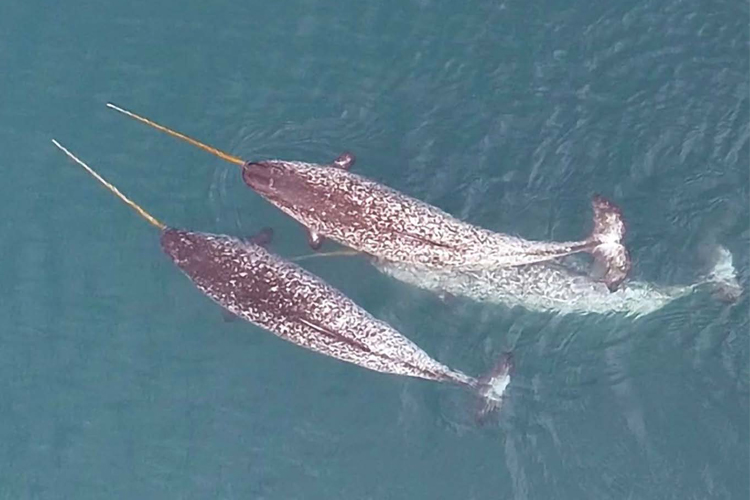
The narwhal, an iconic whale of remote Arctic waters, is widely known for its long, spiral tusk, which is really an elongated tooth. The tusk, which is predominantly found in males and can grow up to 10 feet long, is one of the most fascinating traits in nature and is the inspiration for myths such as the unicorn. While it is believed to play a role in competition for mates, its function is still debated because few people have observed how these elusive animals use their tusks in the wild.
Using drones, researchers from Florida Atlantic University’s Harbor Branch Oceanographic Institute, and Canada’s Department of Fisheries and Oceans, in partnership with Inuit communities in Nunavut in Canada’s High Arctic, provide the first evidence of narwhals using their tusks in the wild to investigate, manipulate and influence the behavior of Arctic char, including delivering enough force with their tusks to stun and possibly kill the fish. Researchers captured 17 distinct behaviors, which shed light on the dynamics between the narwhal, its prey and avian competitors.
Results of the study, published in the journal Frontiers in Marine Science, also reveal the first evidence of likely play in narwhals, as well as other fascinating insights into narwhal behavior, including social learning, and possibly social instruction and personality differences among individual narwhals. These novel findings further enrich our understanding of narwhals’ complex behavior. Findings also provide the first reports of interactions between narwhal, fish and birds, including attempted kleptoparasitism, a “food thief” situation, among narwhals and glaucous gulls.
“Narwhals are known for their ‘tusking’ behavior, where two or more of them simultaneously raise their tusks almost vertically out of the water, crossing them in what may be a ritualistic behavior to assess a potential opponent’s qualities or to display those qualities to potential mates,” said Greg O’Corry-Crowe, Ph.D., senior author, research professor at FAU Harbor Branch and a National Geographic Explorer. “But now we know that narwhal tusks have other uses, some quite unexpected, including foraging, exploration and play.”
For more information, email dorcommunications@fau.edu to connect with the Research Communication team.