Fall 2025
Florida Atlantic: Hooked and Snatched
How Citizen Science is Reeling in Shark Depredation
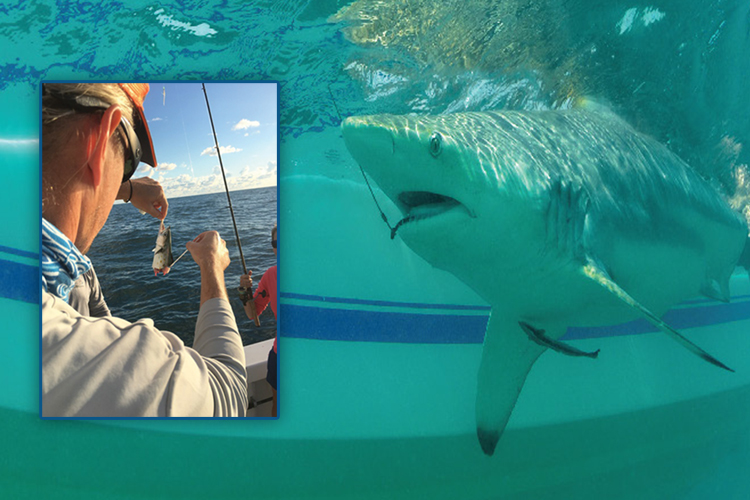
Imagine finally landing the fish of the day — only to have it ripped off your line at the last second by a lurking shark. All that's left is a tattered leader, a severed head, or sometimes, nothing at all. For thousands of Florida anglers, this frustrating scenario has become increasingly common. It's called shark depredation, and it's turning a relaxing day of fishing into a battle of wits with some of the ocean's most cunning predators.
Shark depredation — when a shark steals a hooked fish before it can be reeled in — is more than just a nuisance. It's a growing challenge that affects fish populations, disrupts recreational experiences, and raises questions about how humans and predators share marine resources. In Florida, where saltwater fishing is both an economic driver and a cultural pastime, the issue is especially pressing.
But thanks to researchers from Florida Atlantic's Harbor Branch Oceanographic Institute, the scope — and possible solutions — to this underwater tug-of-war are becoming more understood.
The study, led by Matt Ajemian, Ph.D., associate research professor and director of the Fisheries Ecology and Conservation Lab at FAU Harbor Branch, tapped into an underutilized yet powerful resource: the anglers themselves. Through a combination of social media outreach, online surveys, charter boat collaborations and genetic analysis, the team turned citizen science into a key tool for tracking and understanding shark depredation.
"Our research provides crucial insights into the growing challenge of shark depredation, helping to build a comprehensive understanding of this human-wildlife conflict and how different fishery sectors are being affected by it," Ajemian said.
One of the most innovative aspects of the study involved using Facebook. Researchers monitored posts from the group Sportsmen Fighting for Marine Balance, where more than 6,500 members shared depredation experiences. These real-time reports provided valuable insight into where, when and how depredation is happening. Meanwhile, quarterly surveys sent to thousands of Florida saltwater license holders helped build a broader picture of trends across the state.
But understanding which sharks are responsible is no easy task. Most depredation happens out of sight, deep below the surface. That's where the science got even more creative. Working with local fishing charters, researchers collected DNA samples not just from bite-marked carcasses, but even from the frayed ends of fishing lines — the first time such a technique has been used. Nearly half the line swabs successfully identified shark DNA, a breakthrough in species identification where visual confirmation is nearly impossible.
The results? Bull sharks and sandbar sharks were the most frequently identified culprits, while popular game fish like mutton snapper, red snapper and greater amberjack were among the most common victims. Interestingly, while depredation occurred more often in spring and in hotspots like the Florida Keys and Southeast Florida, the actual rate of catch lost to sharks didn't vary as much — suggesting local factors like depth, habitat and fishing technique may play an even bigger role.
Shark depredation is on the rise in high-shark-density regions around the globe — from Florida to Australia.
"Our findings could help fishery managers in developing informed, science-based strategies to address shark depredation while balancing conservation and recreational fishing interests," Ajemian said.
For now, Florida anglers may still lose the occasional fish to a shark's sneaky ambush. But thanks to this groundbreaking work, the gap between frustration and understanding is narrowing — and the tug-of-war between angler and apex predator is finally getting the scientific attention it deserves.
For more information, email dorcommunications@fau.edu to connect with the Research Communication team.