Spring 2025
Florida Atlantic: From Campus to Catching Critters
College of Business Alumnus Tackles Florida’s Iguana Invasion
Florida Atlantic University alumnus Pierce Kennamer grew up in Cincinnati, but he spent summers visiting his grandparents in Fort Lauderdale. With each summer visit, he’d see more and more green iguanas, an invasive, non-native species in the Sunshine State.
By the time he started at Florida Atlantic in 2019, the area was overrun by iguanas wreaking havoc on homes, businesses and power grids. They were an economic problem and an environmental one, he said.
After graduating from Florida Atlantic in May 2023 with a bachelor’s degree in finance and a minor in cybersecurity, Kennamer, now 24, decided to invent a sustainable solution to gain control of the invasion — humanely.
“Many companies offer some solutions to help keep the lizards at bay. For many years, there wasn’t a sustainable, humane solution on the market that could get the population under control in a timely fashion,” Kennamer said. “For many larger properties, the only thing that existed was raccoon traps, where you could only obtain one at a time, and it might not trap the targeted species. The market needed a company that could build something specifically tailored to capturing iguanas.”
It was then that the patented technology and his current company, IggyTrap, was born.
Trap Technology
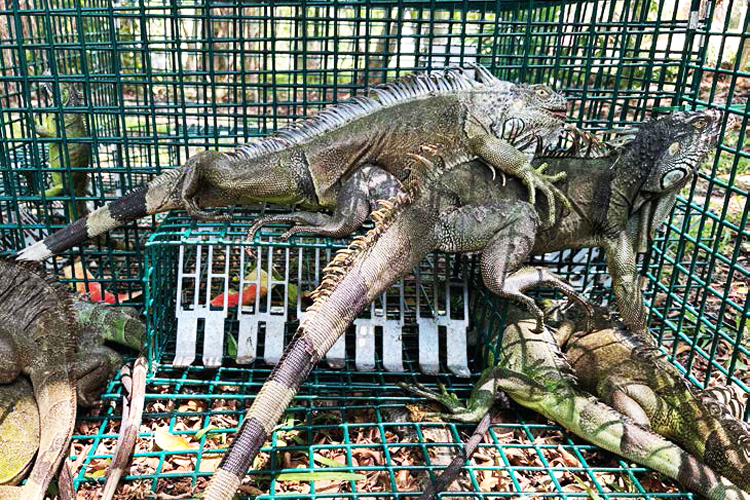
IggyTraps for commercial use are 48 by 84 inches, while residential traps are 48 by 48 inches. Each trap has fresh fruit hanging inside. The smell attracts the iguanas, prompting them to walk through a one-way door. The door shuts behind them using just its weight, mimicking what iguanas feel as they push through a bush or pass through the branches of a tree. They slide in on their bellies and once in, they’re trapped.
IggyTraps are the only traps on the market that allow “non-target” animals to escape, while keeping the iguanas inside. This includes smaller rodents and native snakes and lizards. The door design, which took more than 1,000 hours to complete, also allows animals with more arm mobility, like raccoons, to escape.
IggyTrap can catch up to 25 iguanas at one time, setting it apart from many solutions on the market. IggyTraps are larger than most single animal traps and allow the iguanas to move around so they don’t feel as confined in the space. With food and water inside the traps, the animals are later removed to be humanely euthanized, under Florida state law.
IggyTrap’s Trajectory
Since its inception, IggyTrap has seen a growth and diversification in the customer base, including golf courses, homeowner associations, farms, residential properties, hotels and resorts, and utility and electricity providers.
“Our employees are seeing new challenges daily with the iguana population,” Kennamer said.
One challenge he hopes IggyTrap will help solve is crop loss at fruit farms in the Miami area. According to Kennamer, iguanas have caused extensive crop damage, as many eat the tiny flowers that need to be pollinated to further fruit growth.
“The problem needed a solution that could capture as many as possible most efficiently while also being scalable to fit different properties and environments,” Kennamer said.
Two years after launching IggyTrap, Kennamer has secured the attention of the Florida Fish and Wildlife Conservation Commission, opened a full-scale office in Deerfield Beach, and hired full- and part-time employees, many of them from the Florida Atlantic ecosystem.
Kennamer credits his classes at the College of Business with providing him with the tools to manage the company’s finances and take it to market, as well as with the overall support he still receives from the college’s community.
“It gave me a leg up in terms of getting the business started. Dean Gropper gave a tremendous amount of moral support when I shared with him what I was doing upon graduation,” Kennamer said. “Running a startup means doing everything from marketing, accounting and everything else that comes with balancing day-to-day operations. The College of Business and my professors helped prepare me immensely for all these different areas that come with running a business.”
Kennamer said the next step for IggyTrap is to roll out more products to help tackle invasive species. He also plans to open offices in Monroe County and outside of the United States to establish the company as the premier provider for invasive species technology worldwide.
“We are constantly pushing growth and are excited to see where we can take these products,” he said.
For more information, email dorcommunications@fau.edu to connect with the Research Communication team.

Adult iguanas have few natural predators in Florida and generally live up to 15 years. They lay 10 to 70 eggs at a time and only take two to three months to reach full maturity.
As an invasive species, iguanas pose serious risks to homeowners, businesses and the ecological ecosystem in Florida; and many cities have spent millions of dollars to offset damage caused by them. For example, West Palm Beach spent $2 million in January 2020 to repair damage to an aging dam caused by iguanas, and Lake Worth Beach attributed multiple power outages over the years to iguanas settling into the power grids.