Spring 2025
Florida Atlantic: Feet First
How AI is Unlocking the Secrets of Infant Interaction
Advances in artificial intelligence and motion analysis are providing groundbreaking insights into how infants transition from random movements to intentional actions. Researchers at Florida Atlantic University used AI to analyze infant behavior, revealing new details about how babies learn to interact with their environment.
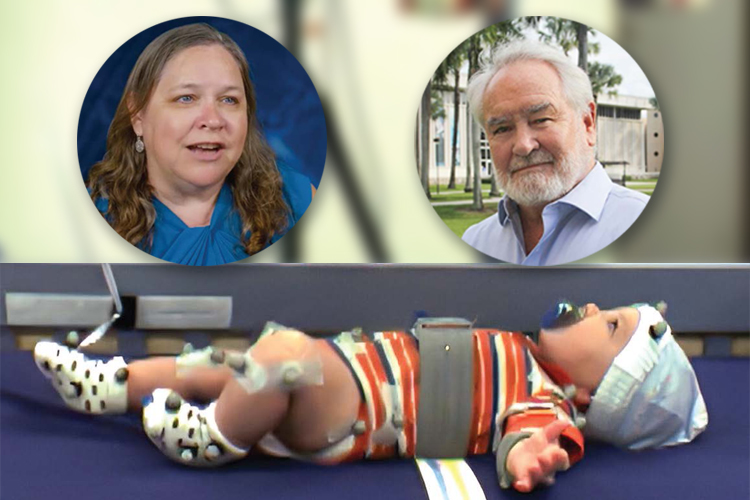
The study, published in Scientific Reports, builds on the classic baby-mobile experiment first introduced in the late 1960s. In this setup, a colorful mobile is tethered to an infant’s foot. When the baby kicks, the mobile moves, teaching the infant that their actions can influence their surroundings. This simple yet powerful method offers a glimpse into how infants develop purposeful control over their movements.
Florida Atlantic researchers employed a Vicon 3D motion capture system to track infant movements during their experiment. By applying machine learning and deep learning techniques, they analyzed changes in movement patterns across different stages of the experiment, classifying five- second clips of motion data.
Deep learning demonstrated exceptional accuracy in detecting the nuances of infant behavior, especially in foot movements.
“This finding is significant because the AI systems were not told anything about the experiment or which part of the infant’s body was connected to the mobile,” said Scott Kelso, Ph.D., co-author and Glenwood and Martha Creech Eminent Scholar in Science at the Center for Complex Systems and Brain Sciences in Florida Atlantic’s Charles E. Schmidt College of Science. “What this shows is that the feet — as end effectors — are the most affected by the interaction with the mobile. In other words, the way infants connect with their environment has the biggest impact at the points of contact with the world. Here, this was ‘feet first.’”
The deep-learning model achieved 86% accuracy in analyzing foot movements, outperforming analysis of hands, knees or whole-body movements. Notably, foot movements displayed accuracy rates approximately 20% higher than other body parts, underscoring their critical role in early interactions.
The experiment revealed intriguing behavioral patterns. After the mobile was disconnected, infants displayed increased exploratory movements, suggesting an eagerness to reconnect with their environment.
“We found that infants explored more after being disconnected from the mobile than they did before they had the chance to control it,” said Aliza Sloan, Ph.D., a postdoctoral research scientist in the Schmidt College of Science. “However, some infants showed movement patterns during this disconnected phase that contained hints of their earlier interactions with the mobile. This suggests that only certain infants understood their relationship with the mobile well enough to maintain those movement patterns, expecting that they would still produce a response from the mobile even after being disconnected.”
Researchers emphasized the challenge of studying infant behavior, as infants cannot communicate their experiences verbally.
“AI can help researchers analyze subtle changes in infant movements, and even their stillness, to give us insights into how they think and learn, even before they can speak,” said Nancy Aaron Jones, Ph.D., co-author and professor in Florida Atlantic’s Department of Psychology. “Their movements also can help us make sense of the vast degree of individual variation that occurs as infants develop.”
This study marks a step forward in using AI to explore infant development. By leveraging the capabilities of AI, researchers are gaining deeper insights into the earliest stages of human interaction, opening doors to more effective approaches in developmental science and early interventions.
For more information, email dorcommunications@fau.edu to connect with the Research Communication team.