12/4/2025
Drone Reveals Loggerhead Nesting Preferences
Drones map Boca Raton beach, finding areas key to loggerhead sea turtle nest success.
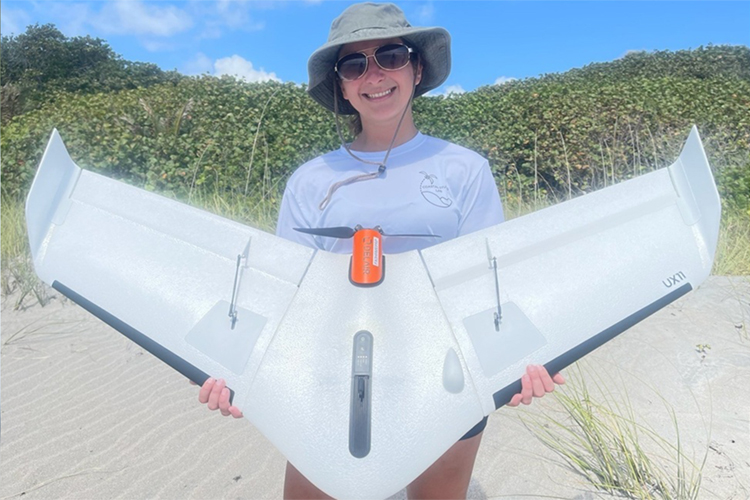
Researchers from the Charles E. Schmidt College of Science used drones and field surveys to study how environmental and human factors affect loggerhead sea turtle nest site selection on a high-density beach in Boca Raton. The team looked at beach slope, sand texture, and proximity to structures like dune stairs – wooden stairways that let people safely cross sand dunes without damaging them. Understanding these factors is important because where turtles nest directly affects hatchling survival and sex ratios.
The study found that successful nests were more likely on steeper parts of the beach and farther from dune stairs, while false crawls – when sea turtles come ashore but do not lay eggs – were more common in flatter areas or near stairs. These findings give researchers new tools for monitoring nesting activity and help guide efforts to protect Florida’s critical sea turtle habitats.
“This research really demonstrates how new technology can deepen our understanding of natural processes,” said Tiffany Roberts Briggs, Ph.D., co-author and chair of FAU’s Department of Geosciences. “By combining drone-based mapping with on-the-ground data collection, our team has revealed how even small variations in beach shape or the presence of human structures can influence whether a sea turtle successfully nests. These findings are not just important for science – they directly inform how we manage and protect Florida’s beaches for generations to come.”