9/12/2025
Bend, Twist, Grasp, Curl, Roll
FAU Study Reveals Arm Action of Octopuses in the Wild
Octopuses are known for their intelligence and dexterity but, until now, little was known about how they use their eight arms in the wild.
A new study from Florida Atlantic University’s Charles E. Schmidt College of Science, in collaboration with the Marine Biological Laboratory in Woods Hole, offers the most detailed look yet at how octopuses move across different habitats.
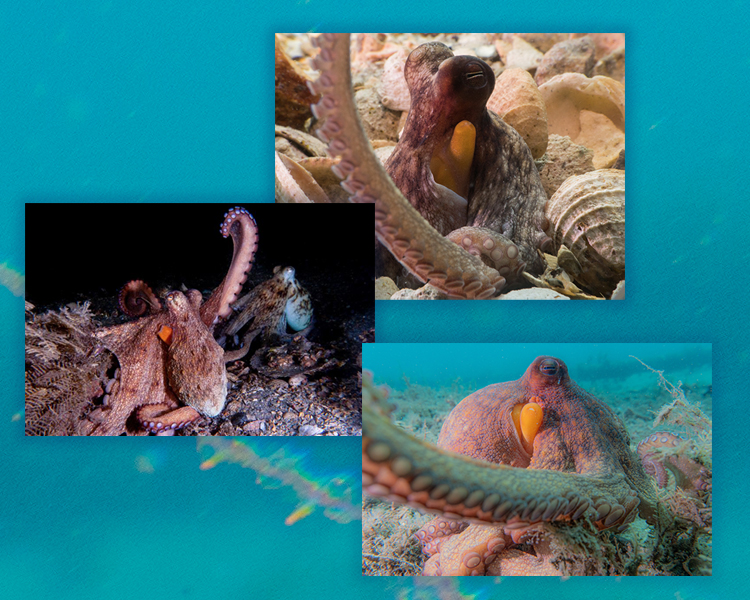
Analyzing nearly 4,000 arm movements from three species in the Caribbean and Spain, researchers documented 12 distinct arm actions tied to 15 whole-body behaviors. They found that while every arm can perform all actions, there is a clear division of labor: front arms often explore and manipulate objects, while back arms primarily aid in locomotion.
“Observing them in the wild, we saw octopuses use different combinations of arm actions – sometimes just one arm for tasks like grabbing food, and other times multiple arms working together for behaviors like crawling or launching a parachute attack – a hunting technique they use to catch prey,” said Chelsea O. Bennice, Ph.D., lead author and postdoctoral fellow at FAU’s Marine Laboratory.
The study also showed that arms can bend, elongate, shorten and twist in highly coordinated ways, with different regions of each arm specializing in certain movements. These complex abilities not only help octopuses capture prey, escape predators and compete for mates but also highlight why they are among the most adaptable animals in the ocean.
“Understanding these natural behaviors not only deepens our knowledge of octopus biology but also opens exciting new avenues in fields like neuroscience, animal behavior, and even soft robotics inspired by these remarkable creatures,” Bennice said.