Fall 2025
Florida Atlantic: AI on the Move
How Your Eyes Could Help Diagnose Dizziness from Home
Imagine diagnosing a balance disorder using nothing more than your smartphone. That's the future being shaped by Florida Atlantic University researchers who developed a deep learning tool capable of detecting nystagmus — a condition marked by involuntary eye movements often linked to neurological or vestibular disorders.
Traditionally, detecting nystagmus requires expensive and bulky equipment like videonystagmography, which can cost nearly $100,000 and demand in-clinic visits. FAU's new AI-based system offers a portable, affordable and remote alternative. Patients simply record a video of their eyes on a smartphone, upload it to a secure cloud platform, and receive expert analysis — all from home.
"Our AI model offers a promising tool that can partially supplement — or, in some cases, replace – conventional diagnostic methods, especially in telehealth environments where access to specialized care is limited," said Ali Danesh, Ph.D., principal investigator, professor in the College of Education and professor of biomedical science in the Charles E. Schmidt College of Medicine. "By integrating deep learning, cloud computing and telemedicine, we're making diagnosis more flexible, affordable and accessible — particularly for low-income rural and remote communities."
The team's pilot study involved 20 participants and showed that their system's diagnostic accuracy closely mirrors that of standard clinical devices. The secret lies in a smart algorithm trained on more than 15,000 video frames and designed to track 468 facial landmarks in real time.
It calculates slow-phase velocity — a key sign of nystagmus — and produces clean, readable graphs for clinicians to interpret via telehealth.
The technology goes beyond just diagnosis. By integrating with electronic health records, it enables physicians to develop personalized treatment plans, monitor progress over time, and minimize unnecessary in-person visits. Built-in filtering even eliminates errors caused by blinking or facial movement, making the readings more reliable.
"While still in its early stages, our technology holds the potential to transform care for patients with vestibular and neurological disorders," said Harshal Sanghvi, Ph.D., the study's first author and postdoctoral fellow in the Charles E. Schmidt College of Medicine and College of Business. "With its ability to provide non-invasive, real-time analysis, our platform could be deployed widely — in clinics, emergency rooms, audiology centers and even at home."
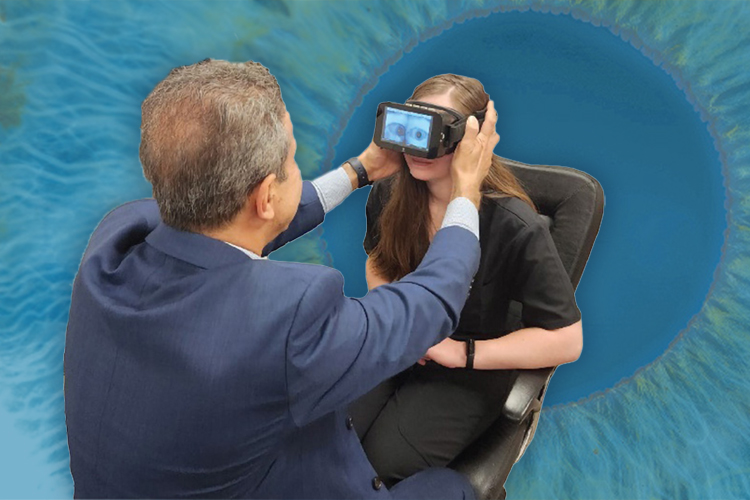
The interdisciplinary initiative includes several academic and clinical research collaborators. The team also is testing a wearable headset version of the system to capture live data in real-world conditions.
"As telemedicine becomes an increasingly integral part of health care delivery, AI-powered diagnostic tools like this one are poised to improve early detection, streamline specialist referrals, and reduce the burden on health care providers," Danesh said. "Ultimately, this innovation promises better outcomes for patients — regardless of where they live."
For more information, email dorcommunications@fau.edu to connect with the Research Communication team.