Fall 2025
Florida Atlantic: AI, AMBITION AND ADVOCACY
One Student’s Bold Path in STEM
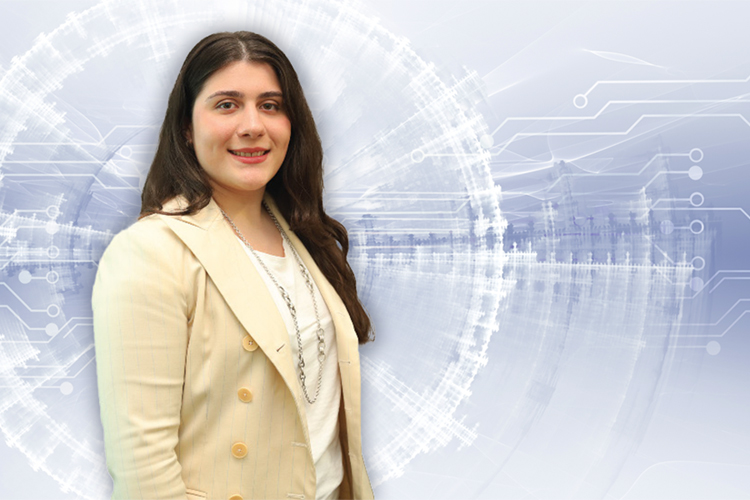
Paulina DeVito has already earned two bachelor’s degrees, a master’s and a spot in one of the country’s most prestigious research fellowships. But at 22 years old, her journey isn’t just about academic milestones — it’s about a clear vision: using artificial intelligence to make education more accessible and empowering.
DeVito, a doctoral student at Florida Atlantic’s College of Engineering and Computer Science, was awarded the National Science Foundation Graduate Research Fellowship, a highly competitive honor that recognizes top graduate students in STEM. The fellowship includes three years of financial support, including a $37,000 annual stipend and funding for tuition.
“I am both honored and humbled to receive this fellowship,” DeVito said. “This award is a validation of the vision I’ve carried since I first stepped onto FAU’s campus when I was 16. It not only affirms my commitment to advancing artificial intelligence and natural language processing research but also my deep passion for education in STEM. Impactful research is not limited by age or background, and young women, especially in tech, have a powerful voice in shaping the future.”
A graduate of A.D. Henderson University School and FAU High School, DeVito fast-tracked her academic career through Florida Atlantic’s dual enrollment program. By age 20, she had earned degrees in both computer science and computer engineering — graduating with the highest GPA in her class. She completed her master’s in computer science with a minor in AI in just one year, finishing with a perfect 4.0.
Her doctoral research focuses on how public discourse — particularly on social media — reflects evolving attitudes toward generative AI in education. By combining natural language processing with large language models, DeVito studies platforms like Reddit and other social spaces to better understand how students and educators interact with AI.
“Paulina is one of the most driven and forward-thinking researchers I’ve had the pleasure of working with,” said Hari Kalva, Ph.D., professor and chair of the Department of Electrical Engineering and Computer Science in the College of Engineering and Computer Science. “Her work touches on an area of critical national importance: how to use AI to improve learning outcomes and enhance educational environments for a wider spectrum of students.”
As part of her NSF fellowship, DeVito will expand her research to analyze social media posts by and for young women in STEM, including content under hashtags like #WomenInSTEM. Her goal is to extract themes and engagement patterns that can inform AI-driven educational tools tailored to support various groups.
"My long-term goal is to become a professor and lead a research lab focused on advancing AI and natural language processing in education," DeVito said. "I believe generative AI has the potential to enhance how we teach and learn, and I hope to contribute to its responsible development and meaningful application in education."
Her early research contributions include an NSF-funded study with Kalva and Hanqi Zhuang, Ph.D., associate dean and professor in the Department of Electrical Engineering and Computer Science, analyzing nearly 15,000 Reddit posts about generative AI in education. The study uncovered widespread student concerns over inaccurate AI-based plagiarism detection and the emotional impact of false accusations — insights that have been shared at academic conferences and policy discussions.
“Paulina’s natural talent for research became apparent early on during our NSF-funded study,” Zhuang said. “Her ability to navigate complex data and draw meaningful insights stood out, and I’m excited to see her pursue a Ph.D. in the critical and rapidly evolving field of AI in education.”
With her rare combination of intellect, drive and empathy, DeVito is redefining what it means to lead in STEM — and reminding the world that the future of innovation is not only smart, but inclusive.
For more information, email dorcommunications@fau.edu to connect with the Research Communication team.