Spring 2025
Florida Atlantic: A Step Forward in Alzheimer’s Research
Advanced Tools Increase Understanding of Cholesterol’s Impact
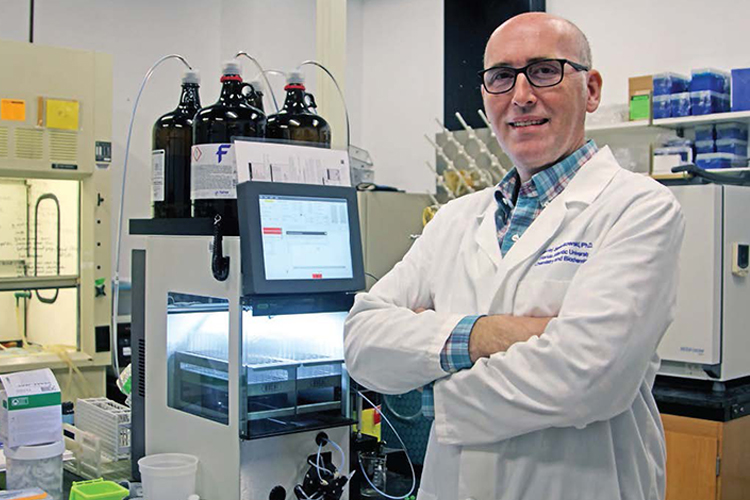
The search for answers to Alzheimer’s disease and other neurodegenerative disorders remains one of the most pressing goals in brain research. Maciej J. Stawikowski, Ph.D., an assistant professor of chemistry and biochemistry in Florida Atlantic University’s Charles E. Schmidt College of Science, believes the key may lie in understanding how cholesterol and other lipids move through cells and affect their communication.
“It’s well known that lipids and Alzheimer’s are linked,” said Stawikowski, a member of the Florida Atlantic Stiles-Nicholson Brain Institute. “Lipid imbalance may lead to amyloid plaque formation – oversized protein clumps that disrupt cell function, a hallmark of Alzheimer’s.”
Stawikowski’s team, including Qi Zhang, Ph.D., an associate professor in the Department of Chemistry and Biochemistry and a member of the Stiles-Nicholson Brain Institute, has focused on developing advanced tools to investigate the relationship between lipids and cellular function.
Cholesterol is a crucial component of cellular membranes, enabling hormone production, membrane stability and signaling. However, disruptions in cholesterol movement between cell compartments may play a role in Alzheimer’s and other neurodegenerative diseases. To study this, Stawikowski and his team developed innovative fluorescent probes to enhance understanding of how cholesterol imbalances contribute to Alzheimer’s disease and other neurodegenerative disorders. This, in turn, could help researchers develop drugs to modulate lipid activity, potentially leading to new treatments or preventive strategies.
The research team’s fluorescent cholesterol probes offer applications beyond Alzheimer’s, with potential uses in membrane biology, lipid dynamics and drug delivery. By combining experimental techniques with computer simulations, the Florida Atlantic team has laid the foundation for developing better tools that can be used to study a wide range of lipid-related disorders.
“Cholesterol is essential for brain function, but its dysregulation could be a key factor in disease progression,” said Stawikowski. “Our new tools provide a window into how cholesterol impacts cellular processes and may help identify therapeutic targets for conditions like Alzheimer’s.”
For more information, email dorcommunications@fau.edu to connect with the Research Communication team.