12/5/2024
Florida Atlantic: Gauging America's Political Fault Lines
Florida Atlantic PolCom Lab Informs Voters and the Media
A common refrain heard today is that America has not been this politically divided since the Civil War. Red states vs. blue states, urban vs. rural, and "culture wars" seem to be fueling deeply entrenched disagreements on everything from gun rights to climate change, to abortion to Taylor Swift. And all this conflict occurs through a framework of decentralized social media and web platforms, with little to no editorial oversight, where facts often go unchecked and conspiracy theories thrive.
The political discourse created in this chaotic environment is distilled into a set of decisions made by voters during election years. Presidential election years, such as this year, increase the consequences of those decisions as the pressure applied by politicians and political parties to motivate their voters also increases.
Understanding the minds and feelings of voters and how they got their information from the media helped us better understand where the country might be heading during the recent election cycle. This is why Florida Atlantic University's Department of Political Science and School of Communication and Multimedia Studies — both housed in the Dorothy F. Schmidt College of Arts and Letters — established the FAU Political Communication and Public Opinion Research Lab (PolCom Lab) with Mainstreet Research USA.
"The PolCom Lab represents a collaborative effort to understand political communication and public opinion, especially in the rapidly evolving digital landscape," said Kevin Wagner, Ph.D., co-director of the PolCom Lab and professor of political science. "By combining rigorous academic research with real-world applications, we're not just observing political trends — we're actively exploring how emerging technologies like AI are reshaping democratic processes. Our work provides insights for both the academic community and the broader public, helping to foster a more informed and engaged citizenry."
The members of Florida Atlantic's interdisciplinary team merge their collective experiences from the worlds of polling, political communication and journalism to investigate and analyze public opinion and political trends across the nation, and particularly in Florida — the nation's third-most populated state.
"Integrating film and media students, journalists and the latest media technology into our PolCom Lab is essential for its success," said Carol Bishop Mills, Ph.D., co-director of the PolCom Lab and professor in the School of Communication and Multimedia Studies. "This multidisciplinary approach enables us to go beyond traditional polling analysis. We're not just collecting data; we're producing news stories, crafting press releases, creating podcasts and developing video reports.
"By engaging with media in all its forms, we're able to disseminate our findings more effectively and provide a richer, more nuanced understanding of political communication. This hands-on experience also prepares our students for the realities of today's media landscape, where the ability to translate data into compelling, multi-platform content in our BrandStar Studios at Florida Atlantic is invaluable."
Generously donated by Pompano Beach-based production company BrandStar, a 30-foot eyebrow shaped LED Volume Wall, coupled with cutting-edge technology and Unreal Engine software, immerses students in state-of-the-art visual storytelling technology. The gift allows talented students to have access to tools that will differentiate them as they enter the workforce. They are learning alongside industry professionals while using the same technology used in the field.
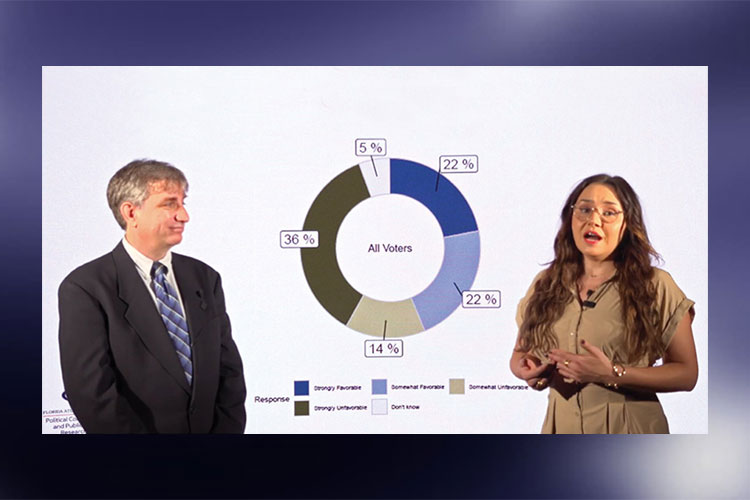
This impressive visual tool is perfect for sharing poll data infographics. For example, students use the BrandStar Studios wall when they produce video presentations about poll results for the PolCom Lab's YouTube channel. The videos feature pollsters and local reporters discussing the latest results in front of large infographics, visually showing the story they are discussing.
Florida Atlantic's partner in the PolCom Lab, Mainstreet Research USA, is a Florida polling organization founded by Mainstreet Research, a firm based in Canada. Its team has decades of experience with polling across North America, including experience with daily tracking polls of Canadian federal and provincial polls, as well as experience correctly forecasting surprise victories in high-profile U.S. elections. Fusing Mainstreet's respected data mastery with Florida Atlantic's localized strengths and extensive political science and communication expertise creates a substantial knowledge base. This union gives the PolCom Lab the foresight to stay ahead of shifting electoral trends.
"We were in the most interesting U.S. election cycle in at least 50 years," said Steven Pinkus, vice president of Mainstreet Research. "By collaborating with the team at FAU, we were very fortunate to add their formidable resources to our practical experience tracking elections. The FAU team brought a deep understanding of the American political context, and together we developed the scripts and subjects that we wanted to address as we sought to understand and explain what was driving the electorate."
For example, the team developed a unique tool built on daily polling during the last six weeks of the election, allowing them to track all the twists and turns of the election in real time. The public could also use Mainstreet's unique dashboard to gain an unprecedented understanding of what was happening, broken down by demographics and geographics. They could scan it at a glance, but also dig deep into the data to better understand what was happening from their personal perspectives — essentially a daily election primer.
Findings from the polls inform local, national and international media reporting, influence university curricula, and drive faculty, student and industry research. Additionally, polling insights make waves across the media landscape, spanning the political spectrum. Major national news outlets, such as Newsweek, MSNBC, Fox News, ABC News and Newsmax, as well as important media outlets across Florida, widely cited the findings of Florida Atlantic's PolCom Lab leading up to the presidential election.
This is because reporters are keen to understand the issues driving voters to the polls. For example, abortion was one of the top issues this election cycle that the FAU PolCom Lab tracked. It was a controversial issue and a state-by-state battle.
"Since almost one-third of respondents in recent polls do not know how they would vote if faced with the ballot initiative, this means that it could go either way," said Luzmarina Garcia, Ph.D., assistant professor of political science at Florida Atlantic and PolCom Lab-affiliated researcher, before the election. "There is some evidence of greater turnout in elections when people can vote on more emotionally charged issues, including same-sex marriage and, more recently, abortion. However, this has primarily been in mid-term elections, when there is no election for president. With this being a presidential year, many of the people who would turn out to vote on one of these ballot initiatives would probably turn out anyway to vote for a president."
The polls also went beyond "horse races" and pure policy questions, diving into the mindset and media habits of voters. One product of this exploration is the FAU/Mainstreet Happiness Thermometer, which shined a light on the emotions and psychology likely to influence voters as they headed to the polls.
"Happiness is important to understand as it influences the well-being and satisfaction of citizens, which in turn shapes their voting behavior," Mills said. "As demonstrated by Ronald Reagan's enduring question in the 1980 presidential election, ‘Are you better off today than you were four years ago?,' capturing public sentiment toward governance and policy efficacy is critical — especially in today's political climate."
The pollsters also looked at how voters consume media to form their opinions and cast their votes. They found that cable news networks remain a popular source of political news, with 40% of voters ranking this as their primary source for information. However, responses also showed a continued reliance on online media as a major source of political information, with 13% of respondents indicating they turn to social feeds, while 19% said they turned to other blogs and websites for political news.
"Political communication remains heavily influenced by the internet and digital media," said Robert E. Gutsche Jr., Ph.D., associate professor in Florida Atlantic's School of Communication and Multimedia Studies. "The problem remains, however, in understanding just how deeply voters rely on their politically affiliated messages and their true impacts on the legitimacy of journalism from more traditional outlets."
Wagner added that the lab's significant media reach and impact in its inaugural year underscore the important role it plays in bridging the gap between scholarly research and public discourse.
"As we continue to grow, the PolCom Lab will become a resource for people seeking to understand how information and media affect political attitudes, and the future of our democratic institutions."

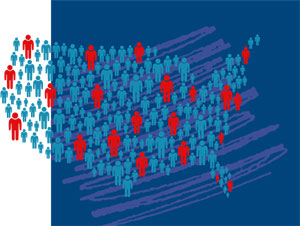
Florida Atlantic's PolCom Lab/ Mainstreet Research polls use registered voter lists from state election authorities wherever available. When those lists are not accessible, they construct a representative sample frame of eligible, registered voters using vetted data providers. To field their surveys, they employ a multimode approach combining interactive voice response phone polling and text-toonline probability sampling. This mixed methodology allows the team to reach voters through multiple channels and maximize representativeness. It may also incorporate respondents from credible online panels to further enhance younger voter representation in the samples.
FAU PolCom's rigorous data collection process, probability-based sampling across modes, and online panel usage adheres to industry best practices. PolCom's method relies solely on random probability sampling techniques, with no predetermined partisan quotas or assumptions. This allows the initial sample's composition to be naturally determined through true randomization. Following data collection, samples may be weighted for age, gender, race, education, region and past voter behavior to mirror the population being surveyed. This approach of random sampling followed by population-matching weighting eliminates biases from oversampling. The pollsters are guided by American Association for Public Opinion Research standards and ethics. Methodology details are provided in the full report for each poll on the PolCom website,www.fau.edu/ artsandletters/fau-polcom-lab/.