9/14/2023
Drone Discovery
Researchers Use Unmanned Aerial Vehicles to Learn More About Marine Mammals
An FAU researcher recently used drones to help document the first-known case of two species of dolphins interacting off the Southeast coast of Florida, highlighting the value of drones in helping scientists collect previously-unavailable data, including habitat details, body size and health information.
“During our Florida surveys we have seen spotted dolphins, and bottlenose dolphins, but never together,” said Denise Herzing, Ph.D., affiliate professor with the Charles E. Schmidt College of Science. “Drones offer a new perspective of course and provide researchers with an important new tool. In our case, verification that these two species interact.”
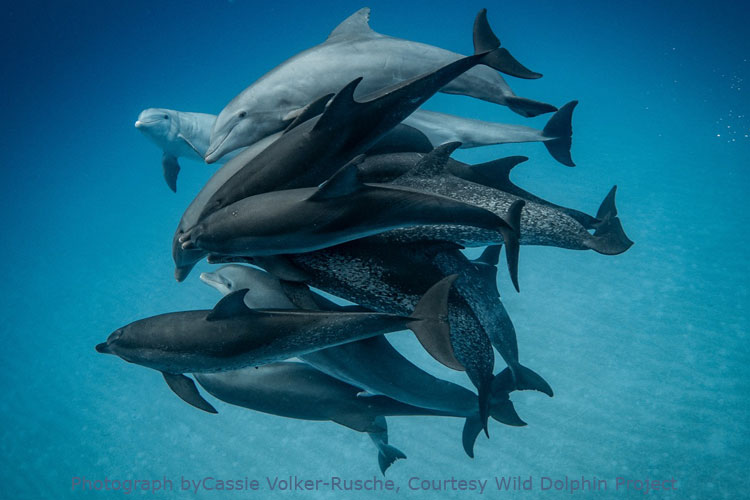
Whales and dolphins, known as cetaceans, often form mixed-species groups, for benefits that include defense from predators, better success when hunting fish, and social interactions. Mixed -species groups are common around the world, yet gaps remain in why and how they form, said Herzing, who also serves as the research director of the Wild Dolphin Project (WDP), and has studied the interactions between two species of dolphins – Atlantic spotted dolphins and common bottlenose dolphins – that coexist in the Bahamas.
Interactions include observing them traveling together, mating, feeding and even fighting. It’s gaining a deeper understanding of their aggressive encounters and why they occur that has been the subject of many of Herzing’s studies in the Bahamas.
The drone footage documenting the first known case of these two dolphin species interacting in Florida waters, was recently published in the journal Southeastern Naturalist.
“Although this interaction is not surprising, given the degree that we observe these two species interact in the Bahamas, it gives us real data to assess what might be going on off the coast of Florida,” she said.
The dolphins were originally found by another researcher, Jessica Pate, who was studying manta rays, “a reminder that cooperative work is really important in the scientific community,” Herzing said.
Initially, Pate found 23 bottlenose dolphins and one spotted dolphin via drone. The bottlenose were chasing and hunting fish at the surface. The spotted dolphin tried to engage the bottlenose dolphins by swimming ahead in an inverted position, thought to often indicate a solicitation, Herzing said, and by occasionally tail-slapping the water surface, which is often interpreted as an attention-getting signal. The spotted dolphin was never seen feeding, according to the scientists.
This study provides a baseline of understanding to begin understanding these interactions, even if the exact reason is unclear, she said. More data on mixed-species groups in Florida are needed to answer why these groups form and their functions, she added. Additionally, “with climate change underway we are seeing more and more issues with cetacean communities moving or being forced together to survive,” Herzing said.