07/24/2022
World Manta Day: Finding Flatsharks
FAU Researcher Co-Authors Study to Find Giant Manta Rays
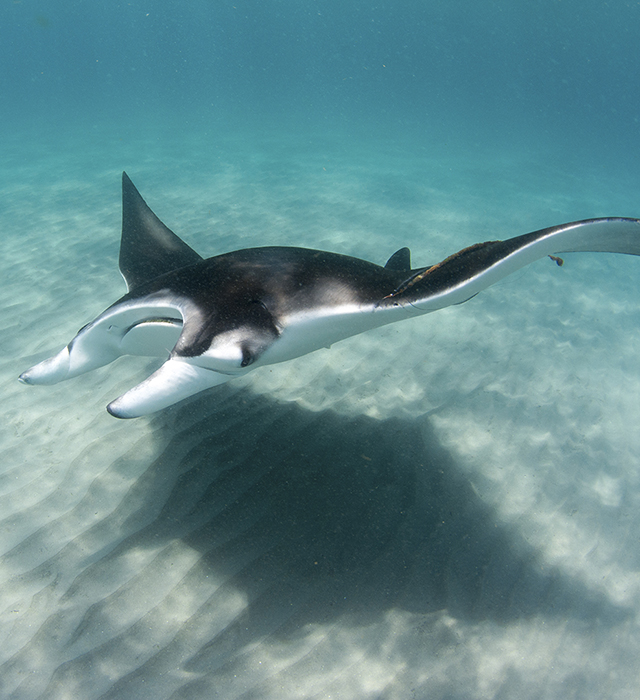
Despite being the world’s largest rays, spanning up to 29 feet from wingtip to wingtip, the whereabouts of giant manta rays in the U.S. has largely remained a mystery to researchers — until recently.
A new study, published in the journal Scientific Reports, and co-authored by Stephen Kajiura, Ph.D., a professor in the Charles E. Schmidt College of Science, has narrowed down when and where to expect manta rays, which are part of the elasmobranch group that includes sharks, skates and other rays. These gentle giants were listed on the U.S. Endangered Species Act in 2018, “so it is very important to learn as much as we can about their life history and behavior in order to develop effective management plans,” Kajiura said.
Researchers from across the country combined their data of manta ray sightings, as well as sighting information from the public, to map out their distribution. Since Kajiura regularly flies planes for his shark research and records when he spots mantas, he had data to contribute. “By pulling together data from various researchers, we were able to create a much larger study than any single research organization could achieve on its own,” he said.
The study also created predictive models of where and when to find the mantas, by correlating environmental information, such as water temperature. “This is important because as ocean water temperatures continue to rise, this might affect the distribution and movements of mantas in the future,” Kajiura said.
According to the research, the manta rays are most often found close to the shore and where deep cold water rises to the surface. Off the northeastern coast of Florida, they are found in the highest numbers in April. As temperatures warm, they are found in higher numbers north of Cape Hatteras, N.C. from June to October, and then south of Savannah, Ga., from November to March as temperatures cool. In the Gulf of Mexico, the highest nearshore occurrence was predicted around the Mississippi River delta from April to June and again from October to November.
South Florida has its own population of young manta rays that can be found right up against the beach. They are often found with trailing fisher gear, Kajiura said. “Learning what we can about their distribution allows us to be better informed and minimize any negative impacts on this ecologically important and charismatic species.”
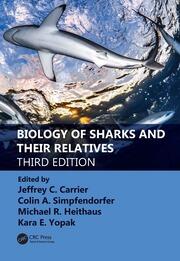
To help share the latest discoveries in shark science, Florida Atlantic University researchers and alumni collaborated to author the book “Biology of Sharks and Their Relatives.”
“This book was written not only with the scientific community in mind but also the interested public,” said Tricia Meredith, Ph.D. director of research in FAU’s on-site lab school, A.D. Henderson University School and FAU High School. “Anyone who enjoys learning about marine biology, especially of the enormously charismatic sharks and rays will find many of the latest discoveries captured in one place in this third edition.”
Meredith is lead author on chapter five, regarding sensory biology of sharks and rays, collectively called elasmobranchs, which includes co-authors Stephen Kajiura, Ph.D., professor in the Charles E. Schmidt College of Science.
Elasmobranchs rely on all their senses, often in concert, for survival, including finding prey and mates, as well as homing and navigation. According to Meredith, this chapter discusses some of the newest findings regarding sharks’ sense of smell, such as the surprising number of receptor genes they have. “Another cool aspect to this chapter is that so much of what we know about sharks’ sense of taste has been discovered in the past 10 years,” she added.
Marianne Porter, Ph.D., an associate professor in the College of Science, co-authored chapter three, which explores the mechanics of shark movement and the development of novel materials and devices inspired by their biology.
“There have been big advances in many of the fields included in this volume,” Meredith said. “I think my fellow shark nerds may enjoy learning beyond the oft-repeated shark tropes on certain documentaries to the real cutting edge of shark science.”
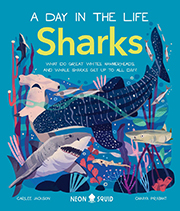
FAU shark lab alumna Carlee Jackson, co-founder of Minorities in Shark Science (MISS), recently wrote a children’s book all about sharks.
Jackson fell in love with sharks after reading a shark book in first grade, and she hopes this does the same for others. “It means so much to me that I now have the opportunity to spark another kid's passion for sharks with this book,” she said.
Jackson said she never thought about writing a children’s book, but a publisher reached out to her after hearing her on a podcast. “I thought ‘why not?’ and gave it a go. My inspiration throughout writing this was to make kids excited and amazed with sharks,” she said. “Kids will love it because it's full of beautiful illustrations of sharks they may never have heard of. It's fun and easy to read.”
The book is part of the "A Day in the Life" book series that features different animals. It takes readers on a trip around the world and follows different species of sharks over a 24-hour time span, Jackson said. “You learn what each shark is doing at a particular time of the day. It reads like a story while weaving in scientific information on each species of shark,” she said. “Kids learn that each shark species is very different from the other in the way it looks, eats or interacts with its environment.”