Coffee Colloquium
The Coffee Colloquium of the Center for Body, Mind, and Culture provides a regular monthly forum for presentations of research work in progress by members of the FAU community. The atmosphere is friendly and informal but also scholarly, and the forum’s goal is to help FAU faculty toward progress in research while building stronger interdisciplinary connections between researchers in different departments. Most of the speakers come from our home College of Arts and Letters, but we sometimes have speakers from other FAU Colleges and special visiting guests from other institutions. The meetings take place during the Fall and Spring teaching semesters. Although the prime focus of the colloquia is to advance FAU research, the colloquia are fully free and open to the public. In accordance with its name, fresh coffee is served at the colloquium events. The Coffee Colloquium is an old Center tradition that began back in 2007 and is still going strong.
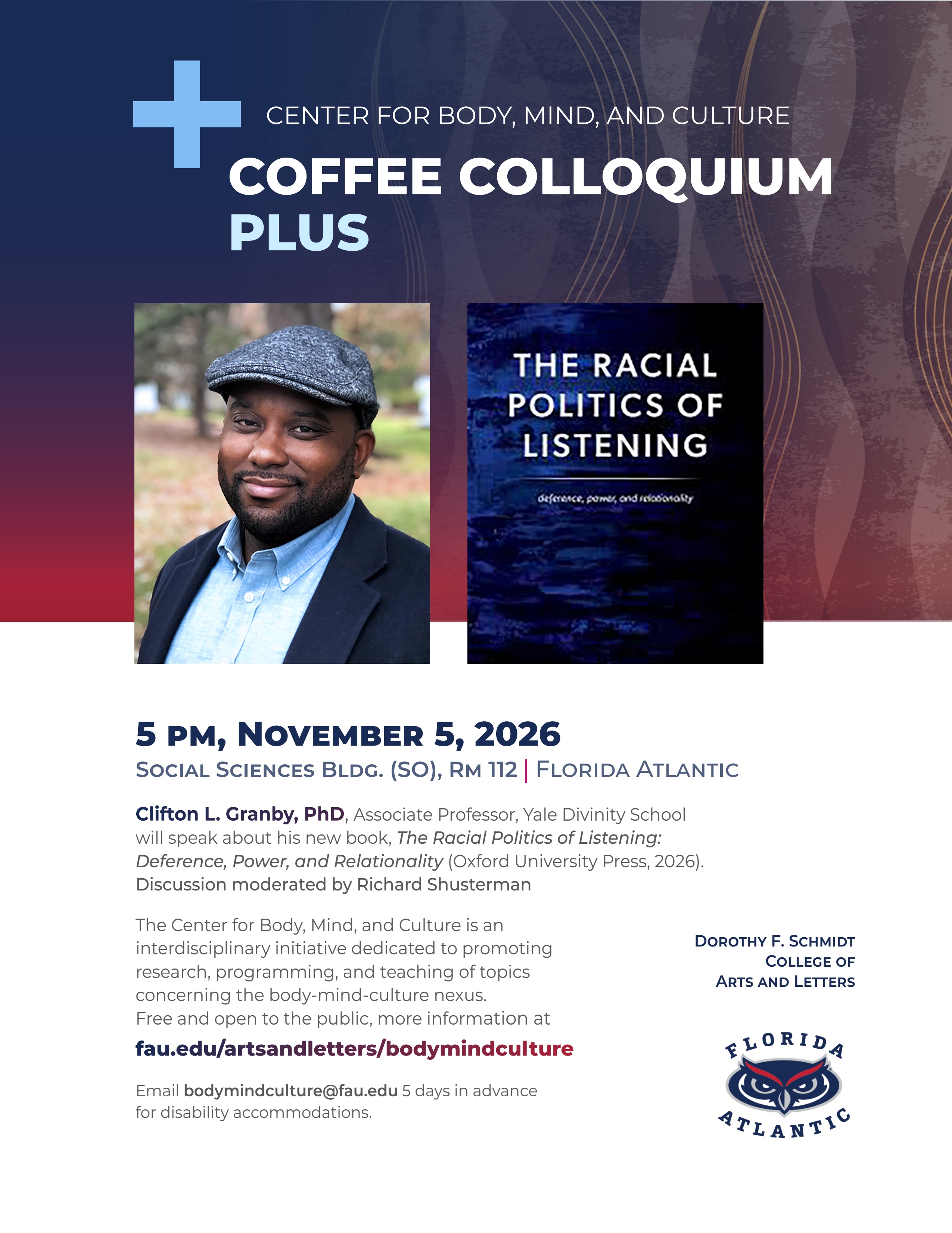
Coffee Colloquium Plus
We are pleased to invite you to the first Coffee Colloquium Plus, a new addition to the Center for Body, Mind, and Culture’s long-running Coffee Colloquium. For this special event, Clifton L. Granby, PhD, Associate Professor at Yale Divinity School, will discuss his new book "The Racial Politics of Listening: Deference, Power, and Relationality", followed by a discussion moderated by Richard Shusterman.
Join us on November 5 at 5 PM in SO 112. The event is free and open to the public.
Fall 2026
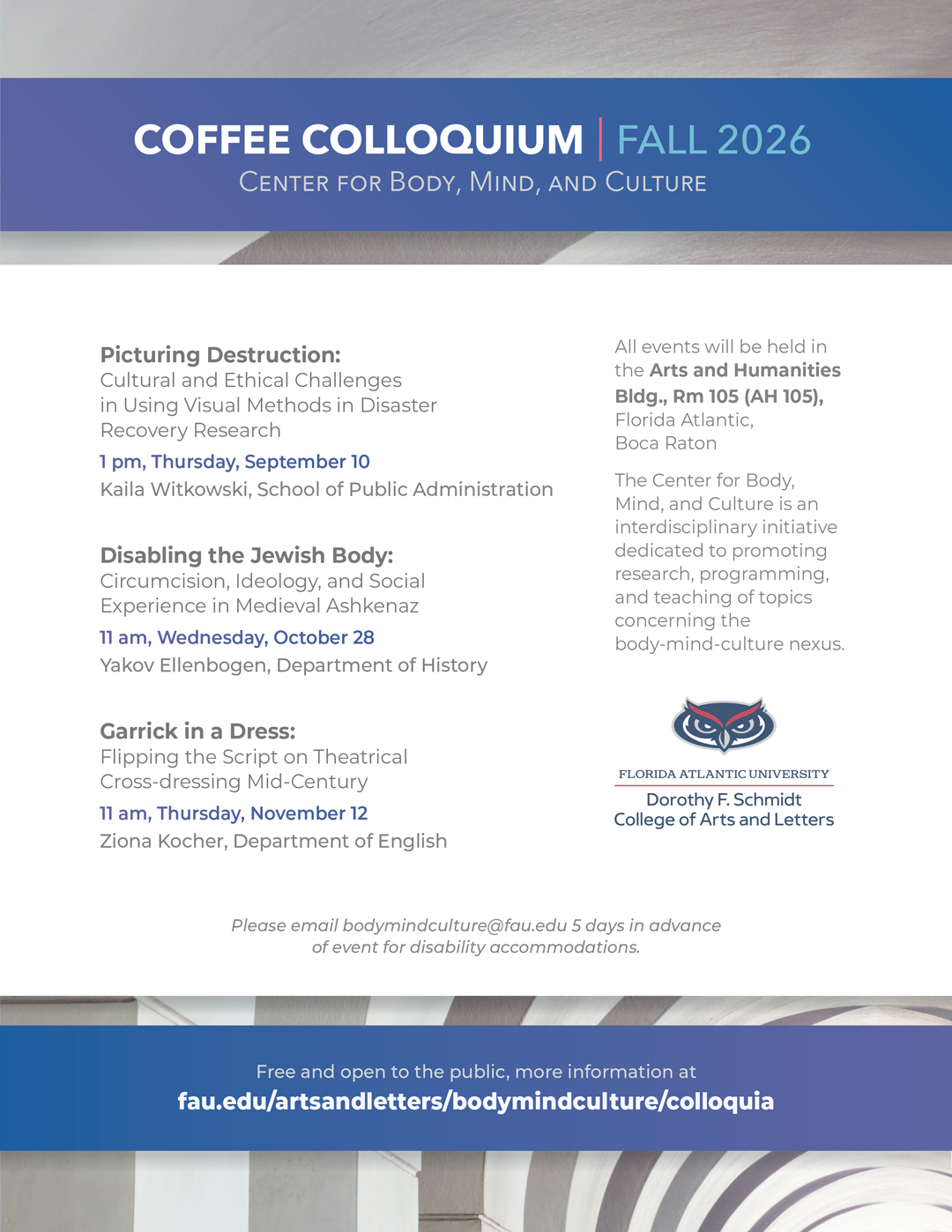
September 10, 2026 AT 1 pm
Kaila Witkowski, School of Public Administration
Picturing Destruction: cultural and ethical challenges in using visual methods in disaster recovery research
Abstract: While photographs have been used in popular culture for decades to capture the devastation of natural hazards, the use of visual methods as a tool to study these disasters is a less common practice. Engaging with literature on visual research methodologies and disaster recovery, this article explores the cultural and ethical challenges of using photo-elicitation to study long-term recovery efforts following the 2023 Maui fires. Drawing on interviews (n=31), researcher-taken photos (n=23), and supplemental data, including social media posts (n=413), we explore the ways we adapted the photo-elicitation method to account for cultural differences between the researchers and participants and how we overcame implementation challenges in the field. The examples presented in this article highlight the importance of reflexivity and flexibility when implementing visual methodologies to study hazards, crises, and disasters.
October 28, 2026 at 11 am
Yakov Ellenbogen, Department of History
Disabling the Jewish Body: Circumcision, Ideology, and Social Experience in Medieval Ashkenaz
November 12, 2026 at 11 am
Ziona Kocher, Department of English
Garrick in a Dress: Flipping the Script on Theatrical Cross-dressing Mid-Century
Abstract: Renowned theater manager, playwright, and actor David Garrick was, in many ways, the defining figure of mid-eighteenth-century drama. Active in the theatrical world from the early 1740s to the mid 1770s, Garrick’s career flourished during the tense period following the passage of the 1737 Licensing Act, which placed significant limitations on the plays performed in London during the period. His focus on adaptations of Shakespeare and bawdy Restoration comedies made him popular in the face of growing cultural conservatism, with tastes turning away from the explicit sexuality that was embraced earlier in the period. For example, his adaptation of William Wycherley’s The Country Wife, titled The Country Girl, removes the play’s cuckolding protagonist, Horner, in favor of recentering the romantic B-plot between Harcourt and Alithea. Despite his turn way from the raunchiness of the late seventeenth- and early eighteenth-century stage, however, Garrick carried one tradition on through his time at Drury Lane: theatrical cross-dressing. While breeches parts for actresses were losing some of their popularity mid-century, such cross-dressing is central to plays like Garrick’s afterpiece The Male Coquette. Garrick himself did not shy away from cross-dressing on stage – a practice that was a rarity during the period. This paper explores how Garrick’s personal embrace of cross-dressing on the stage challenges our understanding of the mid-eighteenth-century stage as a space that rejected the fluidity of gender-sexuality embraced during the early part of the period.
All talks are in collaboration with the Center for Cosmopolitan Culture and will be held in the Arts and Humanaties Bldg., Rm 105 (AH 105). Florida Atlantic University, Boca Raton.
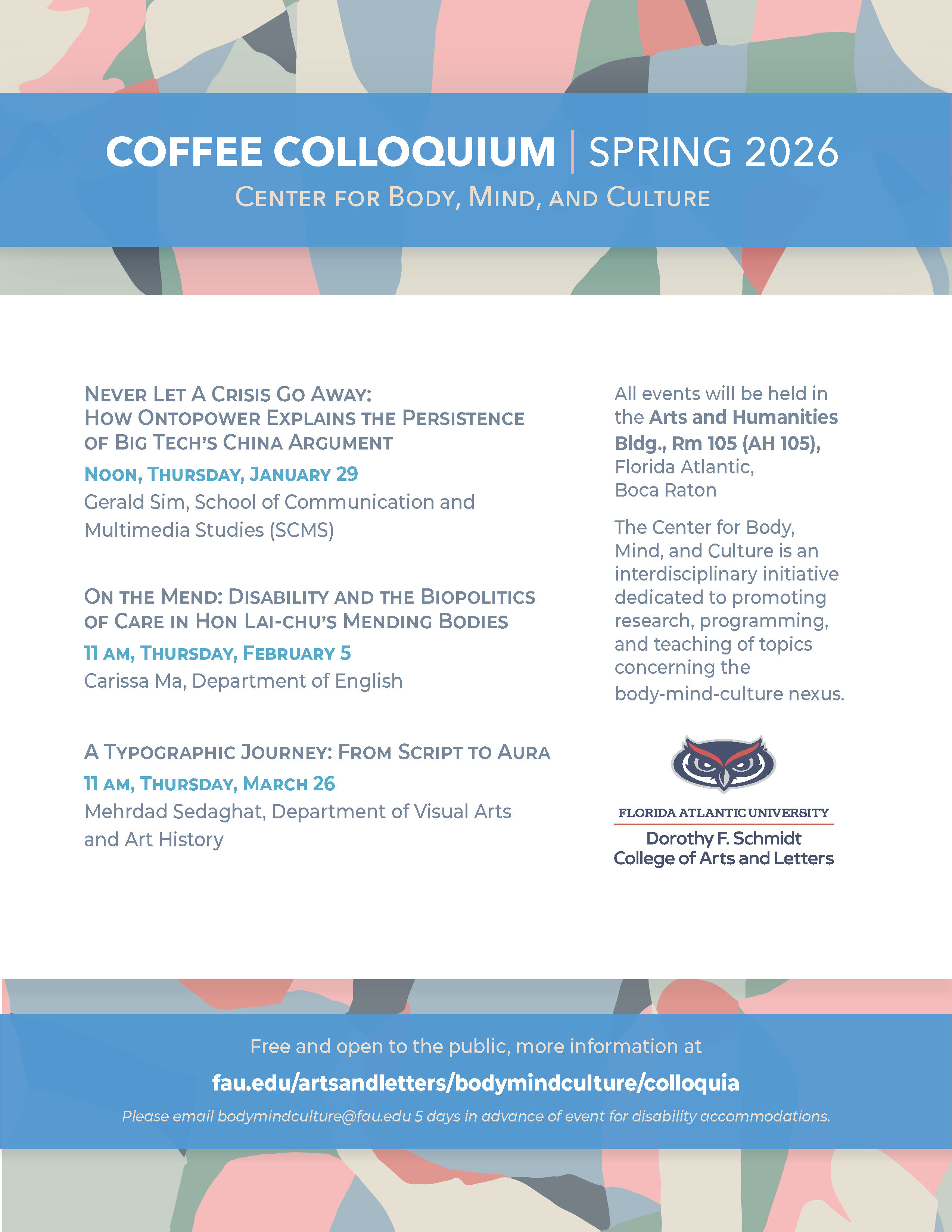
Spring 2026
*These talks are in collaboration with the Center for Cosmopolitan Culture .
January 29, 2026 at 12:00 pm
Gerald Sim: School of Communication and Multimedia Studies
Title: “Never Let a Crisis Go Away: How Ontopower Explains the Persistence of Big Tech's China Argument”
Abstract: AI Doomers and Zoomers both agree on one thing, that we stand on a historical precipice where one wrong move can propel humankind into AI dystopia."Crisis" framings deeply inform current technocultural discourse, purveyed by leading figures in Silicon Valley and industry-adjacent media. That techno-media-industrial complex operationalizes crisis, fear, and confusion for power. This presentation examines one crisis in particular, the US-China AI war. In response to the techlash and bipartisan support for antitrust enforcement, regulation, and oversight of the technology sector, Silicon Valley warned that these moves would impede innovation and undermine US national interests. Cue the specter of a world ruled by a geopolitical adversary with antithetical values. Legal scholar Tim Wu refers to this anti-regulatory message as the China Argument, Big Tech's version of "too big to fail." Yet even after insinuating itself into the highest levels of government and thus forestalling regulatory action, Big Tech continues to press the China Argument. The talk is animated by examples from media culture, and the specific images that stoke emotions in furtherance of crisis.
February 5, 2026 at 11:00am
Carissa Ma: Department of English
Title: "On the Mend: Disability and the Biopolitics of Care in Hon Lai-chu’s Mending Bodies."
Abstract: In this talk, Hon Lai-chu’s newly translated novel Mending Bodies is examined through the lenses of critical disability studies and affect studies to explore how state-imposed conjoinment under the fictional Conjoinment Act reveals the coercive underside of enforced intimacy and public health rhetoric. Set in a dystopian society that mandates surgical attachment as a form of social optimization, the novel critiques the instrumentalization of bodies under neoliberal and authoritarian logics. By portraying conjoinment as both literal and symbolic violence, Mending Bodies challenges dominant models of disability, agency, and care. It positions bodily difference as a potential site of resistance rather than pathology, resonating with Hong Kong’s post-pandemic reality of intensified surveillance and suppression.
March 26, 2026 at 11:00am
Mehrdad Sedaghat: Department of Visual Arts and Art History
Title: "A Typographic Journey: From Script to Aura"
Abstract: Typography begins as a cultural technology; scripts invented to record, communicate, and transmit meaning across time and space. Yet for those living between languages and cultures, typography becomes something more: a site of atmospheric encounter, emotional resonance, and embodied belonging. This presentation traces my journey from traditional graphic design practice through immersive installation work toward what I call type-escaping, a design approach where typography moves beyond legibility into felt experience.
Drawing from my work as an Iranian artist based in the United States, navigating multiple visual and linguistic cultures, I explore how typography can create affective spaces rather than simply deliver messages. Through projects that layer Persian and Roman scripts, historical archives, and participatory technologies, I examine how type becomes atmosphere, a sensory environment that speaks to the body as much as the mind.
Building on Roland Barthes' concept of punctum and somaesthetic theory, type-escaping proposes that what pierces us most deeply in typography is not what we read but what we feel: those visual details, cultural memories, and bodily responses that resist algorithmic capture and restore human connection. In an age where AI parses text as data, type-escaping reclaims typography as belonging.
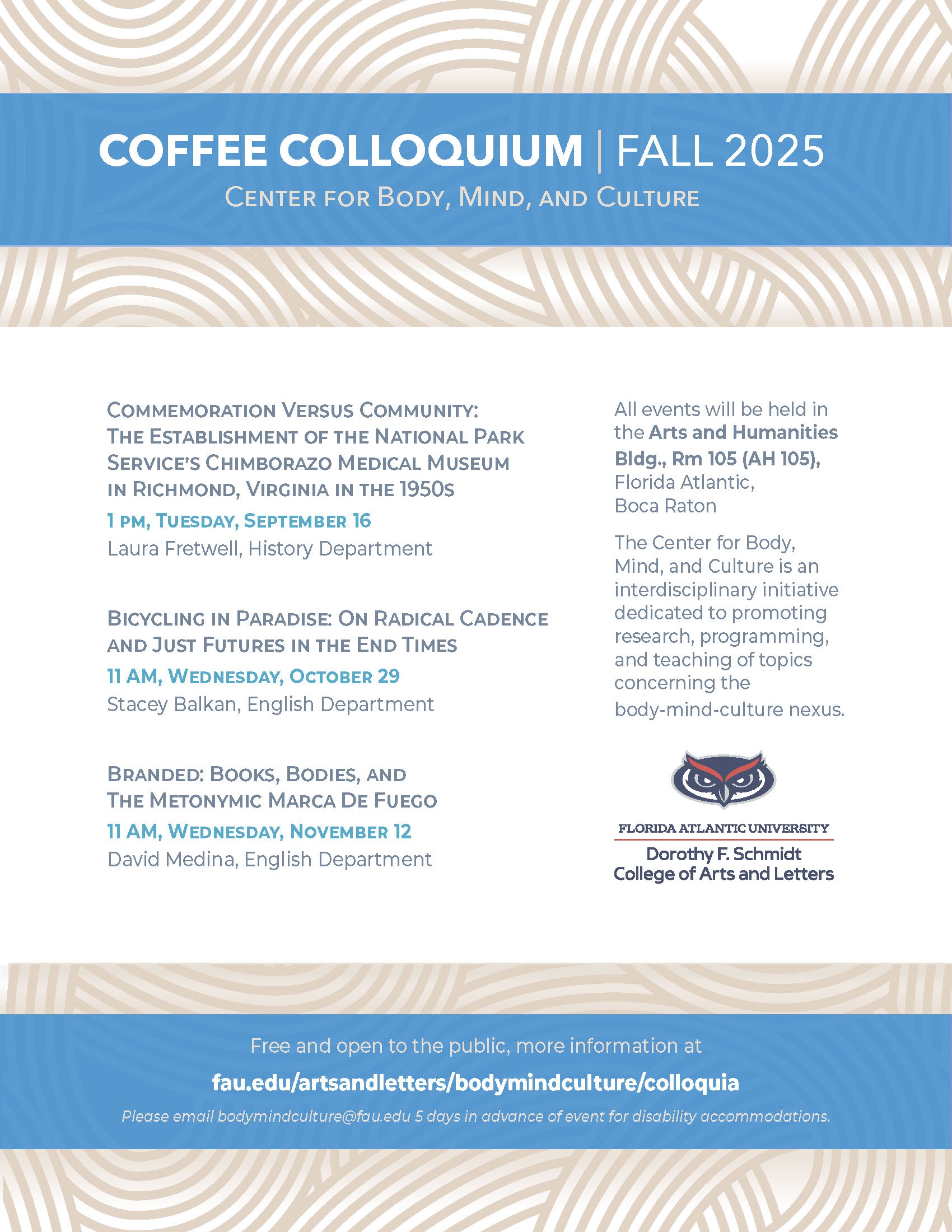
Fall 2025
*These talks are in collaboration with the Center for Cosmopolitan Culture .
September 16, 2025 at 1:00 pm
Laura Fretwell: Assistant Professor of History
Title: Commemoration versus Community: The Establishment of the National Park Service’s Chimborazo Medical Museum in Richmond, Virginia in the 1950s
Abstract: Richmond, Virginia’s Chimborazo Hill’s site witnessed crucial moments in American history that represented prevailing racial tensions of its time: a Confederate Army hospital during the Civil War, a post-war settlement for African Americans, a municipal city park during the Jim Crow-era, and a museum about the Confederacy established in the 1950s. Fretwell discusses the most recent period when the National Park collaborated with local groups to establish a museum about Confederate battlefields at Chimborazo Park in anticipation of the nation’s Civil War centennial by 1961. The museum omitted the post-war history about the African American community that lived on-site and was then displaced for the construction of the municipal park, but oral history interviews conducted by Fretwell showcase several longtime residents of the nearby Black community used the municipal park in the 1960s despite feeling unwelcome at the museum. Overall, the competing claims over the local memory and federal use of Chimborazo Park in the mid-twentieth century, and its racialized forms of competition, represent the larger struggles over race, racial identity, ideas of belonging, and commemoration at local and national levels. This presentation is part of Fretwell’s larger book manuscript project, entitled “Forgetting the Freed: The Buried Histories of Chimborazo Park, 1861-1961”.
October 29, 2025 at 11:00 AM
Stacey Balkan: Associate Professor of English
Title: Bicycling in Paradise: On Radical Cadence and Just Futures in the End Times
Abstract: In Energy and Equity (1973), Ivan Illich made a powerful case for a threshold beyond which the amount of energy expended has an inverse relationship to collective flourishing–a sentiment that reflected contemporary debates around the biophysical limits of economic growth. In this paper, I revisit Illich with the hindsight of decades of political struggle against the forces of a planetary “petropatriarchy” lately emboldened by renewed calls to “drill baby drill.” I then turn to speculative fictions, such as those collected in Elly Blue’s Biketopia series, that imagine a post-oil horizon neither powered by invisible labor, nor beset by scarcity.
November 12, 2025 at 11:00 AM
David Medina: Assistant Professor of English
Title: Branded: Books, Bodies, and The Metonymic Marca De Fuego
Abstract: If you spend time in any archive with books from New Spain, you're likely to encounter a marca de fuego—a firebrand seared into the head, tail, or fore-edge of a book. Applied primarily by monastic friars, these marks signify ownership with a sharp sense of permanence. Shortly before this practice became widespread, another kind of branding had swept through New Spain: the branding of human flesh. In a letter to the Council of the Indies, Vasco de Quiroga—Spanish judge and first Bishop of Michoacán—describes this brutal practice: “They are marked with brands on the face...imprinted with the initials of those who own them...some have three or four names, so the faces of these men...have been, by our sins, transformed into paper.”
This talk presents an overview of Medina’s monograph-in-progress, Branded: Books, Bodies, and the Metonymic Marca de Fuego, which argues that branded books and branded bodies must be understood in relation to one another—linked through a metonymic logic in which each stands in for the other, collapsing the boundary between object and subject, text and flesh. In arguing that aesthetic projects and slaveholding practices must be read as mutually informing, Medina seeks to show how authorship, illustration, and design encode the logics of mastery, ownership, and extraction. Drawing on material culture studies, book history, and early modern literature, the talk will explore how the conquest of the Americas depended upon media, which Medina defines as socially realized structures of communication comprised of technologies and protocols that make meaning. The presentation opens with an overview of the project and then proceeds to share findings from chapter two, which investigates how branding actively contributed to colonial desire to produce differentiations between Indigenous knowledge systems and European ones.
For the Coffee Colloquium Archive press here