5/4/2026
Triple Threat
Sharks, Beach Nourishment and Murky Waters Collide
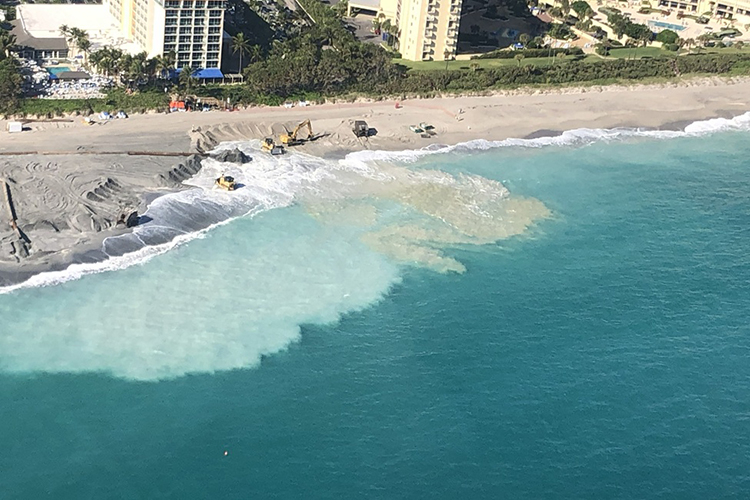
Each winter, thousands of blacktip sharks migrate to the shallow, clear waters just offshore of South Florida, coinciding with annual beach nourishment projects in northern Palm Beach County. These projects, which add sand from nearby or offshore sources to widen beaches and protect shorelines, can create prolonged turbidity – murky water from suspended sediments that persists especially in areas with silts and clays. To understand how these conditions affect sharks, FAU researchers tracked turbidity events during the 2020 and 2021 seasons along both nourished and natural beaches. Using monthly aerial surveys capturing more than 10,000 images and underwater cameras placed at varying distances from shore, they mapped sediment plumes and monitored shark presence and fish diversity.
The study provides one of the clearest views yet of how coastal engineering intersects with marine ecosystems. Findings reveal that blacktip sharks consistently concentrate within 50 meters of the shore, where prey is abundant. Researchers found persistent turbidity, often stretching nearly 15 kilometers alongshore and more than 250 meters offshore, reducing water clarity. This could interfere with sharks’ ability to hunt, potentially altering their behavior and increasing the risk of shark-human encounters. While beach nourishment remains an important tool to protect coastlines from erosion, the research highlights tradeoffs: widespread, long-lasting sediment plumes may disrupt key ecological processes. The findings call for improved monitoring, refined sediment management, and careful consideration of how these projects affect both marine life and the safety of coastal communities.
“Beach nourishment is a critical tool for combating erosion and protecting infrastructure, but in some cases it may come with tradeoffs that we’re only beginning to fully quantify,” said Tiffany Roberts Briggs, Ph.D., co-author, chair and associate professor of geosciences in FAU’s Charles E. Schmidt College of Science. “These projects involve dredging and placing large volumes of sediment onto the beach, and what we observed was turbidity in the adjacent nearshore on a scale that exceeded what’s typically described in the literature – with plumes stretching for kilometers and persisting across the exact time and space where marine species are most active. That tells us we need to take a closer look at how the entire process of beach nourishment may be influencing marine habitat.”