4/20/2026
The ‘Croak’ Conundrum
Parasites Complicate Love Signals in Frogs
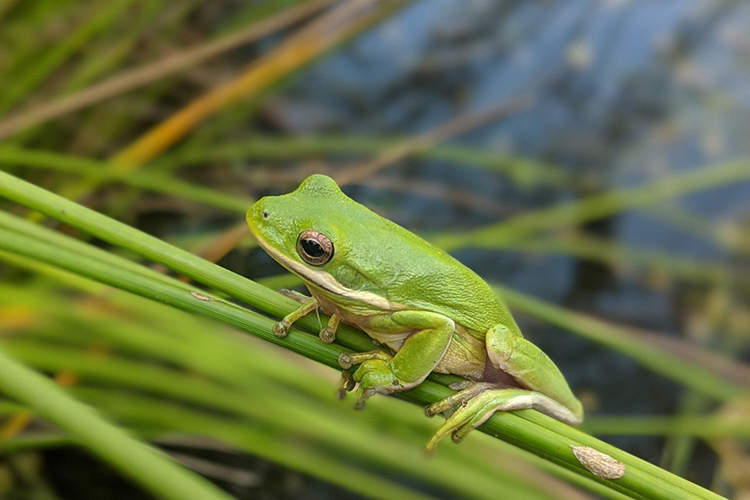
Across the animal kingdom, sound is more than communication – it’s a signal of survival and success. Male green treefrogs use loud, repeated “honking” calls to attract mates, with females favoring lower-frequency, faster or longer calls that often signal size, health and stamina. FAU researchers investigated how oral tongueworm parasites affect these mating signals. By recording calls in the wild, counting parasite loads, and analyzing call features, they found that heavily infected males produced lower frequency but shorter calls. Playback experiments showed that females avoided the most heavily infected males but sometimes preferred moderately infected ones, suggesting they weigh multiple cues simultaneously.
These findings challenge the long-standing idea that parasites simply weaken sexual signals. Instead, infections create a complex mix of information about size, condition and infection risk, subtly reshaping how females evaluate potential mates. Call duration emerged as particularly important, reflecting both energy reserves and parasite load, while other call traits signaled body size or attractiveness. The study highlights the nuanced ways parasites influence sexual selection and mate choice in natural populations.
“Parasites don’t always tell a simple story about health or weakness,” said Sarah R. Goodnight, Ph.D., first author, a Ph.D. graduate of FAU Harbor Branch, and a postdoctoral fellow at the Smithsonian Environmental Research Center. “In this system, the frogs most successful at finding food may also be the ones most likely to pick up parasites. That means females are evaluating signals that can simultaneously advertise both strength and risk.”