7/14/2026
Out of Darkness
Blind Cavefish Illuminate Brain Evolution
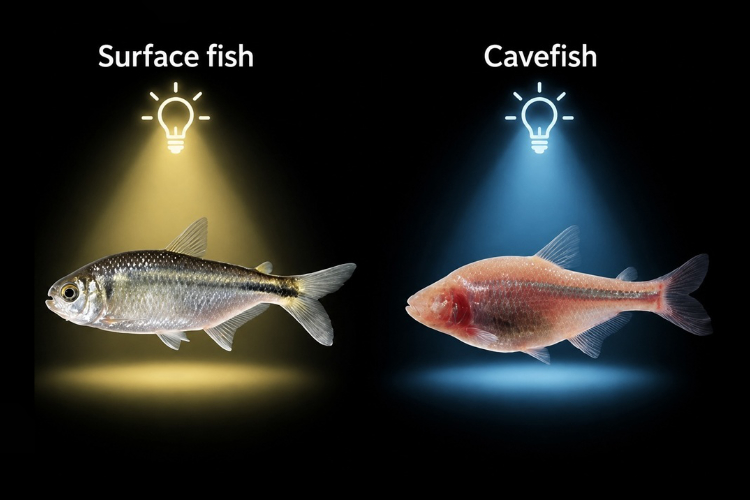
Deep within the caves of northeastern Mexico, the blind Mexican cavefish (Astyanax mexicanus) has evolved to thrive in perpetual darkness, losing its eyes and pigmentation while developing unique adaptations for survival. In a new study published in Science Advances, researchers from Florida Atlantic University and collaborators used advanced whole-brain imaging and genetic tools to compare cavefish with their sighted surface relatives, revealing how evolution reshapes neural circuits and behavior in response to extreme environments.
The researchers discovered a striking evolutionary reversal: while surface fish become more active in darkness, cavefish become more active in light, likely helping them avoid cave entrances and potential predators. By mapping brain activity at cellular resolution, the team identified changes in dopamine-related pathways and found that neurons responding to darkness in surface fish respond to light in cavefish. The findings provide new insights into how evolution rewires the brain and may have broader implications for understanding sensory processing and neurological disorders such as Parkinson’s disease, schizophrenia, autism spectrum disorder and ADHD.
“Our discovery that cavefish have evolved light-evoked photokinesis allowed us to ask what brain regions are affected and which neuronal subgroups could contribute to behavioral variation,” said Erik R. Duboué, Ph.D., senior author, an associate professor of biology in FAU’s Harriet L. Wilkes Honors College, and a member of FAU’s Stiles-Nicholson Brain Institute. “The fact that all previously studied eyed fish exhibit dark photokinesis and that only cavefish exhibit light photokinesis suggests that this behavior evolved as an adaptation to cave life.”