6/19/2026
AI Listens to Underwater Shell-crushing
FAU scientists use machine learning to monitor predator-prey dynamics in real time.
Predator-prey interactions between shell-crushing marine predators and hard-shelled mollusks such as clams, oysters and snails play an important role in shaping coastal ecosystems, yet they have remained difficult to study in the wild. Many of these feeding events occur in subtidal environments where direct observation is limited. This makes it challenging for scientists to measure predation pressure on shellfish populations that are critical for water quality, shoreline stability, biodiversity, aquaculture and restoration efforts.
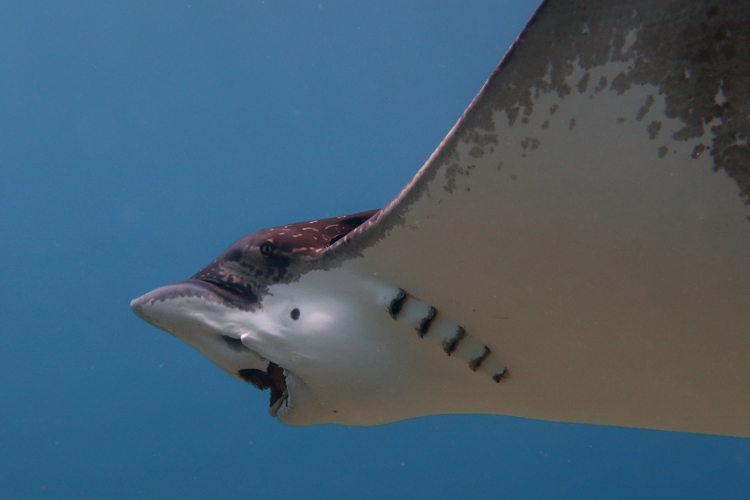
Florida Atlantic University researchers have developed a machine learning-based acoustic monitoring system capable of detecting and classifying shell-crushing events from underwater feeding recordings of whitespotted eagle rays – large and highly mobile predators known for crushing hard-shelled prey. The study found that computationally efficient GTCC-based models performed nearly as well as more complex deep learning systems while requiring far less processing power, making them especially promising for deployment on autonomous underwater platforms. The technology also demonstrated strong performance in real-world conditions, bringing researchers closer to scalable, real-time monitoring of predator behavior and shellfish predation in marine ecosystems.
“Shell-crushing sounds contain a surprising amount of ecological information about predator-prey interactions and feeding behavior,” said Laurent Chérubin, Ph.D., corresponding author and a research professor at FAU’s Harbor Branch Oceanographic Institute. “This work shows how passive acoustic monitoring can be used not only to detect these events, but also to better understand how marine predators interact with their environment in places that are otherwise difficult to observe.”