Prof. Stacey Balkan reviews Tracking Capital: World-Systems, World-Ecology, World-Culture in ISLE
Prof. Stacey Balkan's review of Tracking Capital: World-Systems, World-Ecology, World-Culture is out in the August issue of ISLE: Interdisciplinary Studies in Literature and Environment.
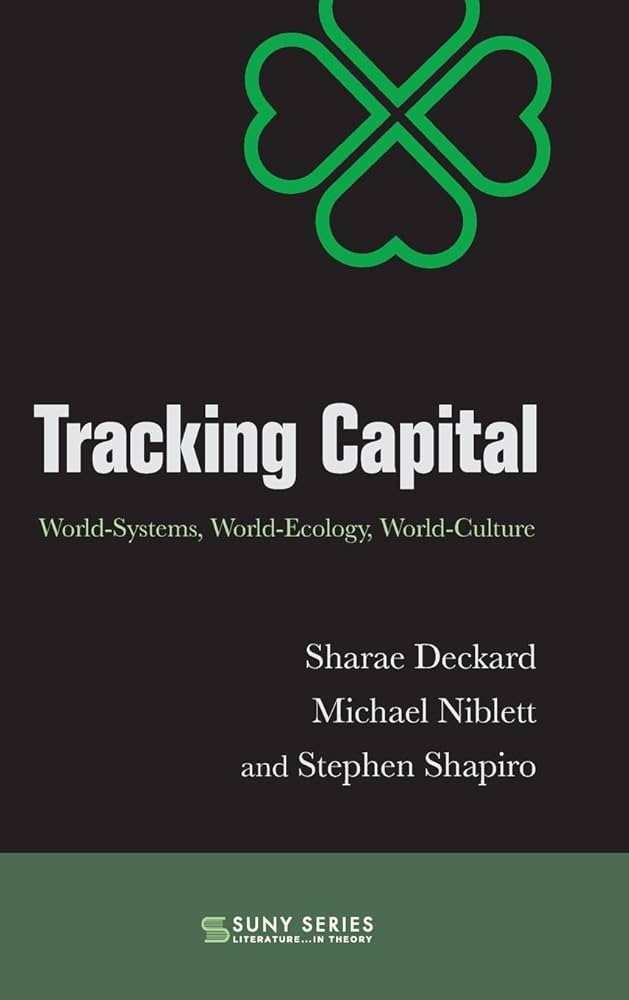
Tracking Capital—authored by Sharae Deckard, Michael Niblett, and Stephen Shapiro—was published in March 2024 with SUNY.
The extract, as published on ISLE:
Tracking Capital offers a compelling introduction to the affordances of world-systems criticism for grappling with cultural forms that exceed the stale periodicity and “disciplinary fiefdoms” of the Anglo-European academy. Resonant with interventions in the energy humanities, this volume employs a world-systems analytic to track cultural productions that do not reflect or represent but register the “world-system” that has been shaped by the logic of extractive capitalism for the past 500 years. Tracking Capital both continues the work of the Warwick School’s 2015 Combined and Uneven Development: Toward a New Theory of World Literature and builds upon discussions around world literatures famously disputed by critics such as Pascale Casanova, Franco Moretti, Emily Apter, and Gayatri Chakravorty Spivak. As “self-enclosed” totalities, “world literatures,” per Deckard, Niblett, and Shapiro, register entanglements within a world-market in which “cultural production and social reproduction [are] constitutive, not epiphenomenal to ‘economic exchange’” (69), and in which the modern novel tracks both global markets and “all matter of geobiospheric relations” (3).
i