Four Fantastic Cryptography Faculty Are Leading the Way to the Cyber Future
Tuesday, Oct 28, 2025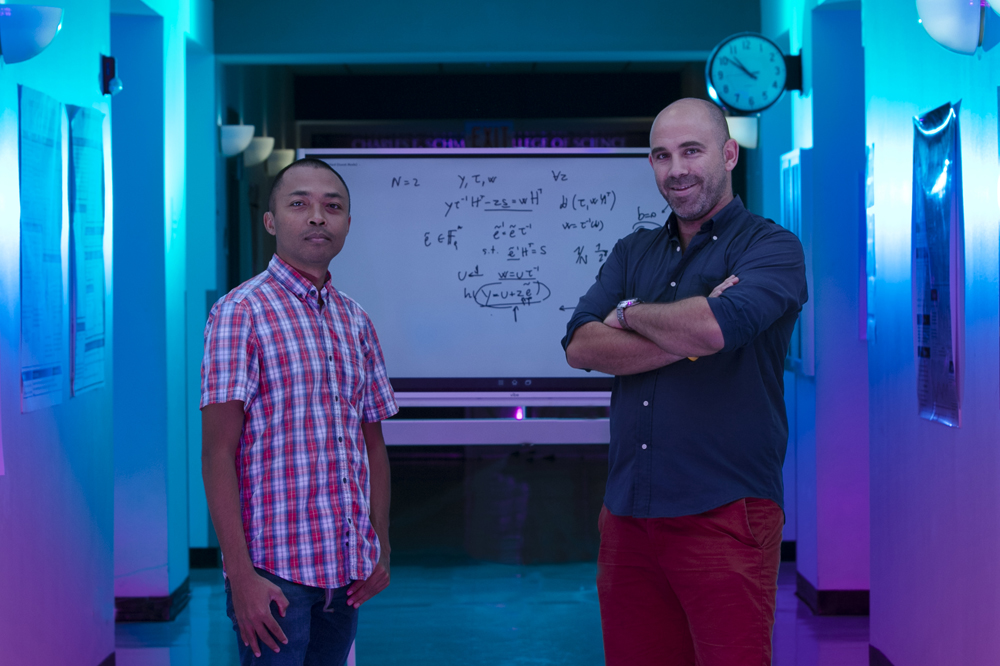
Cryptography is one of the main building blocks of security for numerous digital systems, including banking, internet communications, digital health care and cryptocurrencies, and has rapidly become part of our daily lives. These critical security systems that silently run in the background to protect our most sensitive data rely on cryptographic techniques such as encryption, identification and digital signatures to ensure data confidentiality, integrity and authentication.
 However, these digital systems face constant dangers from adversaries like hackers and malicious actors, who exploit vulnerabilities to compromise security. Traditional cryptographic methods may be susceptible to powerful quantum computer attacks, making “post-quantum” cryptographic solutions—meaning built to protect against future threats posed by quantum computing—essential. Consequently, researchers and cybersecurity experts must continually develop innovative and robust cryptographic systems to replace those that are outdated or compromised.
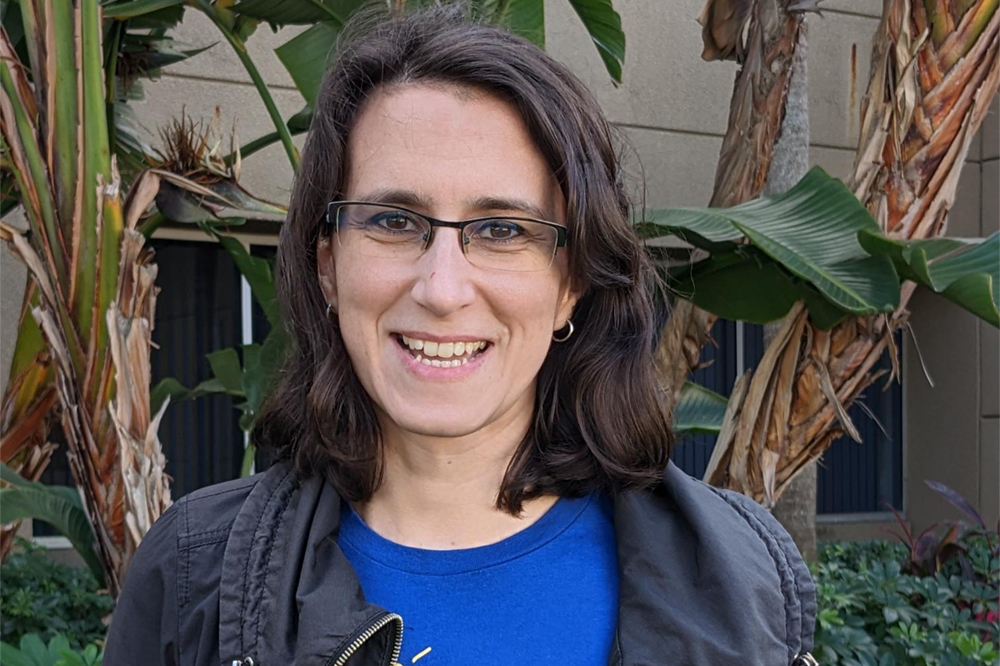
“As quantum computing advances toward reality, it poses a significant threat to many existing cryptographic systems, potentially compromising the security of our digital world,” stated Veronika Kuchta, Ph.D., assistant professor, Department of Mathematics and Statistics, Charles E. Schmidt College of Science. “Therefore, developing new cryptographic systems resistant to quantum computer attacks is imperative.”
These innovative cryptographic systems belong to the field of post-quantum cryptography, which is the central focus of research in the college’s Department of Mathematics and Statistics. Their work involves advancing encryption and digital signature algorithms, improving existing cryptographic protocols, and making them resistant to attacks from quantum computers.
The group is distinguished by its four mathematicians, each exclusively dedicated to advancing this innovative area that aims to secure systems against future quantum computer threats. Setting itself apart from similar groups in the U.S. and abroad, the Florida Atlantic University team is the largest in the nation devoted exclusively to the mathematical exploration of post-quantum cryptography.
“It is rare to have large cryptography groups, and even more so within a mathematics department,” noted Edoardo Persichetti, Ph.D., an associate professor in the Department of Mathematics and Statistics. “Traditionally, cryptography is a small part of a computer science or engineering department, with no more than one or two faculty.”
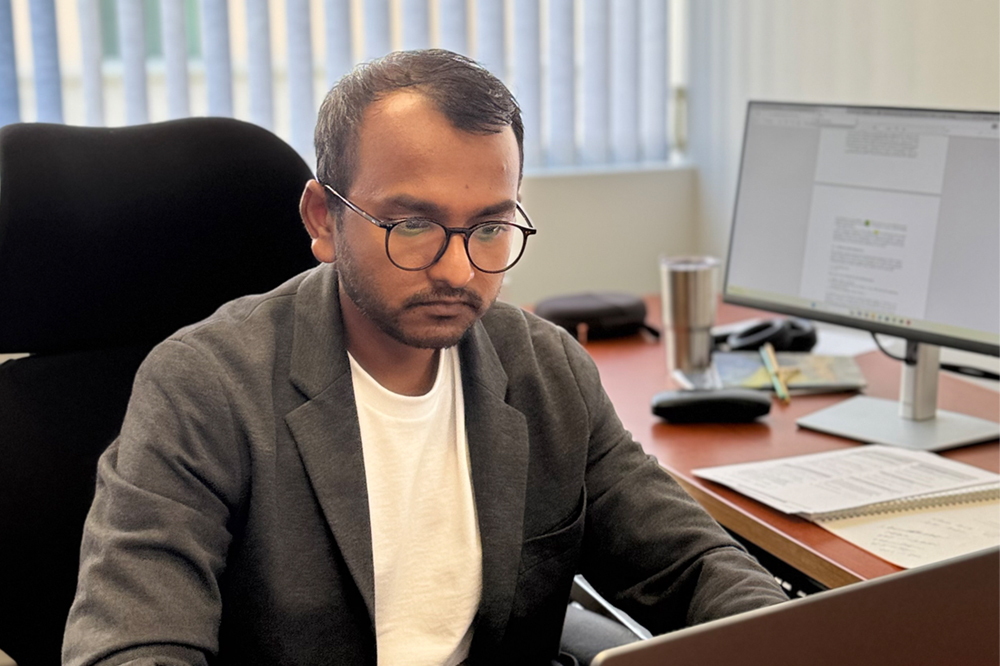
Each member of the college’s expert team specializes in different fields. Kuchta’s research focuses on the design of post-quantum cryptographic protocols such as signature schemes and zero-knowledge proofs; Persichetti works with public-key cryptography to secure digital communications; Francesco Sica, Ph.D., assistant professor of Mathematics and Statistics, explores the mathematical theory behind how cryptographic algorithms work; and Dipayan Das, Ph.D., assistant professor of Mathematics and Statistics, studies cryptographic problems, particularly lattice-based cryptography.
“We use various sophisticated methods from different areas of mathematics, such as lattices, error-correcting codes and isogenies on elliptic curves, which is why it is necessary to have highly skilled mathematicians working on it,” explained Persichetti. “The race to quantum supremacy has only just started, and it is proceeding at an impressive pace, which is why our team is hard at work preparing the world for a new security ecosystem.”
The team’s dedication and ambition are being met with great success. Earlier this year, the National Institute of Standards and Technology (NIST) selected Florida Atlantic University’s Hamming Quasi-Cyclic (HQC) algorithm for standardization in its post-quantum cryptography project to be part of the new generation of encryption standards, for its ability to meet its criteria for security, efficiency and practical implementation. HQC, of which Persichetti is a designer, is a cryptographic algorithm aimed at providing secure key exchange between two parties, enabling them to share a common, secret key that can be used to encrypt and decrypt messages.
“NIST standards become a sort of digital ‘black box’ that practitioners can utilize within their products, without questioning the technology inside,” said Persichetti. “This provides the industry with a strong quality guarantee—in our case, safe cryptography which is tried and tested. The recently standardized post-quantum cryptographic algorithms are a crucial piece of the new puzzle which will form the security landscape for years to come.”
The Schmidt College of Science, in collaboration with the university’s College of Engineering and Computer Science and College of Business, received a $2.6 million grant from the National Science Foundation (NSF) to establish a scholarship program in the burgeoning and critical field of cybersecurity in 2024. The NSF’s CyberCorps® Scholarship for Service program seeks to increase the number of qualified cybersecurity professionals working for federal, state and local governments, and it provides full scholarships and stipends to students pursuing studies at the intersection of cybersecurity and artificial intelligence (AI).
In 2003, the Center for Cryptology and Information Security (CCIS) was established in the as an Schmidt College of Science Center, with funding provided by a Federal Earmark, and founded on the unique strengths of cryptology and information security specialists in four different colleges within the university: the Schmidt College of Science, the College for Design and Social Inquiry, the College of Business and the College of Engineering and Computer Science. Florida Atlantic is also recognized as a National Center of Academic Excellence in Information Assurance/Cyber Defense Research (CAE-R) by the National Security Agency (NSA) through 2030.
“As a recognized NSA Center of Academic Excellence in Cybersecurity, FAU is in the unique position among Florida universities, to form well-rounded cybersecurity experts, conversant with its mathematical language, the architecture of its implementation and the management of its deployment in the workforce,” stated Sica. “Our students are formed through a mix of academic courses and directed research on the latest advances in the field.”
The Department of Mathematics and Statistics has a longstanding commitment to undergraduate and graduate students to make the Cryptography and Information Security programs a success. It offers a robust course list, including Introduction to Cryptography, Cryptanalysis, Coding Theory and Number Theory and Cryptography. In addition, graduate students can earn a Cybersecurity Graduate Certificate with a focus on mathematics and cryptography, to expand their knowledge and skills. In the coming months, the department plans to expand its curriculum to include courses like Post-Quantum Cryptography, Mathematics of Cryptography and Cryptography of Blockchain—some of which will be available in spring 2026.
“The Schmidt College of Science and the Department of Mathematics and Statistics are committed to preparing the next generation of cryptographers and cybersecurity experts through a combination of rigorous academic programs, hands-on research opportunities and industry engagement,” shared Das. “Students gain a strong foundation in mathematical theory, computational methods and emerging topics in cryptography, including post-quantum cryptography, through different cryptography courses and the Ph.D. program.”
Outside of the classroom, the team works hard to provide outreach and programming activities for the community. The department organizes Crypto Café, a semesterly series of invited talks featuring experts, faculty and students; Crypto Teens in South Florida, a five-day camp for high school students who are interested in exploring the technology and science behind cryptography; and Codebusters, a code-cracking competition which is part of the annual Science Olympiad.
The college helped win the bid to host the prestigious International Association for Cryptologic Research (IACR) Public-Key Cryptography (PKC) 2026 conference, in South Florida for the first time since 2003. The conference is scheduled to take place May 25 to 28 in West Palm Beach.
“This conference will showcase our achievements to the local tech community, as well as reward the university— and in particular the math crypto group—as an active and international research player,” said Sica.
Learn more about the department’s cryptology research and academic programs.