6/26/2026
Uncharted Waters
FAU Harbor Branch Researcher Joins Landmark Ocean Exploration Cruise in Trinidad and Tobago
Trinidad and Tobago (T&T) is the southernmost Caribbean island nation, located just seven miles from the coast of Venezuela at the closest point. The vast mesophotic and deep ocean habitats surrounding T&T comprise the nation’s largest ecosystem – but less than 1% has been seen or scientifically explored. Heightened environmental pressures have presented new threats to these unique, fragile habitats, creating an urgent need for scientific exploration to document and characterize them before they disappear.
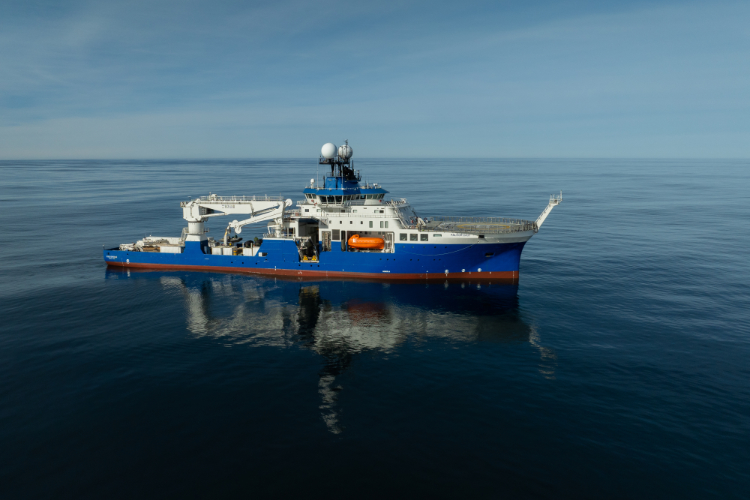
Florida Atlantic University’s Harbor Branch Oceanographic Institute is set to join a landmark, multinational and multidisciplinary research expedition aboard Schmidt Ocean Institute’s renowned Research Vessel (R/V) Falkor (too) to conduct a baseline study of mesophotic and deep-sea ecosystems to inform future ocean stewardship in the region and beyond. During its month at sea (June 29 to July 28, 2026), scientists will explore the waters surrounding Trinidad and Tobago and the adjacent high seas, reaching depths from 250 to more than 4,000 meters. Megan Conkling, Ph.D., a research scientist at FAU Harbor Branch, has been named a co-principal investigator on the project. Shirley Pomponi, Ph.D., an FAU professor emeritus, will also be aboard as an independent research collaborator.
Scientific objectives of the expedition include high-resolution mapping of the sea floor, investigation of dynamic geological features to identify potential “hotspots” of biodiversity, identifying and characterizing unexplored benthic ecosystems, and assessment of impacts from microplastics and marine debris. Conkling’s research will focus on discovery and preservation of biodiversity, specifically preservation of living tissues of deep-sea benthic organisms utilizing a first-in-class cryopreservation medium.
The medium, DoriSol™, is created by CryoCrate, a company focused on revolutionizing cell and tissue cryopreservation in the life sciences. Conkling’s lab at FAU Harbor Branch was the first to test DoriSol™ on a marine species – sea sponges. After proving the viability of the medium for this use, Conkling is ready to test its efficacy in the field.
“This expedition is an opportunity to establish a standard method to cryopreserve specimens on board the ship using standard [-20°C] freezers,” Conkling said. “We have the potential to create a simple, easy-to-replicate procedure to help preserve biodiversity across the globe."
Schmidt Ocean Institute is a U.S.-based nonprofit that provides scientists from around the world access to state-of-the-art marine research technology on board the R/V Falkor (too) at no cost in exchange for making their research available to the public. Underwater exploration will be conducted using an autonomous underwater vehicle (AUV) called The Childlike Empress and a remotely operated vehicle (ROV) called SuBastian. All dives will be livestreamed, allowing anyone with an internet connection to join the scientists on board as they explore the deep sea in real time.
The expedition is led by Diva Amon, Ph.D., director and founder of SpeSeas, a T&T-based marine research organization. This marks the first time local scientists will lead a scientific expedition to explore the country’s deep-water ecosystems.
To access livestreams, visit Schmidt Ocean Institute on YouTube or Twitch.