Fall 2026
Florida Atlantic: Preying for Success
Project to Study Everglades Wading Birds
Florida Atlantic’s Charles E. Schmidt College of Science recently secured a five-year, $1,427,679 grant from the United States Army Corps of Engineers (USACE) to investigate the factors affecting the survival of wading birds in the Florida Everglades during the dry season.
“This project is incredibly exciting because it allows us to quantify the link between water conditions, fish populations and wading bird nesting across the Everglades,” said Michelle L. Petersen, Ph.D., assistant research professor in the Department of Biological Sciences and director of the environmental science program in the School of Environmental, Coastal, and Ocean Sustainability. “By identifying when and where prey concentrations occur, we can better understand what drives nesting success and provide information that directly supports restoration efforts in this unique and vital ecosystem.”
The research directly supports the USACE’s Comprehensive Everglades Restoration Plan, the sweeping environmental initiative authorized in 2000 to restore South Florida’s natural water flow, part of which tracks how wildlife responds to restoration efforts and guides adaptive management. “One of the biggest questions we’re trying to answer through this project is how wading birds respond to changes in water levels, especially during the dry season when the concentration of prey can make or break their nesting success,” Petersen said.
Decades of decline in wading bird populations have been tied not just to overall fish abundance, but to whether fish and other prey form dense, accessible clusters for predators in drying wetlands. Historically, researchers struggled to measure these concentrations because monitoring often stopped once water levels became too shallow for boats. Petersen’s team is overcoming that gap using a probabilistic, multi-stage sampling framework to measure maximum prey densities across diverse habitats, including Everglades National Park, water conservation areas and canals.
By linking hydrology, prey availability and bird nesting success, the project aims to sharpen predictive models and strengthen long-term restoration strategies.
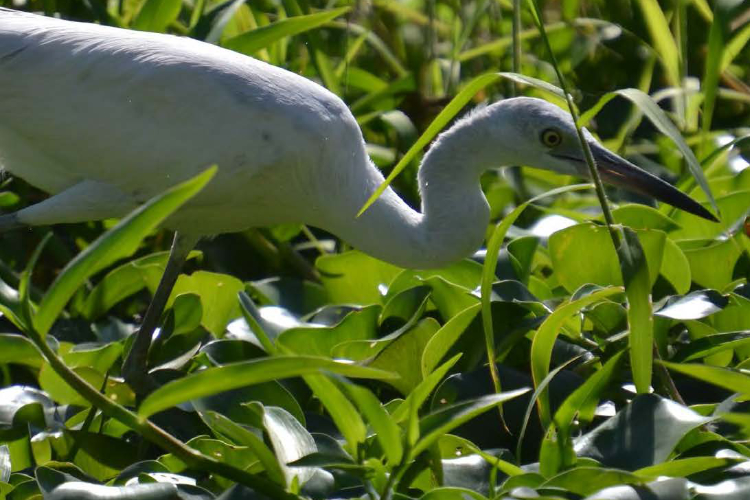
“Dr. Petersen’s work underscores the vital role university-led research plays in driving effective ecosystem restoration,” said Valery Forbes, Ph.D., dean of the Charles E. Schmidt Juvenile Little Blue Heron College of Science.