Fall 2026
Florida Atlantic: More Than the Game
Turning a Career-Ending Diagnosis into a Calling to Help Students
The dream was within reach — college scholarships, packed stadiums and a future built on speed and strength. Then, in his senior year of high school, Terrance Tarver’s heart stopped that momentum cold.
A newly discovered heart condition forced the South Georgia football standout to confront a reality no young athlete expects: sometimes the body decides before you do. For Tarver, the game he loved was suddenly no longer the path forward. But what felt like an ending became the beginning of something far bigger.
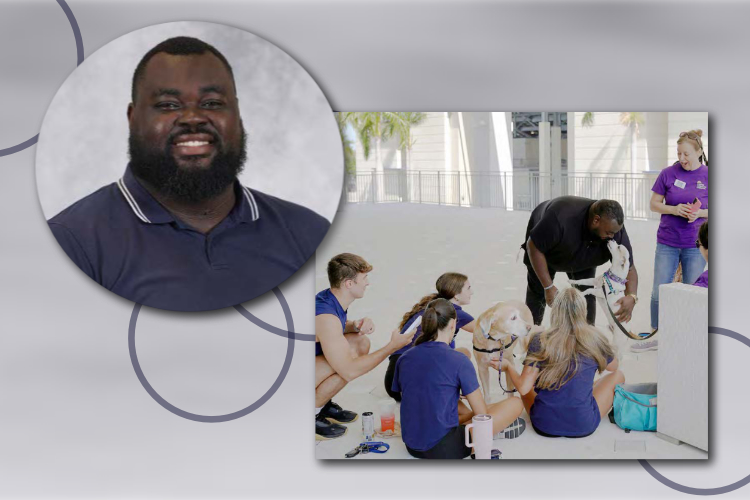
Today, Terrance Tarver, Ph.D., is the director of mental health and performance for athletics at Florida Atlantic University, guiding more than 450 student-athletes through the pressures of competition, identity and life beyond the scoreboard. His journey from athlete to scholar to clinician mirrors the very transitions he now helps others navigate.
Raised by a teacher and a truck driver, Tarver grew up immersed in sports. Football and baseball weren’t just hobbies, they were possibilities. When his playing career was cut short, he faced a crossroads.
As an undergraduate at Columbus State University, he made a pivotal decision to study psychology that led to nearly a decade of post-secondary education, culminating with a doctorate degree in counseling psychology from the University of Tennessee, Knoxville. Along the way he earned two master’s degrees, one in psychology from Tennessee and another in kinesiology with a sport and exercise psychology concentration from Georgia Southern University.
Those paths led Tarver to a career that bridged the gap between what inspired him as a student — psychology — and his passion for sports. As he pursued his educational journey, an increasing number of sports organizations and athletic departments were encouraging their athletes to heal and care for their mental health as they would a twisted ankle or a torn ACL. Following graduation and a gap year, Tarver studied with Brandonn Harris, Ph.D., a professor of sport and exercise psychology at Georgia Southern, to further his education.
“I fell in love with the different things like visualization,” Tarver said. “But also how student-athletes think when they have performance anxiety. Or pre-performance and time management. It’s struggle with focus. For example, now with NIL and revenue sharing it is the transition of power.
“We don’t talk about that a lot — the transition for athletes who depended on parents but now they become the primary breadwinner in families. It is also very hard for athletes who have high ability when their playing time ends. They’ve been the superstar and when it is done, they do not have that identity anymore. They are left in limbo.”
Committing Resources
While Tarver was navigating his journey, Brian White, vice president and director of athletics at Florida Atlantic, was navigating the task of meeting the ever-changing landscape of college athletics and, more importantly, the needs of the university’s 450+ student-athletes.
“We are thrilled to have Terrance in this incredibly important position,” White said. “As a former student-athlete himself, he has a deep understanding of the challenges and opportunities that come with competing and training at the highest levels. An absolute priority for FAU is the health and well-being of our athletes, and we appreciate the expertise and effort Terrance provides in getting the best out of the Owls. We are also profoundly grateful to Barb Schmidt, whose vision helped make this crucial position a reality.”
In 2022, thanks to a gift commitment from the Schmidt Family Foundation, the FAU Athletics Mental Health Fund and the director of mental health and performance position were created. Both are keeping the university at the forefront of providing mental-health resources to student-athletes.
“Now more than ever we are being asked to provide trusted support for our student-athletes and their mental health,” Schmidt said. “I am so grateful to the FAU Athletics Department for prioritizing this initiative and believing that inner wellness strengthens external success. The future is bright for every student-athlete, knowing that programs and guidance like this exist.”
Supporting Students and Student-Athletes
In 2024, Tarver joined the Counseling and Psychological Services (CAPS) at Florida Atlantic as part of his doctoral internship. CAPS provides Florida Atlantic students with timely and effective mental health services that allow them to improve and maintain their mental well-being, in order to meet their educational, personal, emotional and psychological goals. A year later, Tarver was named the director of mental health and performance for FAU Athletics. He emphasizes forecasting goals and working on a day-to-day basis with student-athletes in the areas of therapeutic services and performance.
“I’m grateful for the training I’ve had, which allows me to blend both counseling and performance,” Tarver said. “They struggle with performance, but there’s so much more that they are dealing with — not only as student-athletes, but as siblings, as romantic partners, as friends and as children. It’s all the different roles that they play in life. They have different things going on and it is just working with this age. These are such formative years. Every day, I come in and I know that my days will be different. We may laugh, we may cry — and everything between.”
Tarver praises his support system built first through parents, then mentors and his own mental health provider, and finally the support of Florida Atlantic’s CAPS program.
“When I came to Florida Atlantic as a doctoral student in 2024, I came thinking that I was going to do clinical work and help with sports psych as well, but I knew the majority of my caseload would be general population,” Tarver said. “I think that CAPS did a great job of finding ways for me to be able to work with some student-athletes and at times do some things with the teams. I love working with this population and I have enjoyed making relationships with some of the teams, some of the coaches and of course, the student-athletes.”