Fall 2026
Florida Atlantic: Forging the Future of Environmental Science
Funding and Fieldwork Prepare Students to Change the World
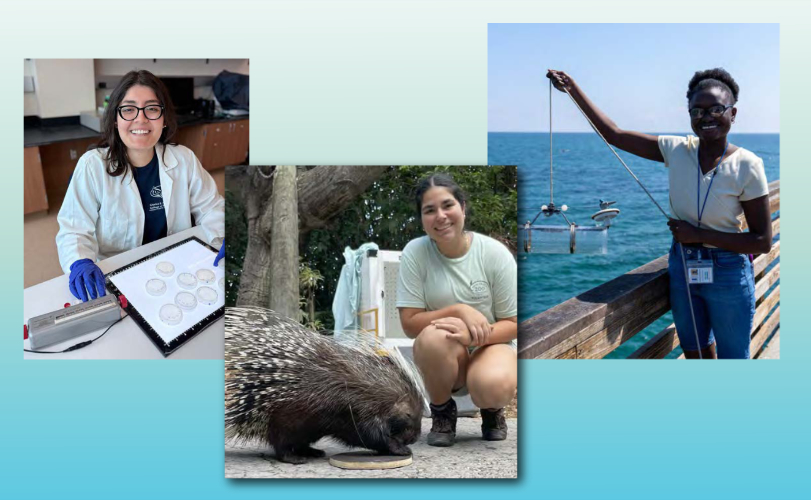
Kayla Mosteller arrived at Florida Atlantic University from Pennsylvania with a love of science and the outdoors, but no clear vision for her future. A single geosciences course and transformational research opportunities changed everything, she said. What started as curiosity quickly became a calling, setting her on a path toward graduate school and a career in environmental science.
“I’ve always loved science and always loved the environment, but I never really saw it as a path to a career,” Mosteller said. “It wasn’t until I took a course with Dr. Briggs. It snowballed after that. I started researching microplastics in coastal sediments like our local beaches and then had the opportunity to study microplastics in sea turtles. After graduation, I’m hopeful to start graduate school in environmental science.”
Mosteller’s mentor, Tiffany Briggs, Ph.D., is chair and associate professor of geosciences in the School of Environmental, Coastal, and Ocean Sustainability (ECOS). She has done extensive studies on coastal sediments.
“Microplastics and the contamination they cause in our environment, food, water — and even people — is an issue the scientific community is still grappling with,” Briggs said. “We are just beginning to understand how microplastics impact our coastlines and marine life along the Florida coast.”
Transformational Gift
Mosteller, now a senior, was among the first undergraduate students to receive a scholarship made possible through a visionary gift to ECOS from philanthropists Wayne and Lucretia Weiner. Their gift positions ECOS as a leading school for innovative, solution-based environmental research to attract and train the next generation of environmental scientists. Because of the Weiners’ bold investment in ECOS, FAU is building an opportunity pipeline to give students — beginning in their undergraduate years at FAU — real-world experience in environmental science.
The gift establishes undergraduate research opportunities typically found only at the largest science and technology institutes, creating new pathways for FAU students to gain experience outside the classroom. In the 2025-26 academic year, there were 150 scholarships for juniors and seniors interested in environmental science, 70 paid internships with environmental organizations in South Florida, 90 paid fellowships to conduct research in FAU faculty members’ labs, and 10 summer externships for juniors to conduct research at partner institutions across the nation.
“Because of this gift, we are removing financial barriers and broadening the availability of immersive opportunities for our students,” said Valery Forbes, Ph.D., dean of the Charles E. Schmidt College of Science. “These opportunities will be truly transformational for ECOS.”
Under Forbes’ leadership, ECOS was launched in 2023 as a partnership between the college and FAU Harbor Branch Oceanographic Institute. Steven Vollmer, Ph.D., a distinguished marine biologist who studies coral reef genomics and resilience, is director of ECOS. He said his top priority is to grow ECOS into a national leader in the environmental sciences by championing innovative research and educational programs that focus on South Florida’s unique ecosystems, environmental challenges and ocean economy.
“We want to engage with these future environmental scientists from the day they step onto campus and launch them on their scientific journey,” Vollmer said. “With scholarships, internships and even externships, students have multiple opportunities to become research scientists. The gift allows students to get paid to perform research or participate in paid outside internships in the community. Students don’t have to choose between their passion for science and working an outside job just to make ends meet.”
Research in Bloom
Adam Bloom, a senior studying biology, began performing research in his first semester at FAU. Then, he applied for a research opportunity made available through ECOS.
“I jumped at the opportunity,” Bloom said. “I was working in the lab within a week or two of arriving at FAU. It really opened doors for me. It also enabled me to be eligible for the research honors track, which has been a great opportunity.”
Bloom is currently working in the lab of Jake Francis, Ph.D., assistant professor in the Schmidt College of Science. He is studying Richardia grandiflora, better known locally as “Florida snow” — the invasive weed that blankets local lawns in white flowers every winter. By looking at the microscopic crystals inside the plants, Bloom hopes to learn how they defend themselves against hungry herbivores and adapt to the changing environment.
“What makes Adam’s project exciting is that it connects plant defense, reproduction and environmental change in a very tangible way,” Francis said. “In South Florida, we’re surrounded by non-native and invasive plants that thrive in Florida’s lawns, roadsides and disturbed habitats. Adam’s research is asking why these non-natives are so successful with the hope of identifying ways to control them. This research asks a simple question, ‘Why do some plants do so well here?’ We want to understand what it takes to thrive here and how tiny, subtle traits can eventually lead to massive changes that shape the world around us.”
Bloom will be contributing a paper based on the research.
“It’s good to be getting paid for work that I really enjoy doing and that will have a positive impact for the world,” Bloom said.
Broadening Exposure
Vollmer said he believes getting students excited about environmental science comes through exposing them to research inside and outside of Florida Atlantic’s labs. This includes the university’s renowned marine science research facility — FAU Harbor Branch Oceanographic Institute on the banks of the Indian River Lagoon in Fort Pierce.
“Most students on the Boca Raton campus may never get to Harbor Branch,” Vollmer said. “We’re now running four field trips a year to expose our students to world-class research happening at Harbor Branch. We want these students to go there as freshmen and sophomores and walk away saying, ‘I want to get involved in scientific research as an undergrad.’”
One of those research opportunities is Semester by the Sea, Harbor Branch’s spring experiential learning program. Students live onsite and work alongside research teams studying topics that are affecting not only Florida’s coast but oceans and marine species worldwide. Need-based scholarships are available for students who would like to participate in the 10-week residential program.
In addition, through the 10 summer externships, students are able to study at partner institutions, including field stations at the University of Washington’s Friday Harbor Laboratories in San Juan Island, Washington; the W.K. Kellogg Biological Station near Battle Creek, Michigan; and the Marine Biological Laboratory in Woods Hole, Massachusetts.
“Imagine a student coming to FAU, receiving four semesters of scholarships, research fellowships in our labs, outside internships with leading environmental organizations and the opportunity to do an externship in a renowned field station,” Vollmer said. “Those students are going to come out with powerful resumes. A student with a resume like this could go on to become a future leader in environmental science. In fact, they could go anywhere in the world.”
Real-World Opportunities
For Juliana Anderson, FAU offered the right location for her chosen career path. The junior who is double majoring in biology and chemistry plans on becoming a marine veterinarian. FAU’s proximity to the ocean brought her here from land-locked Nebraska, she said.
“I’ve been lucky enough to participate in two ECOS internships here,” she said. “The first one was as a research intern at Florida Oceanographic Institute, working with fish and microorganisms and seagrass and how they play a role in the environment. The second one was with the Wild Dolphin Project as a data assistant where I worked on dolphin photo identification and collaborated with their research team. That was a really awesome experience.”
Through research projects, she also has studied sea turtles and two species of lizards not native to Florida — agamas and curly tails.
“FAU definitely has a lot of opportunities for science majors, so it’s great,” she said. “I knew what I wanted to do. I just needed to get my hands dirty.”
Both Anderson and Mosteller were among the students who recently participated in the 17th annual Southeast Florida Climate Leadership Summit in West Palm Beach, which enabled them to interact with faculty and other environmental experts from across Florida. It is one of several national conferences and workshops in which students and faculty participate through ECOS support.
“It’s kind of amazing. When I talk about it, it makes me emotional,” Mosteller said. “Every experience rippled off one another. Everybody I’ve met has been equally as passionate about the environment and the work that we’re doing.”
SUPPORTING STUDENT SUCCESS
Through Wayne and Lucretia Weiner’s gift, the School of Environmental, Coastal, and Ocean Sustainability (ECOS) at Florida Atlantic University goes beyond scholarships and research placements to ensure students can persist, thrive and graduate. Student-success initiatives include:
- Emergency Student Support Fund to help students deal with unexpected financial hardship, like a housing crisis, loss of employment or emergency medical expenses
- Faculty mentors to provide academic and career mentoring, and promote ECOS opportunities to FAU students
- Academic advisors to support ECOS students, manage scholarship applications and provide at-risk students with additional guidance
- ECOS student organization to develop and support environment-focused activities