Fall 2026
Florida Atlantic: Digging Discovery
Archaeology is Transforming Education
Archaeology is far more than shovels and dirt. It blends ecology, geology, chemistry, history, math and even artificial intelligence to reconstruct the human past from the materials people leave behind.
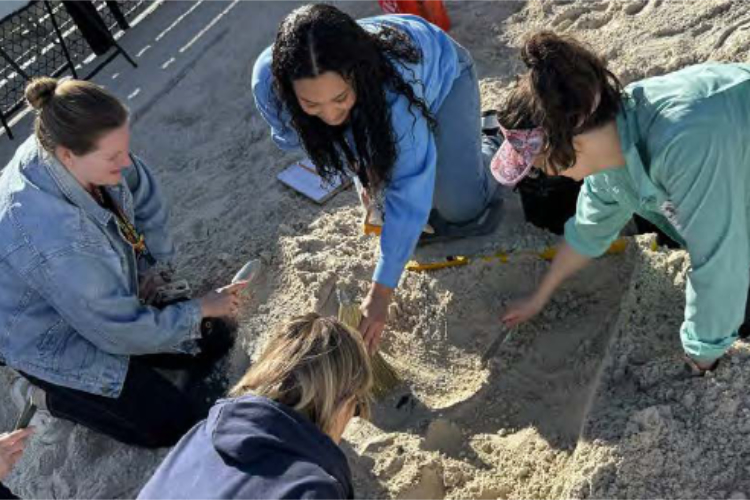
This interdisciplinary nature makes archaeology a powerful teaching tool, according to Katharine Napora, Ph.D., assistant professor in Florida Atlantic’s Department of Anthropology. That’s why the department and Florida Atlantic Laboratory Schools recently unveiled an 1,100-square-foot archaeological dig site on the Boca Raton campus geared specifically for education.
The dig site design was modeled after the Jupiter Inlet Lighthouse Outstanding Natural Area (ONA) archaeological site in Jupiter. Ongoing research and student education at the ONA is funded through a Bureau of Land Management cooperative agreement headed by the FloridaPublic Archaeology Network and FAU’s Department of Anthropology.
“Archaeology is an inherently interdisciplinary field of study, making it a great way to introduce young students to research and an ideal discipline for teachers to incorporate into existing curricula,” said Sara Ayers-Rigsby, director for the Florida Public Archaeology Network’s Southeast/Southwest Regions.
Creating this one-of-a-kind site required years of planning and a network of additional partners, including Lynn University, Palm Beach County’s Historic Preservation and Environmental Resources Management, and FAU Libraries’ Special Collections Department. The Seminole Tribe of Florida’s Historic Preservation Office also provided invaluable guidance to help accurately represent ancestral and historic indigenous lifeways.
At the site, students not only learn how soil layers reveal timelines, but they apply math to map excavation grids, explore ecological systems to understand ancient environments and examine how modern technologies — from chemical analysis to AI — can help archaeologists interpret artifacts.
“There’s something for everyone,” Napora said. “Whether a student loves science, storytelling, technology or art, archaeology connects those interests.”
Since the dig site opened in fall 2025, more than 460 students have participated in 38 different curricular experiences developed by K-12 educators in partnership with Florida Atlantic Laboratory Schools’ Research Program leads Tricia Meredith, Ph.D.; Lauren Simonitis, Ph.D.; and Jamie Thompson, Ph.D. Students excavate permanent and movable structures modeled after real, ongoing excavations.
“This is not a classroom exercise, it’s research-informed experiential learning,” Meredith said.
For kindergarteners, that might mean uncovering replica artifacts and learning how objects tell stories. For middle and high school students, it involves more complex research questions, data recording and interpretation techniques that mirror professional archaeological practice.
“By giving students the tools to investigate the past, the university is cultivating critical thinking, collaboration and curiosity,” Napora said. “Because sometimes, the best way to understand history is to pick up a trowel — and start digging.”