Cetacean Species of the Caribbean
Small Toothed Whales
Short-finned Pilot whale
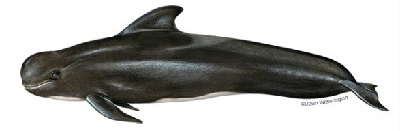
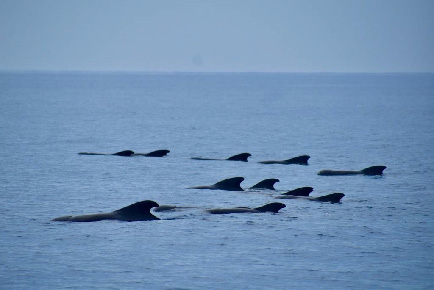
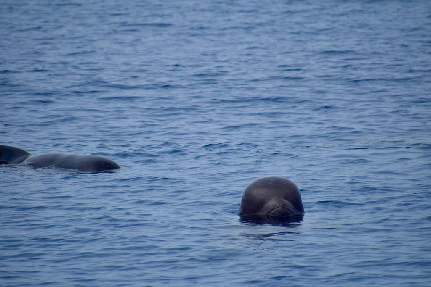
- Robust body and a bulbous to squarish melon that protrudes beyond the front of the mouth.
- Short beak, mouthline slants up toward the eye.
- The curved and pointed dorsal fin has a long base relative to its height and rises at a shallow angle.
- Flippers are short, no more than one-sixth of the body length.
- Coloration is black or dark brown, with a light gray throat patch that is joined by a narrow stripe to a wider light area in the genital region. There is usually a light gray streak behind the eye extending to the back behind the dorsal fin like a saddle.
Melon-headed whale
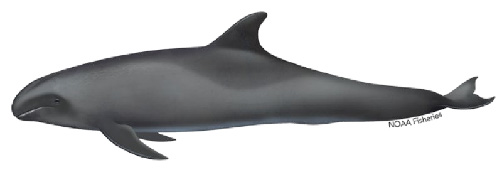
- Robust body that tapers noticeably at both ends.
- Head is small, with little or no beak and rounded melon that slopes downward at a 45 degree angle. It can appear triangular or conical. In older individuals it can be somewhat bulbous.
- Dorsal fin is tall, curved, pointed, and positioned at the midback.
- Flippers are moderately long and taper to a point.
- Coloration is almost completely dark gray or black with light gray or white ventral markings and often light grey, pink, or white lips. A dark dorsal cape dips low onto the sides at midbody, and dark mask-like areas on the side of the face.
Kogia (dwarf and pygmy sperm)
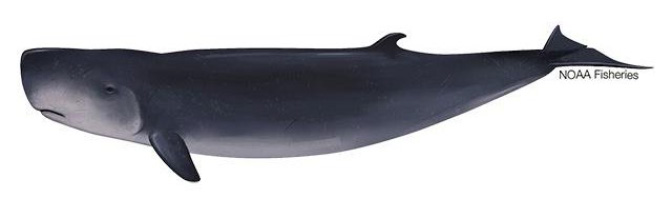
- Smaller bodied whale with a robust head and thorax that tapers rapidly from the dorsal fin to the flukes.
- The head appears conical when seen from above or below with a hidden small jaw.
- The curved dorsal fin is short, small and positioned behind the midpoint of the back in pygmy sperm whales and is more prominent and set somewhat farther forward on the dwarf sperm whales.
- The small flippers are positioned unusually far forward on the body.
- The coloration is drab, bluish-steel gray dorsally, shading to dull white or pinkish on the belly. A light, bracket-shaped marking is present between the eye and flipper that looks like a gill-slit on a fish.
Beaked (Cuvier's, Blainville's, Gervais')
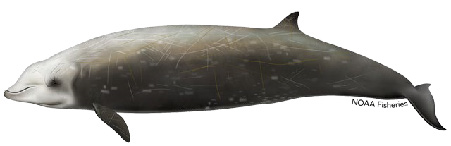
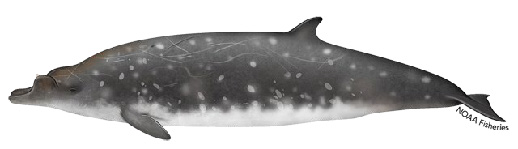
- Beak/rostrum can have various lengths depending on the species.
- The dorsal fin is curved and located in about 2/3's back on the body.
- Males may have erupted teeth from the lower jaw, but otherwise these whales lack teeth.
- These species are usually light to dark grey with visible rounded scars on their body from prior cookie cutter shark bites. Adults may also have linear scars from mating.
- Paired grooves on the throat that converge anteriorly.
- They have relatively small flipper with "flipper pockets" or slight depressions in the body wall into which the flippers can be tucked.
- The flukes are large and lack a median notch.
Killer Whale
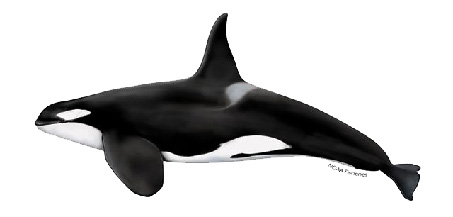
- Extremely robust. The head is conical and lacks a well-defined beak.
- Dorsal fin is situated at midback, is large, prominent, and highly variable in shape; curved in females and juveniles, erect and almost spike like in adult males. On males, the dorsal fin can reach a height of 3-6 feet.
- The flippers are large, broad, and rounded.
- Color pattern consists of highly contrasting areas of black and white. The white ventral zone, continuous from lower jaw to anus, narrows between the all-black flippers and branches behind umbilicus. The ventral surface of the flukes and adjacent portion of the caudal peduncle are also white. The back and sides are black, except for white patches on the flanks that rise from the uro-genital region and prominent oval white patches slightly above and behind the eyes. There is a gray and white saddle marking on the back behind the dorsal fin.
False Killer Whale
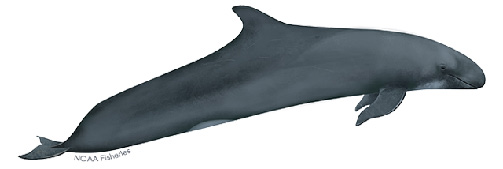
- Slender bodied with a small, rounded or bluntly conical head and a long straight mouthline.
- The melon overhangs the tip of the lower jaw, particularly in adult males.
- Erect slender dorsal fin, can measure more than 15 inches (40cm) high. It is curved and positioned midback.
- The flippers are wider at the base than the tip and have a distinctive hump or bulge midway on the leading edge.
- Coloration is almost entirely dark, light areas on the throat, chest and along the ventral midline. A large, anchor-shaped blaze across the rear of the throat and chest is variably gray to nearly white. This blaze narrows to a thin stripe that may extend to the genital slit. There may also be light gray areas on the sides of the head.
Dolphins
Fraser's dolphin
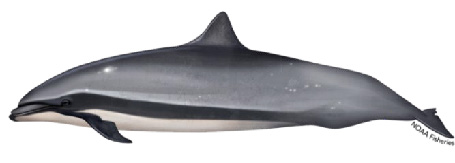
- Robust body, short beak, markedly small flippers and flukes.
- Dorsal fin is small and triangular, slightly falcate in females
- Coloration is dark, grayish-blue cape, the sides are lighter gray and the belly and throat are whitish (cream to pink-tinged). A broad dark stripe from the face to the anus is the most conspicuous feature.
Pantropical Spotted Dolphin
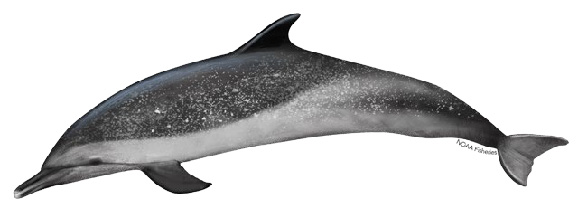
- Slender body, small dorsal fin, long slender beak.
- Adult males have a thickened caudal peduncle and a noticeable bulge behind the anus.
- Dorsal fin is curved and pointed, and the flippers are tapered.
- Coloration is dark black with a lighter belly with complex and variable spotting and striping. The pattern includes a dark gray dorsal cape that dips low onto the sides below and forward of the dorsal fin. The lighter gray ventral color sweeps upward onto the caudal peduncle in a wide swath well behind the dorsal fin. The beak is white-tipped. Adults have a black "mask" as well as a dark jaw-to-flipper stripe. The dorsal fin, flippers, and flukes are dark gray, and the fin and flippers may become spotted on adults. Calves are born unspotted and gain spots as they age.
Atlantic Spotted
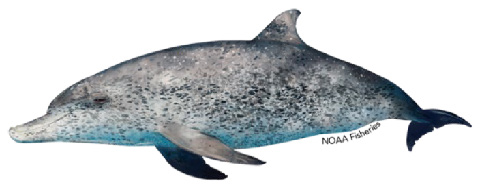
- Robust body, beak is moderate in length and thickness.
- Dorsal fin is erect, curved and pointed, positioned at the midback.
- Coloration is a dark gray dorsal cape, a lighter gray zone on the sides that crosses over the back slightly forward of the middle of the caudal peduncle, and a white belly. A light gray shoulder blaze intrudes onto the cape below the front of the dorsal fin. The beak is white-tipped. Adults have dark spots on the belly and light spots on the sides and back. Calves are born unspotted and gain spots as they age.
Spinner dolphin
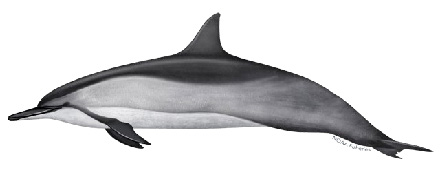
- The body is usually slender but can be fairly robust.
- The melon is flat with a long narrow, well-defined beak.
- Dorsal fin is positioned midback, is erect and can be either slightly curved or triangular. In some adult males the fin angles forward and appears as if it were "on backward", these males also have a prominent bulge on the ventral surface of the caudal peduncle.
- Flippers taper to a considerable degree and are almost pointed at the tips.
- Coloration includes a dark dorsal cape (not always present), lighter gray sides and flanks, and a white or light gray belly. The dorsal cape's lower margin runs almost parallel to the body axis and does not dip low onto the sides. The upper jaw is gray, and the lower jaw white; the beak has a dark tip; and there is a dark border along the mouthline. There is an eye-to-flipper stripe that extends forward from the eye to merge with the dark mouthline.
Bottlenose dolphin
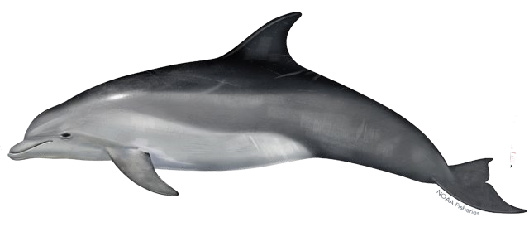
- Wide head and body, short-thick beak, long flippers and a moderately tall, curved dorsal fin.
- It has a marked crease between the melon and the beak.
- Coloration consists mostly of gray tones, with strong countershading (dark dorsally, light ventrally). There is a slightly darker dorsal cape that begins at the apex of the melon and extends back past the dorsal fin. A light blaze may sometime intrude onto the cape. A paler gray overlay covers the sides and flanks, and the belly may be off-white or pinkish. There is a muted eye-to-flipper stripe. The flippers, flukes and dorsal fin are generally dark or medium gray.
Clymene dolphin
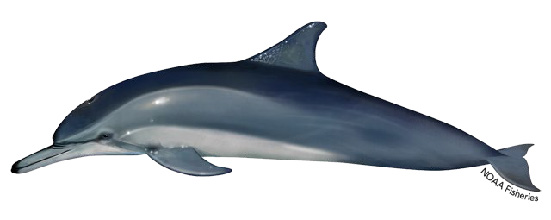
- Short, robust body. Medium-length beak, and slightly curved or triangular dorsal fin.
- Coloration is a dark gray dorsal cape, light gray sides, and a white belly. There is a noticeable dip in the ventral margin of the dark cape below the dorsal fin. The eye-to-flipper stripe is noticeably wider at the flipper end. The lips and tip of the beak are black. Viewed dorsally, the beak is marked by a black band connecting the tip with the melon. This band is bordered on both sides by a pale gray to white blaze. Halfway along the dark band, a dark gray, mustache-like marking is often present.
Risso's dolphin
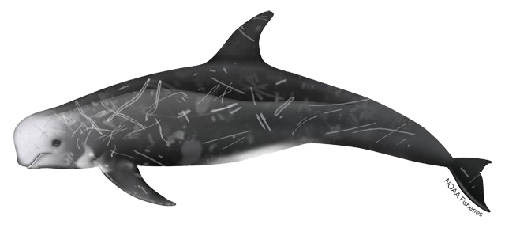
- Beakless head shape and more robust in the front half than in the back.
- Melon is broad, squarish and creased in front by a characteristic longitudinal furrow.
- Upper jaw projects slightly beyond the lower.
- Dorsal fin is tall, erect, and moderately falcate.
- Flippers are long and sickle-shaped.
- The coloration is highly variable with age. Young calves are grey to brown dorsally, becoming almost black. They then lighten with age. The lip margins and chin are often white. The eye area is dark-shaded. Adults have light gray or white marking on the undersides and extensive scarring on the back and sides.
Striped dolphin
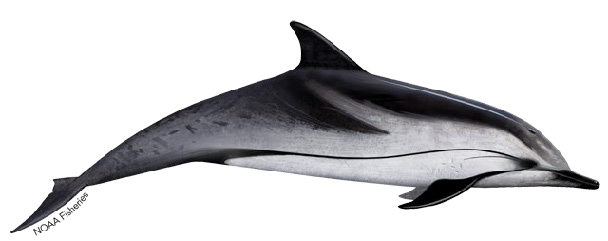
- Fairly robust with a moderately long well defined beak, short tapered flippers, and prominent, curved dorsal fin.
- Coloration is bluish gray and white. The beak, appendages, and back are gray; the throat and belly are white. There are two narrow black stripes on each side of the body. They begin as a single stripe from the beak to the eye that diverges, one branch going from the eye to the flipper and the other continuing along the side from the eye to the anal region. A short subsidiary stripe sometimes branches downward from the side stripe. A light blaze is usually present below and anterior to the dorsal fin, interrupting the dark cape pigmentation.
Rough-toothed dolphin
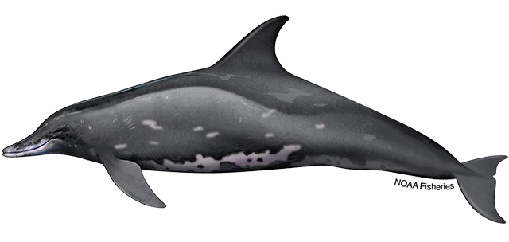
- Lacks a crease at the base of the melon. The "forehead" slopes smoothly from the blowhole onto the long narrow beak.
- The tall dorsal fin is erect and set at midback; it is moderately curved.
- A dark dorsal cape narrows markedly between the blowhole and the dorsal fin, then widens at the dorsal fin and posteriorly. Lighter gray sides give way to a white belly and throat. Considerable dark spotting, giving the sides, throat and belly a mottled appearance. The lips are white, but the upper surface of the beak is dark (except at the tip, which is often white). The eyes are darkly shaded.
Baleen Whales (Mysticetes)
Humpback
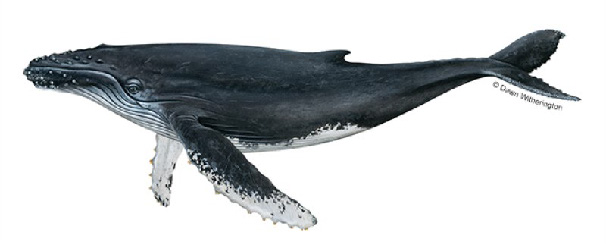
- Large robust body with females being slightly larger than males.
- The head and lower jaw have a variable number of rounded protuberances, called tubercles.
- The baleen plates are all or mostly black. Ventral pleats 14-22 extend from the tip of the lower jaw to the umbilicus.
- The long narrow flippers are approximately one-third the length of the body.
- The dorsal fin is highly variable, from almost absent to high and curved, and is often scarred. Most dorsal fins in the Atlantic have a white dorsal surface.
- The trailing margin of the flukes is prominently serrated.
- The blow is often lower, rounder, and more bushy than those of other baleen whales seen around Dominica.
- The body is black above and black, white or mottled below. The flippers are usually white ventrally. The flukes are black above and have a highly variable pattern below, from all white to all black.
Minke Whale
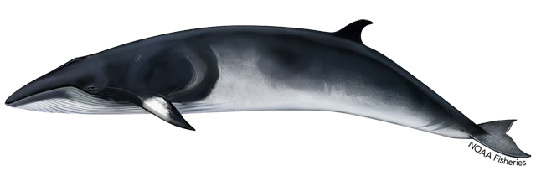
- Small and sleek with a sharply pointed head that looks V-shaped when seen from above.
- A sharp longitudinal ridge runs along the top of the rostrum, and there are short baleen plates that are mostly cream colored or white.
- The 50-70 ventral pleats terminate just behind the flippers, which are narrow and have pointed tips.
- A curved dorsal fin appears simultaneously with the blowholes when they surface.
- Minke's arch their body prior to a dive but do not raise their flukes above the ocean surface.
- Females are slightly larger than males.
- Coloration is black or dark gray above, often with a gray chevron crossing the back behind the head, and white underneath. A white band across the flippers is diagnostic of the species.
Bryde's Whale
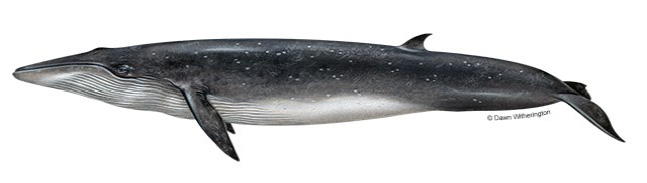
- Moderately large and very sleek whale.
- Three longitudinal ridges on top of the rostrum.
- Dorsal fin is tall, extremely falcate, and often noticeably ragged on the trailing edge.
- There are 40-50 ventral pleats that extend from the chin to the navel.
- Frequently arches its back when diving but does not raise its flukes above the ocean surface.
- The blow can be either columnar or bushy.
- The body coloration is dark gray above and gray or white, sometimes with a pinkish tinge below.
Fin
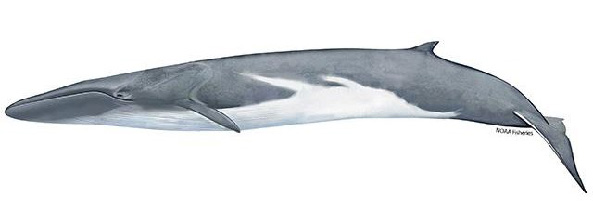
- Is very large and sleek, with a sharp, variably shaped dorsal fin that is often pointed or curved.
- The upper edge of the caudal peduncle is characterized by a sharp ridge.
- There are 260-480 baleen plates on each side of the mouth. The baleen is black or olive green, except for the white or cream-colored front third on the right side. The ventral plears extend at least to the umbilicus and number 50-100.
- They have tall, columnar blow.
- Females are slightly larger than males.
- Coloration is dark gray above and white or cream-colored below, and the flukes are bordered with gray underneath. Black coloration on the left lower jaw and white on the right is diagnostic at close range. Most have swirls ("blaze") on the right side of the head and a V-shaped light colored marking across the back behind the head.
Blue
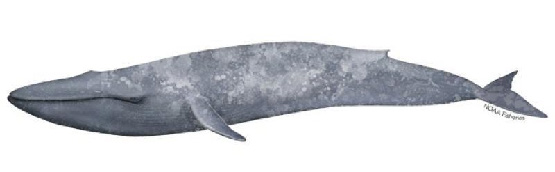
- The largest whale with a huge body, which is mottled, blue-gray in color.
- Diatoms sometimes coats the body and are most visible as a yellowish sheen on the whale's lighter underside.
- The head is U-shaped when seen from above and flat in profile, with a large ridge that rises before the two large blowholes.
- The baleen plates are black with a coarse inner fringe.
- The ventral pleats number 55-68 and extend at least as far as the umbilicus.
- The tiny dorsal fin is set far back on the body and does not appear immediately on most surfacings.
- The triangular flukes are often raised during a dive.
- The blow is very tall and columnar.
- Females are somewhat larger than males.
References
- National Audubon Society., Folkens, P. A., & Reeves, R. R. (2002). Guide to marine mammals of the world. New York: A.A. Knopf.
- NOAA Webpage for Species drawings: https://www.fisheries.noaa.gov/species-directory/marine-mammals