Advancing Ecological Risk Assessment: Researchers and Student Scientists Represent College at SETAC Thanks to WLW-ECOS Support
Tuesday, Nov 25, 2025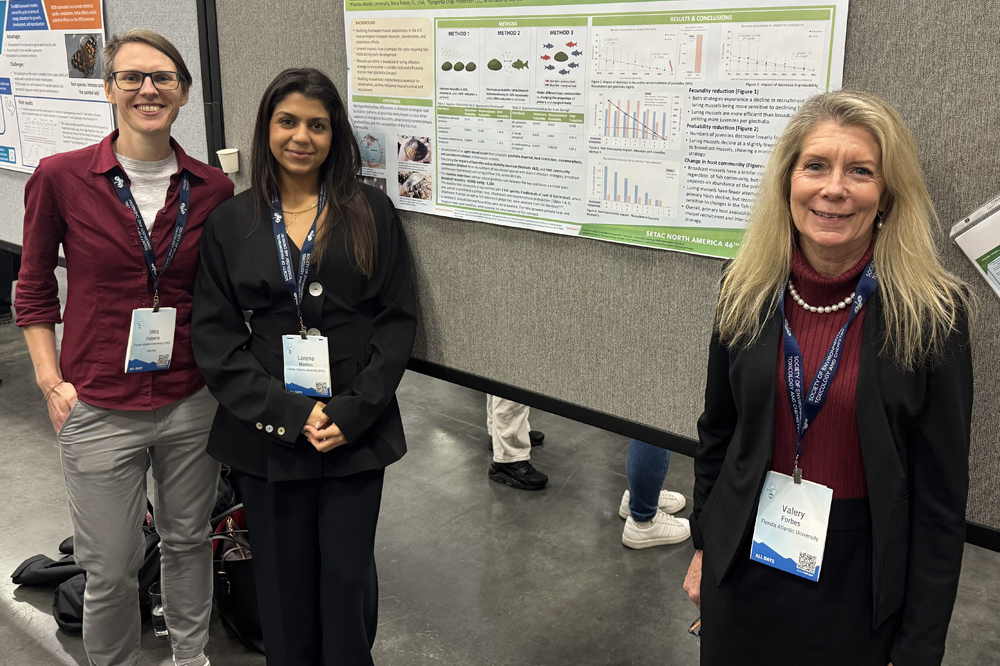
Valery Forbes, Ph.D., dean and professor, Charles E. Schmidt College of Science, along with Ines Haberle, Ph.D., a biological sciences postdoctoral fellow, and undergraduate student Lorena Martins recently attended the Society of Environmental Toxicology and Chemistry (SETAC) North America 46th Annual Meeting in Portland, Oregon. From Nov. 16 to 20, the event brought together more than 1,000 environmental scientists representing academia, government and industry from around the world.
Launched in 1979, SETAC is a worldwide professional organization with approximately 10,000 members and 21,000 followers from more than 90 countries, who are dedicated to advancing environmental science and environmental management. The nonprofit organization was founded on the principles of multidisciplinary approaches to solving environmental problems, multi-sectoral engagement, and science-based objectivity.
For Martins, this was her first opportunity to attend a SETAC conference. The medical biology major also presented a poster titled, “Modeling host specificity and infection strategies to predict glochidia attachment success in freshwater mussels.” Freshwater mussels are among the most imperiled animals in North America, and many species are threatened due to habitat loss and limited host availability.
“SETAC was truly transformative for me. It was my first time presenting at a major scientific conference, and engaging with researchers from around the world was both encouraging and energizing,” said Martins. “Sharing my work and expanding my knowledge in such a collaborative environment was incredibly meaningful, and I was proud to represent FAU on an international stage.”
During the conference, Haberle delivered a talk, “From sub-lethal individual-level stress to population effects – a bioenergetic individual-based model of freshwater mussels.” In addition, she also co-chaired a session with Forbes, along with colleagues from industry and government, on “Advancing effect modeling for ecological risk assessment: Bridging scales, data gaps and regulatory challenges.”
In a session on endocrine disruptors, Forbes gave a talk, “Advancing effect modeling in the context of endocrine-disrupting chemicals,” as well as a presentation for an endangered species session on, “Reducing uncertainties in ecological risk assessments when data are limited – how population modeling can help.” Prior to the conference, Forbes lectured in a full-day training course on population modeling.
“Bringing Ines and Lorena to SETAC was a wonderful opportunity to showcase our team's work that is contributing to advancing ecological risk assessment and management,” said Forbes. “Witnessing the confidence of both Ines and Lorena when presenting their work at a major international conference underscores the value of experiential learning. I strongly encourage my faculty colleagues to pursue WLW-ECOS and other funding opportunities to engage our students in conducting and presenting their research—it's an invaluable investment in our next generation of scientists.”
The three Florida Atlantic researchers attended SETAC with support from a WLW-ECOS Travel Grant. The grant is part of a generous gift from Wayne and Lucretia Weiner who established the WLW-ECOS Fund in 2024, creating invaluable opportunities for students and early-career scientists dedicated to developing solutions for a more sustainable future.