Navigating FAU’s Environmental School into a New Era of Impact
Tuesday, Jul 15, 2025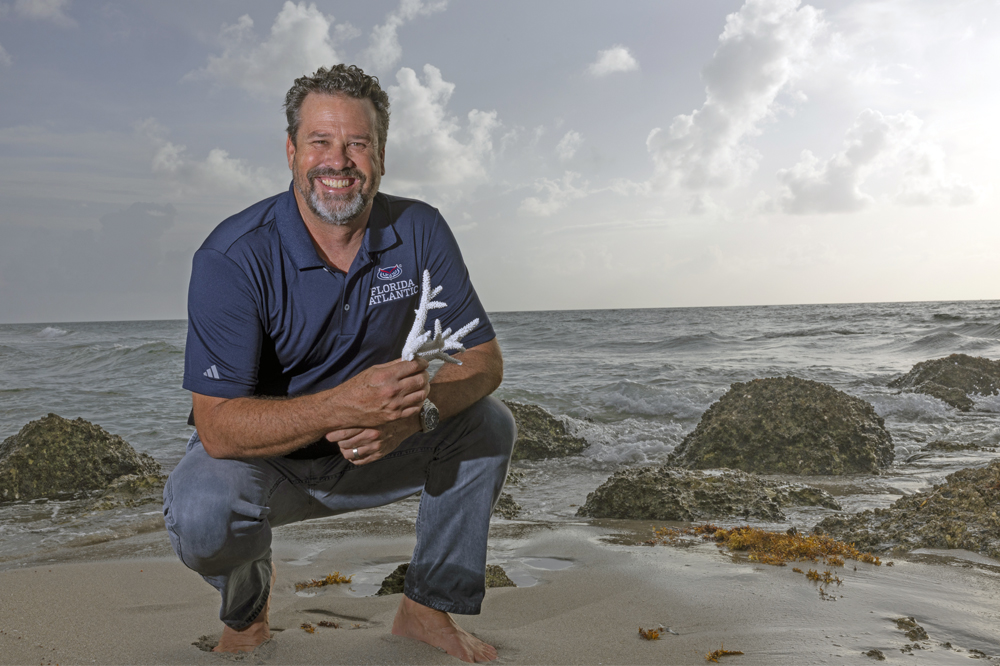
The crystal-clear waters off South Florida are a window to vibrant underwater life, attracting visitors from around the world – yet a fragile frontier quickly comes into focus. It’s here in Florida Atlantic University’s backyard, where the wild lands and waters meet sprawling metropolitan landscapes, creating distinct environmental pressures that present a different kind of attraction for Steven Vollmer, Ph.D., a distinguished evolutionary and ecological genomicist. He joins Florida Atlantic as the director for the thriving School of Environmental, Coastal, and Ocean Sustainability (ECOS). Vollmer has dedicated his career to researching the threats to tropical coral reefs, often viewed as a global barometer for understanding the far-reaching effects of widespread environmental shifts.
The school, a partnership between the Charles E. Schmidt College of Science and Harbor Branch Oceanographic Institute, is Florida Atlantic’s comprehensive hub for environmental academic programs, research, and outreach.
Vollmer arrives with ambitious plans to confront the escalating environmental issues faced both locally and around the world. His vision surrounds leveraging the robust resources of ECOS and rigorously preparing the next generation of scientists.
“My top priority is to grow FAU’s School for Environmental, Coastal, and Ocean Sustainability into a national leader in the environmental sciences by championing innovative research and educational programs across the university that focus on South Florida’s unique ecosystems, environmental challenges, and growing ocean economy,” Vollmer said.
To realize these goals, Vollmer – who will also serve as a professor of biological sciences in the Schmidt College of Science – plans to deepen connections across ECOS’s over 200 affiliate faculty, researchers, postdoctoral fellows, and graduate students, leveraging the combined interdisciplinary expertise across FAU. In addition, he plans on bolstering ties to the centers, field sites, and related initiatives organized directly within ECOS.
“I will prioritize strategic planning for the Center for Urban and Environmental Solutions (CUES) and Center for Environmental Studies (CES) so we can build on their successes, such as CUES’s future flooding virtual reality simulator, CES’s coastal resilience work, Riverwoods Field Lab’s Kissimmee River Restoration project, interconnected Florida Wildlife Corridor projects, and The Invading Sea – our non-partisan news source for climate and environmental issues,” said Vollmer. “I aim to develop new initiatives that draw broadly from the ECOS community and amplify each center’s impact across South Florida.”
A strong emphasis on the next generation of scientists and leaders is also high on Vollmer’s list of actions for the school, which administers two academic programs: the M.S. in Environmental Science and the M.S. in Marine Science and Oceanography. There are also numerous undergraduate and graduate programs affiliated with the school that are linked to well-established, immersive research opportunities for students.
“I am excited to work with the directors of our academic programs to strengthen our master’s degree tracks, and our many connected programs, to expand student support, and grow the accelerated pathways from bachelor’s-to-master’s to ensure that our students are exceptionally well-prepared to enter the workforce,” Vollmer said. “It's about putting knowledge into action, and seeing that students get hands-on, experiential learning – from classrooms to active research and engaging internships. I envision our programs not only providing a top-tier education at unmatched affordability but truly training world-class environmental scientists and policymakers at FAU.”
Recent generous gifts, primarily from Wayne and Lucretia Weiner, have allowed ECOS to expand its offerings dramatically, providing scholarships, enhanced student support, funding for research, paid internships, an inaugural professor-in-residence program, and various other forms of assistance.
Vollmer underscores this key support from donors and external partners, as well. “Integral to this first year as director will be expansion of ECOS’s philanthropic funding base to build on our innovative environmental research and educational programs, and to grow the support for the more than 50 student scholarships, paid internships, and targeted research grants that ECOS funded last year through a large gift,” he said.
Private and non-profit partnerships are also crucial for ECOS, often offering real-world experiences through internships, which can provide a pathway to employment and mutually benefiting partner organizations in the search for highly qualified talent.
“This support from donors and external partners is especially critical early on to ensure students get exposed to what it is to be a ‘scientist’ and launch their scientific careers,” he said. “Hands-on exposure not only builds invaluable practical skills but also ignites passion to pursue enduring careers and cultivates the confidence and professional networks essential for embarking on a rewarding and consequential scientific career.”
This robust preparation of future leaders is precisely what makes FAU students highly sought after in the professional world and is a reputation Vollmer is keen to amplify through strategic collaborations that benefit both students and pioneering research endeavors.
“I want our FAU students to be known as the best trained environmental scientists on the market, and one of the best ways to establish our reputation is through strong partner organizations who praise our students,” said Vollmer. “For our researchers, I see these public-private partnerships as catalysts for commercializing scientific discoveries and driving innovation in sectors such as South Florida's emerging ocean economy.”
“We are thrilled to have Dr. Vollmer join Florida Atlantic as the new director of ECOS,” said Valery E. Forbes, Ph.D., dean of the Charles E. Schmidt College of Science. “This is a critical time in our school’s evolution, and we are energized by Steve’s vision as well as the academic, research, and leadership expertise he brings to this role.”
Vollmer’s training and coral studies began at Harvard, where he performed his Ph.D. research, followed by a postdoctoral fellowship at the Smithsonian Tropical Research Institute in Panama. He was most recently a longstanding faculty member at Northeastern University in Boston, where he built rapidly expanding academic programs. Part of his leadership experience involves recruiting a $10 million endowment for the Ocean Genome Legacy as the associate director of the Marine Science Center for Northeastern’s College of Science.
One of the reasons Vollmer made the move to South Florida is the proximity to his research and the unique collection of interconnected marine, freshwater and terrestrial ecosystems, all converging into major metropolitan zones – a prime location that acts as a living laboratory for students and faculty. The headwaters of Lake Okeechobee support the sawgrass marshes, cypress swamps and pine forest of the Everglades whose estuaries flow into the Florida Bay and onto the world’s third largest barrier coral reef ecosystem.
“At FAU, I can do coral field work in the morning and be back at the lab doing cutting-edge microbiology and genomics in the afternoon,” he said. “I have seen a sharp decline in our tropical coral reefs, principally due to coral disease outbreaks and thermal bleaching. This inspired me to seek practical solutions to the environmental challenges facing us today, and in my field, that means building more resilient coral reef communities.”
His Caribbean coral research uses genomics to identify disease resistant and thermally tolerant corals for selective breeding programs and coral restocking efforts. Relocating to South Florida, the epicenter for coral research in the U.S., greatly benefits his research. Vollmer said, “I am delighted to join FAU’s talented group of coral biologists and be closer to my coral restoration partners like Reef Renewal USA.”
Confronting South Florida's immense environmental stressors requires a multidisciplinary approach, and Vollmer intends to position FAU at the forefront of these efforts.
“To protect the unique natural resources of South Florida while sustaining our vibrant communities and economy, we need to work across our traditional academic silos,” said Vollmer. “FAU and ECOS are poised to become the leaders tackling the complex environmental issues facing South Florida and providing society with sustainable environmental solutions.”