HEALING BEYOND THE CLINIC: DR. HEIDI SCHAEFFER, M.D., JOINS FAU'S PHILANTHROPIC ADVISORY BOARD
Tuesday, Feb 24, 2026
For Heidi Schaeffer, M.D., the practice of medicine has never been solely about treating physical symptoms. It is about understanding the human story behind the patient: the trauma, the resilience, and the often-invisible struggles that comprise a person’s well-being.
A nationally recognized leader in human trafficking awareness and a dedicated physician, Dr. Schaeffer has spent the past two decades bridging the gap between healthcare and advocacy. Now, she’s bringing that unique perspective to Florida Atlantic University as a founding member of the Philanthropic Advisory Board (PAB) for the College of Social Work and Criminal Justice.
“Dr. Schaeffer brings an extraordinary perspective that bridges medicine, social work, advocacy, and philanthropy,” said Dean Naelys Luna. “Her leadership strengthens our ability to prepare students to address complex challenges with compassion, innovation, and evidence-based practice.”
Dr. Schaeffer’s arrival on the board marks a significant milestone for the College. Her background is one of both great professional success and profound personal commitment to some of society’s most "taboo" subjects: abuse, neglect, and exploitation. Her motivation for joining the PAB stems from a deep respect for the professionals who confront these issues daily.
“Social workers are willing to sacrifice their own mental health to help others,” she said. “And that is such a beautiful gift, so I really applaud them.”
The Intersection of Mind and Body
Dr. Schaeffer’s journey to the PAB began long before she donned a white coat. While she’s known today as a prominent physician, her academic roots are firmly planted in the study of the mind, citing psychology as her “first love.” During her undergraduate years, she discovered a fascination with the biological sciences, eventually realizing that the two disciplines were inseparable.
“Ultimately, what I discovered was that the mind-body interaction was so important,” Dr. Schaeffer explained. “There's a real relationship there that I have seen in true practice, where your attitudes about health can really affect your outcomes.”
This realization led her to pursue a double major in psychology and biology, and she graduated as valedictorian in both fields. She went on to earn her M.D. from the University of Miami School of Medicine in 1998, followed by a residency at Jackson Memorial Hospital.
Today, she serves as a Clinical Affiliate Assistant Professor at Florida Atlantic’s Schmidt College of Medicine. In the classroom, she teaches medical students that technical skill is only half the job.
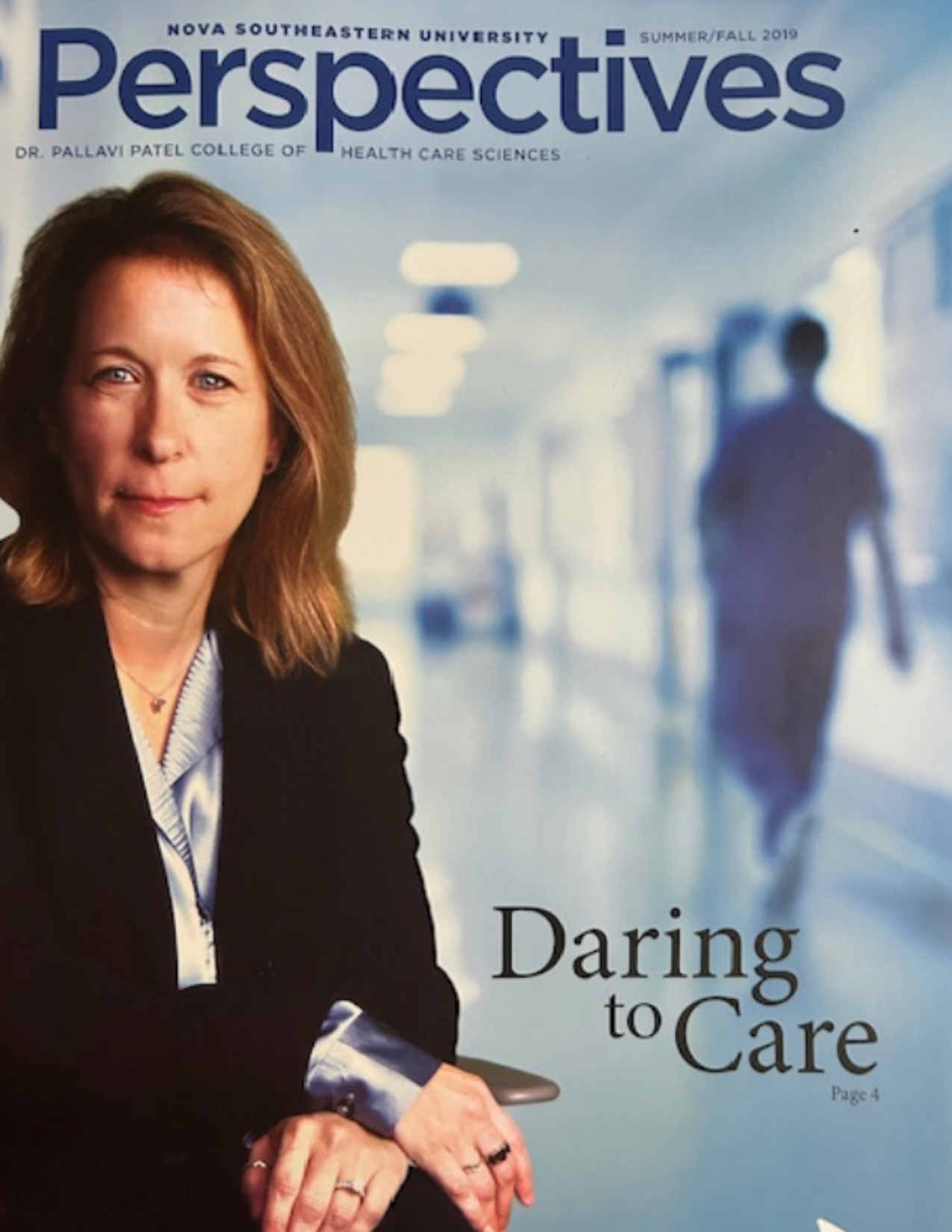
Dr. Schaeffer pictured on the cover of NSU’s Perspectives magazine in 2019.
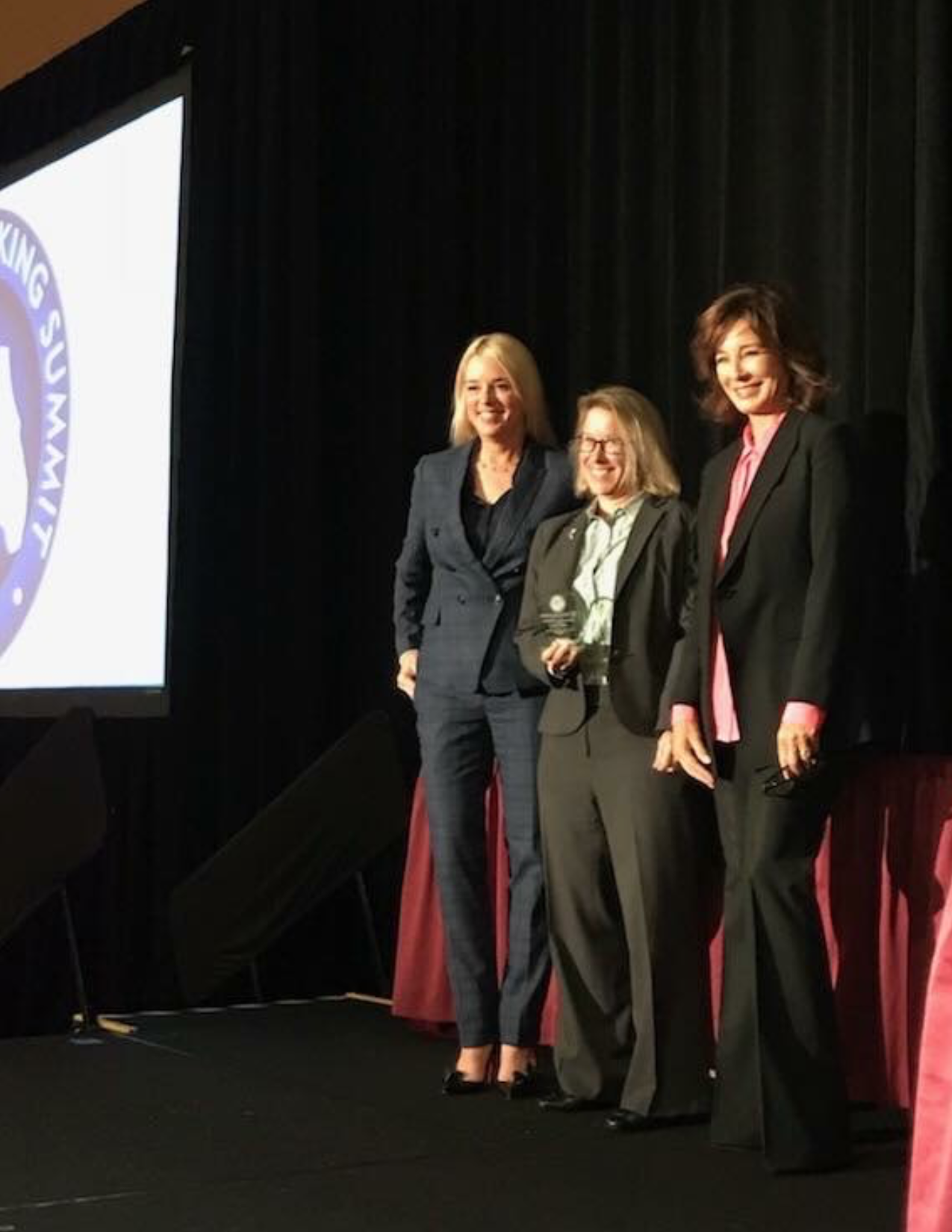
Dr. Schaeffer receives the “Community Advocate of the Year” award in 2017 at the Florida Human Trafficking Summit
A Call to Action: Confronting Human Trafficking
In 2008, Dr. Schaeffer attended a meeting of the Broward Human Trafficking Coalition that would alter the trajectory of her career. Living in Broward County at the time, she walked into the room curious but unprepared for the reality she was about to encounter.
“It opened my eyes to the sheer amount of human trafficking occurring right in our own backyards,” Dr. Schaeffer explained.
The revelation was compounded by a realization about her own industry. Despite attending a top-tier medical school, she had never received training on how to identify or treat victims of trafficking. At the time, it wasn't a standard part of medical curricula; in many circles, it wasn't even recognized as a term.
“I was shocked that as a practicing doctor, there was no training in this area,” she said. “It really made me want to spread that awareness to other clinicians.”
Dr. Schaeffer says she felt "called to this movement." From that moment forward, she dedicated herself to educating healthcare providers on how to diagnose and treat patients presenting with symptomatology of exploitation. She realized that clinicians, regardless of their specialty, were likely seeing victims without knowing it. Her work has since evolved into legislative advocacy, aiming to ensure that the healthcare community is the first line of defense for the vulnerable.
A "Good Marriage" with Social Work
Dr. Schaeffer found her way to social work because it addresses the root causes of the health issues she treats. She views her partnership with the College as a natural evolution of her life’s work.
“I’ve always been philanthropic in nature,” she noted. “I believe the College of Social Work and Criminal Justice is a good representation of what I want to support in the sense that they really focus on complex societal problems associated with mental health issues like trafficking, exploitation, sexual assault, and domestic violence.”
For Dr. Schaeffer, joining the PAB was a “good marriage” of interests. She saw in the College a willingness to address complex challenges affecting our communities, to engage directly with the community to implement solutions, and a steadfast commitment to innovation that matched her own.
“I feel like there's a natural symbiosis of what I envisioned and what Dean Luna envisions,” she said. “And frankly, I've seen the hardworking students and the professors there, too. They're all dedicated to improving the lives of everyday people.”
Championing the Heroes of Mental Health
One of Dr. Schaeffer’s primary goals as a board member is to elevate the visibility and impact of the social work profession. She speaks of social workers not just as professionals but as essential pillars of a healthy society, often overlooked and overworked.
“I love to champion social workers and people that work in the mental health field because it is definitely not recognized as much as it should be,” she asserted. “Ultimately, every single person on the face of the planet goes through some form of trauma or crisis.”
Whether it is grief, divorce, or a health crisis, Dr. Schaeffer emphasizes that social workers constitute the support system that holds communities together.
“What makes Dr. Schaeffer’s partnership so powerful is her deep understanding that healing extends beyond clinical care,” said Dean Luna. “She recognizes the essential role social workers play in addressing trauma, strengthening resilience, and improving lives. Her commitment to the College of Social Work and Criminal Justice reflects the interdisciplinary future of healthcare and social impact.”
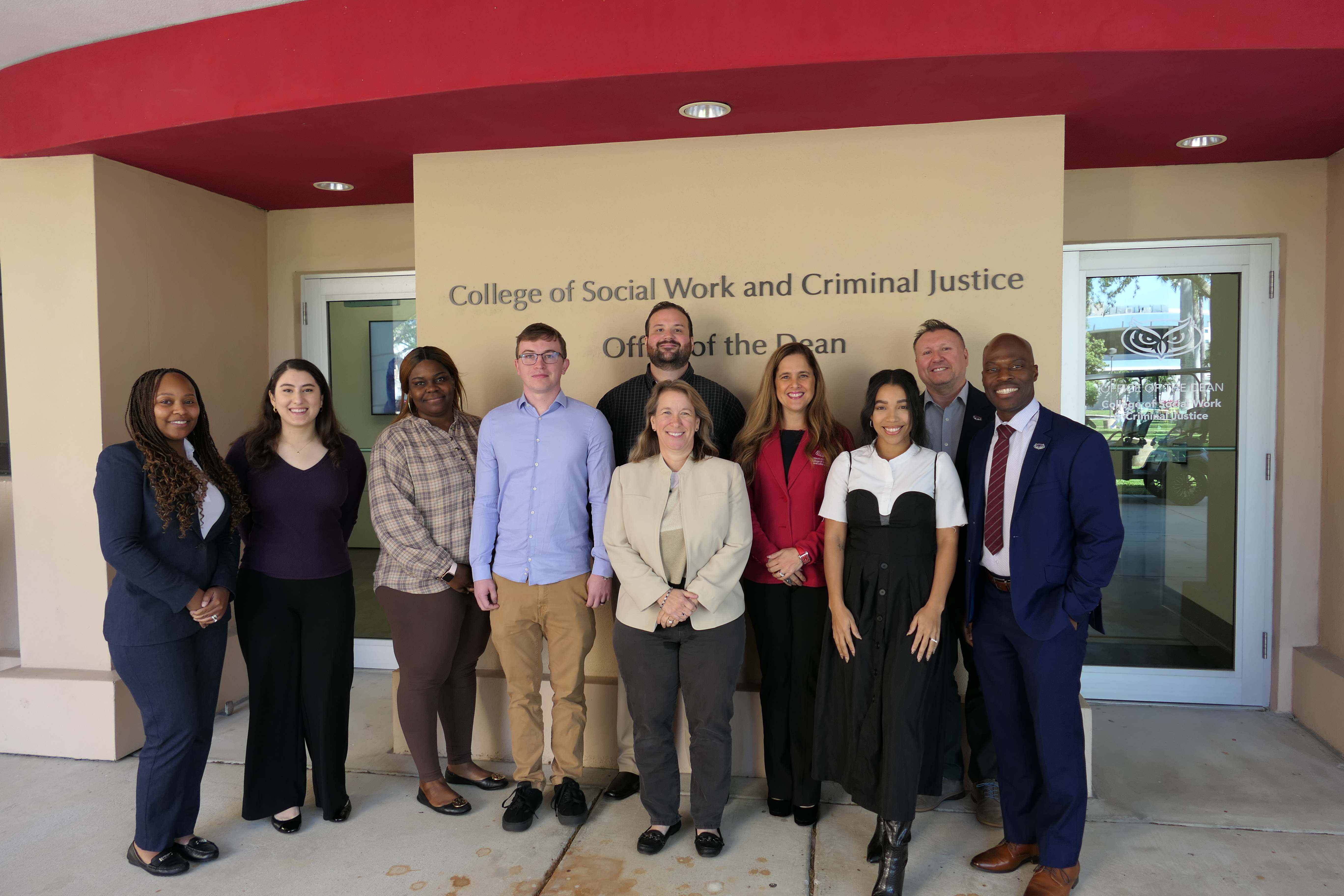
Dr. Schaeffer (center) with Dean Luna (in red), Dr. Precious Skinner-Osei (left), interim director of the Sandler School of Social Work, Dr. Tony Andenoro (second from right), director of community engagement and programming, and Tootie Martin (right), director of development, and five social work students who received $5,000 paid fellowships thanks to The Dr. Heidi Schaeffer Resilience, Hope, and Healing Fund.
Philanthropy with Purpose
In addition to her service on the Advisory Board, Dr. Schaeffer has put her resources behind her vision. She has focused her giving on some of the darker corners of the human experience that others tend to shy away from.
Her impact is already being felt through two major initiatives:
-
The Dr. Heidi Schaeffer Resilience, Hope, and Healing Fund
Understanding that internships in social work are often unpaid, Dr. Schaeffer established the Dr. Heidi Schaeffer Resilience, Hope, and Healing Fund to provide $5,000 fellowships to students completing their clinical practicums. This financial lifeline allows students to focus on their training in community-based placements without the stress of financial insecurity.
Recent recipients include students like James Noel, who works with delinquent children at the Florida Department of Juvenile Justice, and Cameron Godwin, who supports families experiencing homelessness at House of Hope.
-
B.R.A.V.E.R.Y. Grant
Standing for "Bold Research Analyzing Vulnerabilities, Exploitation, and Rape in Youth" (The B.R.A.V.E.R.Y. Grant), this $25,000 seed fund is designed to ignite faculty research into the prevention of human trafficking and child abuse. Securing initial funding for new research is often the hardest hurdle. By providing seed money, Dr. Schaeffer hopes to generate preliminary results that will attract larger federal grants.
“Dr. Schaeffer embodies the integrated approach we strive to teach, which recognizes the inseparable connection between mental, emotional, and physical health,” said Precious Skinner-Osei, Ph.D., MSW, interim director of the Phyllis and Harvey Sandler School of Social Work. “Her work validates what social workers understand deeply: healing happens when we see and support the whole person.”
A Vision for the Future
As she settles into her role on the Philanthropic Advisory Board, Dr. Schaeffer is focused on bringing new ideas, innovation, and visibility to the College. She wants the community to know that the research being done at Florida Atlantic has the potential to change lives and that the students training here are the future guardians of our community’s mental health and well-being.
Her work has already garnered significant acclaim, including being named the Florida Attorney General’s Human Trafficking Advocate of the Year and a "Hometown Hero" by Boca magazine. Yet her focus remains on the work left to do.
She is debunking myths that trafficking only happens to "certain" people, emphasizing that exploitation does not discriminate based on race, gender, or socioeconomic status. Through the PAB, she hopes to rally more community partners to the cause.
“I’m just one voice,” Dr. Schaeffer said. “We need a lot of community partners to help us get there.”
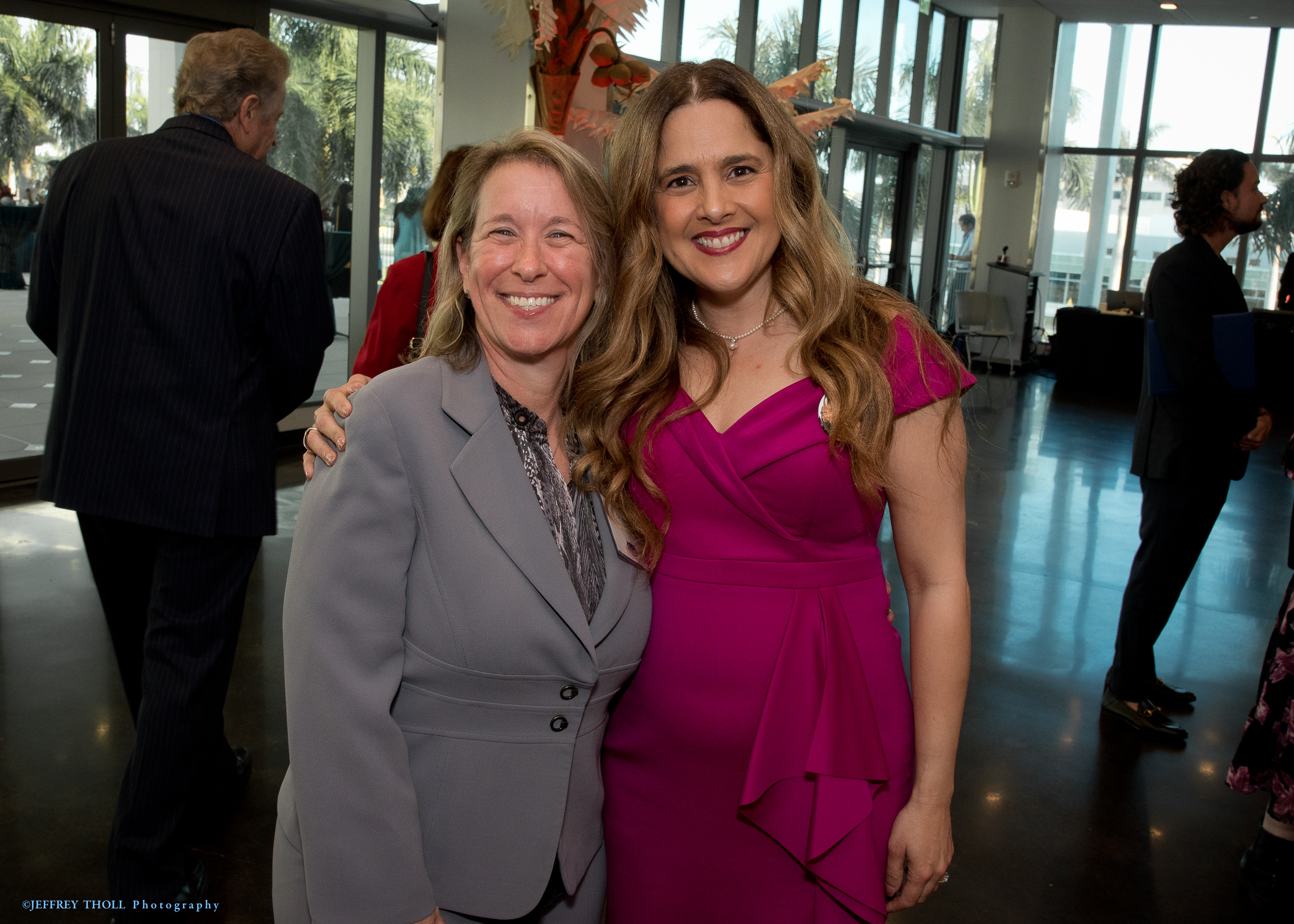
Dr. Schaeffer with Dean Luna at the 2025 Phyllis Sandler Heart of Social Work